

Paper
James L. Schoff, Douglas E. Rake, Joshua Levy
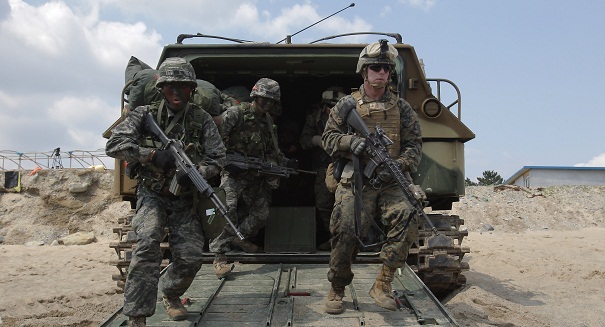
Source: Getty
The United States and Japan should start to make preparations for moving the U.S. Marines on Okinawa to a less-populated part of the island.
Discussions about Japan in 2013 have been dominated by the new prime minister, Shinzo Abe, and his three-pronged plan for Japanese economic revival, dubbed “Abenomics.” Abe’s flirtations with historical revisionism, Japan’s territorial tensions with China, and the upcoming election for the upper house of the Japanese National Diet (which could cement Abe’s Liberal Democratic Party’s hold on power) have also garnered attention. But an equally consequential Japanese issue, at least for the United States—the government of Okinawa Prefecture’s pending decision about the future of U.S. Marines in Japan—has been less noticed. Now is the time to prepare in earnest for what will be a critical inflection point in the plan for a smaller and more sustainable U.S. military footprint in Japan.
The issue of relocating U.S. Marines in Okinawa has a long history. For seventeen years, the United States and Japan have been trying to reduce the presence of marines in the prefecture and move certain components of the Marine Corps Air Station Futenma from the capital city area to a less densely populated part of the island. Currently, the allies plan to relocate them to another marine facility near Henoko Village further north. Doing so requires the construction of an offshore runway to accommodate the marines’ new tilt-rotor Osprey aircraft, which in turn requires a landfill permit.Both the landfill project and future flight operations are bound to disturb the local environment, which has generated controversy even beyond the Okinawans’ normal indignation that the majority of U.S. military facilities in Japan are resident in their small prefecture. Still, the security role played by U.S. forces in Japan is as important as ever, and balancing these factors is the key challenge.
Earlier this year, Okinawan Governor Hirokazu Nakaima accepted the Japanese central government’s application for a landfill permit to begin building the new facility in Henoko. Those documents were made available recently for public inspection, and the comment period will end on July 18. Five or six months from now, Nakaima will either approve or reject the application.
Both possible outcomes pose significant challenges for the allies that require early collaborative planning. Rejection would be problematic and would put the Japanese and U.S. governments in a confrontational position vis-à-vis Okinawa Prefecture. Acceptance would offer hope, but this could fade quickly if the allies stumble out of the gate on implementation.
The initial impetus for the marine relocation policy was an inexcusable rape crime by three U.S. service members and subsequent mass protests in 1995, but other incidents—including a U.S. military helicopter crash at a nearby university in 2004—underscored the U.S. and Japanese conclusion that the status quo U.S. force posture in Okinawa was politically unsustainable in the long term. The area surrounding Futenma had simply become too crowded over the years to continue playing host to noisy and potentially dangerous training flights, so the two countries agreed to “reduce the burden” on the people of Okinawa and cut in half the number of U.S. Marines stationed in the prefecture. The plan’s centerpiece—Futenma relocation and the broader return to Okinawa of up to 1,000 hectares of land—was targeted for completion in 2003.
A decade past that target and after years of political wrangling, local protests, bureaucratic infighting, and revolving leadership, the two governments eventually settled on a location, a design, and a schedule for the relocation. The resulting Henoko plan is a massive and expensive undertaking, with the reclamation of land alone to cost Japan roughly $2.4 billion and take five years. The earliest the marines might move is 2022, and the schedule could slip given outstanding questions about landfill logistics, local politics, U.S. planning and cost estimates for the move, and congressional support for the project.
In other words, anything short of near-perfect implementation risks an alliance disaster. The only thing worse is not moving at all.
Nakaima faces a difficult political decision on the landfill permit with important implications. His main priority is to close Futenma quickly and reduce the U.S. Marine presence in Okinawa, and he criticizes the current Henoko plan as too slow. The majority of Okinawans want the marines to move off the island entirely, and the governor’s office has promoted an expedited “dispersal” alternative that would separate components of marines currently stationed at the Futenma Air Station and have them rotate around different existing Japanese commercial and military facilities in the rest of country. The dispersal concept is vague, but it essentially breaks up the marines in Japan into small units that would base and train temporarily at multiple locations outside Okinawa.
This alternative is unworkable operationally because the marines need a certain critical mass and a reliable combined training regimen to maintain their capabilities and responsiveness. It also risks opening up a whole new can of political worms and inciting multiple local protests in these new host cities. Pursuing this “quick” solution would delay movement on the current plan and cause Futenma to stay where it is even longer than projected.
Rejecting the landfill permit application would similarly leave Futenma in place indefinitely. In both cases, the allies would be forced to spend money on the aging facility’s refurbishment and life extension—a big loss for both countries’ taxpayers and the Okinawan people.
As slow as the Henoko plan option is, it is still the fastest way to move marines, reduce the impact of marine presence, and maintain defense capabilities. The plan rests on the fact that the prefecture most burdened by the relocation is also the one that benefits from the reduction of U.S. Marines and the return of land.
Even so, many Okinawans oppose the move, either because they feel oppressed by the central government and believe their prefecture should be relieved of the duty of hosting marines or because they worry about adverse environmental and safety impacts. Local protests could be severe.
The only way to mitigate this opposition is to realize as quickly as possible the promise of impact reduction by implementing the plan expeditiously. Expanding the use of training relocation programs that send marines to other bases could also show Futenma’s neighbors what a reduced marine footprint might feel like. These measures will help develop local advocates and build political support for follow-through over the next decade.
Although short-term “impact-reduction” measures might be cumbersome for the marines and other military services, they should focus U.S. attention on proper budgeting and prompt implementation—including an associated move of some forces to Guam. Many U.S. stakeholders long ago became used to the inertia associated with the relocation project and have not planned proactively. Real progress on the Henoko plan, however, could create flexibility for U.S. officials if they become confident that these measures will not put their forces in a permanent state of limbo. All parties will have an interest in quickly completing the move to Henoko, even if it involves near-term inconveniences.
Assuming a positive response by the governor before early next year, the allies should take two important steps now: first, plan for high-level political oversight in the early stages of implementation; and second, create a Henoko implementation task force that includes Okinawa as a true partner in the process. Designing temporary impact-reduction measures to help mitigate local protests can be one aspect of this group’s work, along with more detailed and collaborative project programming to speed up implementation.
The allies can prepare now for an early meeting of Abe, Nakaima, and U.S. President Barack Obama’s representative in Japan (a post that may be filled by a new ambassador, Caroline Kennedy, by that time). All three stakeholders will need each other at various times during the construction and relocation, and people involved in the project on a day-to-day basis should know that top leaders are watching as a collective group.
This leaders’ meeting can also empower the follow-on task force, which should be centered on their respective executive offices (Japan’s Cabinet Secretariat, the governor’s office, and the U.S. National Security Council staff). Someone influential in these offices should wake up every day and go to sleep at night thinking about this relocation project, even if he or she is not one of the primary managers of the process. Individuals working on the relocation plan need access to—and the trust of—officials who can push tough decisions. Success will require extensive interagency coordination and timely decisionmaking in Washington and Tokyo.
Bilateral preparations for the governor’s decision should also consider how to respond if he rejects the application. This could include new legal measures by Tokyo to try to work around the governor’s objection, or the allies could put more effort into upgrading Futenma to make it safer and less impactful with the idea of keeping the base open. Neither of these options is desirable, but both are better than trying to find a different new home for U.S. Marines in Japan, which could prolong the status quo for another dozen years or more.
The time for temporary fixes and half-solutions is over. The allies need a solution that balances national security with the safety and well-being of the Okinawan people. The Henoko plan can do this, but the allies must take steps to minimize public protests in Okinawa that can have a debilitating effect on the alliance. Problems and delays will no doubt occur, but they will be manageable if citizens perceive that officials are working effectively to fix them. It is time for the allies to prepare to earn that confidence, or else prepare for the worst.

Former Senior Fellow, Asia Program
James L. Schoff was a senior fellow in the Carnegie Asia Program. His research focuses on U.S.-Japan relations and regional engagement, Japanese technology innovation, and regional trade and security dynamics.
Recent Work
James L. Schoff, Douglas E. Rake, Joshua Levy
James L. Schoff
Carnegie India does not take institutional positions on public policy issues; the views represented herein are those of the author(s) and do not necessarily reflect the views of Carnegie, its staff, or its trustees.

After the chill in ties between 2020 and 2024 that brought India–China relations to their lowest point in several decades, the two countries have engaged each other afresh. This paper argues that there are predominantly four imperatives guiding India’s approach to China, and they exist in an order of priority.

Saheb Singh Chadha

This piece argues that India’s central challenge is not managing a single flashpoint but resolving the underlying tension between expansion and institutional coherency of the BRICS grouping.

Vrinda Sahai

A partnership between India, a country of subcontinental size, and Africa, a continent of fifty-four countries, may seem asymmetric until one notes that both are home to nearly the same number of people—1.4 billion. This essay spells out the existing challenges to the partnership, its optimal potential, and the possible pathways to realize it over the next quarter-century.

Rajiv Bhatia

The India–EU Free Trade Agreement (FTA) is shaping up to be one of the most consequential trade negotiations, both economically and strategically. But, what’s in the agreement, what’s missing, and what will determine its success in the years ahead
Vrinda Sahai, Nicolas Köhler-Suzuki

This piece argues that the present Indian strategy, based on opportunistic diversification and utilization of limited strategic reserves, remains inadequate when confronting supply disruptions. It evaluates India’s options in the short, medium, and long terms.
Vrinda Sahai