

Commentary
Dmitri Trenin
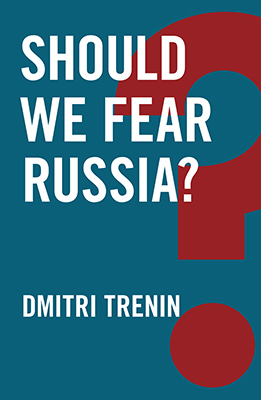
The Cold War analogy is misleading. Relations between the West and Russia are certainly bad and dangerous now but they are bad and dangerous in new ways.
Source: Polity
Since the outbreak of the Ukraine crisis, there has been much talk of a new Cold War between the West and Russia. Under Putin’s authoritarian leadership, Moscow is widely seen as volatile, belligerent and bent on using military force to get its way.
In this incisive analysis, top Russian foreign and security policy analyst Dmitri Trenin explains why the Cold War analogy is misleading. Relations between the West and Russia are certainly bad and dangerous but - he argues - they are bad and dangerous in new ways; crucial differences which make the current rivalry between Russia, the EU and the US all the more fluid and unpredictable. Unpacking the dynamics of this increasingly strained relationship, Trenin makes a compelling case for handling Russia with pragmatism and care rather than simply giving into fear.
“This rich and exceedingly well-written book considers whether the impasse in relations between Russia and the West is due to Putin’s ‘Realpolitik’ or whether it reflects Putin’s lack of realism about Russia’s true national interests. With Trenin we are in good hands. His lively analysis rewards its audience with a stimulating reading and learning experience.”
—Jack Snyder, Columbia University
“Dmitri Trenin is one of the most lucid analysts of Russia writing today. In this short but rich volume, he traces the recent history of misguided policy and conflicts of interest that have produced the current sharp deterioration in relations between Russia and the West. A ‘new normal’ has emerged, he argues. It is not a second Cold War but a period of new challenges and opportunities, in which seeing Russia clearly is critical to peace and security. To that end, there is no better place to start than this present essay.”
—Thomas Graham, Managing Director, Kissinger Associates; former Senior Director for Russia on the US National Security Council staff
Former Director, Carnegie Moscow Center
Trenin was director of the Carnegie Moscow Center from 2008 to early 2022.
Recent Work
Dmitri Trenin
Dmitri Trenin
Carnegie India does not take institutional positions on public policy issues; the views represented herein are those of the author(s) and do not necessarily reflect the views of Carnegie, its staff, or its trustees.

This piece argues that India’s central challenge is not managing a single flashpoint but resolving the underlying tension between expansion and institutional coherency of the BRICS grouping.

Vrinda Sahai

A partnership between India, a country of subcontinental size, and Africa, a continent of fifty-four countries, may seem asymmetric until one notes that both are home to nearly the same number of people—1.4 billion. This essay spells out the existing challenges to the partnership, its optimal potential, and the possible pathways to realize it over the next quarter-century.

Rajiv Bhatia

The U.S.–India semiconductor cooperation story is well-stocked with top-level strategic intent. What remains unresolved, however, are some underlying challenges that will determine whether the cooperation actually functions. Three such friction points stand out.

Shruti Mittal

The India–EU Free Trade Agreement (FTA) is shaping up to be one of the most consequential trade negotiations, both economically and strategically. But, what’s in the agreement, what’s missing, and what will determine its success in the years ahead
Vrinda Sahai, Nicolas Köhler-Suzuki

This piece argues that the present Indian strategy, based on opportunistic diversification and utilization of limited strategic reserves, remains inadequate when confronting supply disruptions. It evaluates India’s options in the short, medium, and long terms.
Vrinda Sahai