• Research
  • About
  • Experts
Carnegie India logoCarnegie lettermark logo
AI
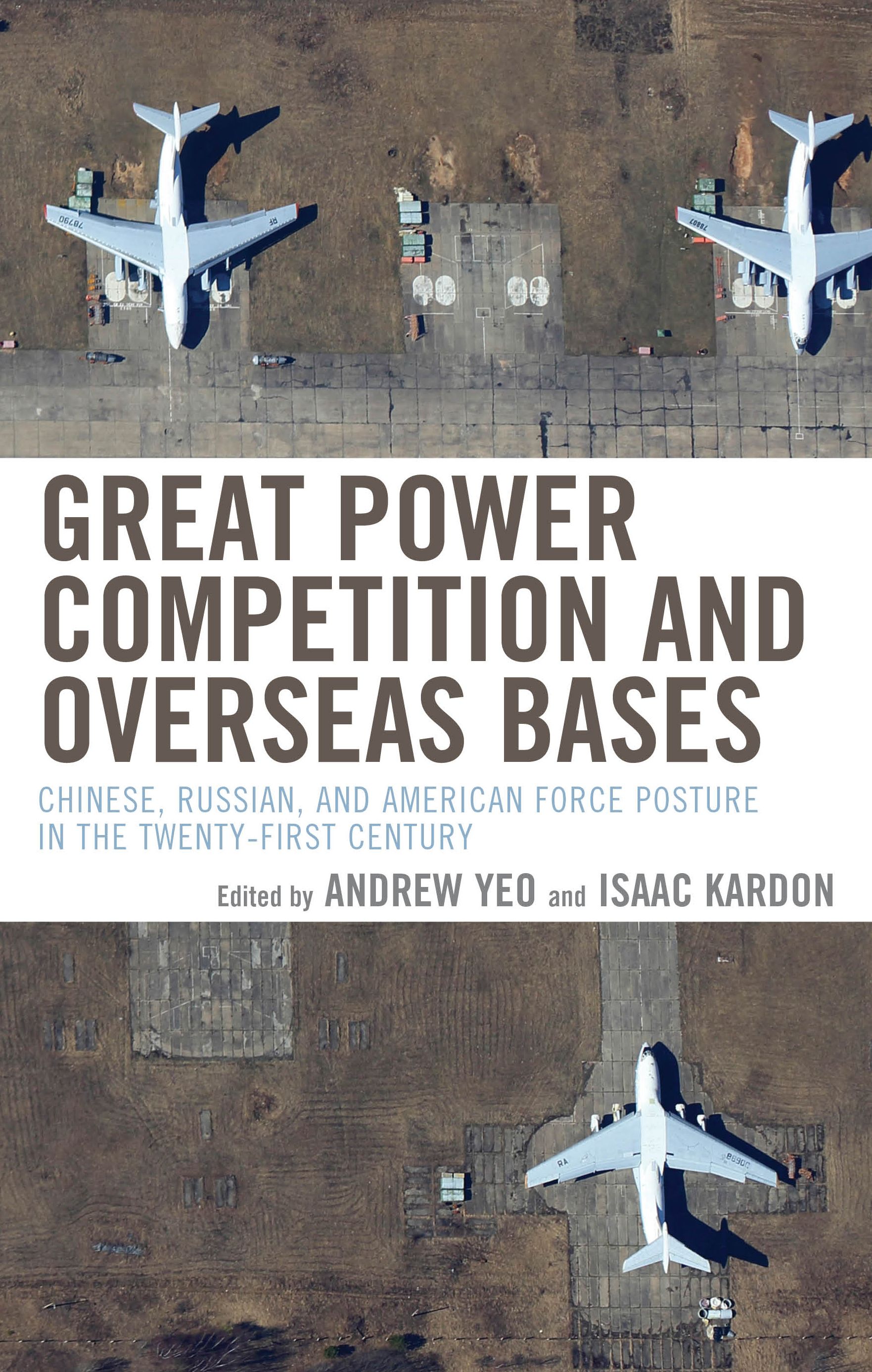
Great Power Competition and Overseas Bases: Chinese, Russian, and American Force Posture in the Twenty-First Century
Book

Great Power Competition and Overseas Bases: Chinese, Russian, and American Force Posture in the Twenty-First Century

This book examines the emerging dynamics of geostrategic competition for overseas military bases and base access.

Link Copied
By Andrew Yeo and Isaac B. Kardon
Published on Aug 27, 2024

Additional Links

Hardback - $85.00Paperback - $32.00Ebook - $30.00

What challenges and risks do Chinese and Russian bases pose to the United States’ military strategy? How do the military postures of great powers interact and with what consequences for regional and global security? This book examines the emerging dynamics of geostrategic competition for overseas military bases and base access. The comparative framework adopted in this volume examines how the geopolitical interests of the United States, China, and Russia and their respective underlying force posture interact in different regions including the Indo-Pacific, Europe, sub-Sahara Africa, the Indian Ocean, the Middle East, and the Arctic Circle.

By exploring the security, political economic, and domestic political dynamics of specific regions, the contributors to this volume reveal varied motivations for overseas military bases and base access among great powers. With analysis on the particular dynamics of overseas bases in major regional theaters, the book offers a valuable window into the nature and scope of the broader “great power competition” underway in the twenty-first century.

Advance Reviews

"Superb. A timely and thoughtful examination of the drivers and consequences of past and future military basing considerations and decisions that have and will shape the geostrategic landscape. A must read by those who ponder the future of great power competition and military force design."
— Gary Roughead, Admiral, U.S. Navy (Retired), Former U.S. Navy Chief of Naval Operations

"The book presents a measured and deeply informed assessment by tremendously talented thinkers from both academic and policy of three different, but potentially effective, approaches to overseas bases and international politics. This is essential reading on an underappreciated subject."
— Jon Caverley, Professor of Strategy, United States Naval War College

About the Authors

Andrew Yeo

Senior fellow and the SK-Korea Foundation Chair, Brookings Institution’s Center for Asia Policy Studies

Andrew Yeo is a senior fellow and the SK-Korea Foundation Chair at the Brookings Institution’s Center for Asia Policy Studies. He is also a professor of politics at The Catholic University of America in Washington, D.C.

Isaac B. Kardon

Senior Fellow, Asia Program

Isaac B. Kardon is a senior fellow for China studies in the Asia Program.

Authors

Andrew Yeo
Senior fellow and the SK-Korea Foundation Chair, Brookings Institution’s Center for Asia Policy Studies
Andrew Yeo
Isaac B. Kardon
Senior Fellow, Asia Program
Isaac B. Kardon
AsiaEast AsiaChinaRussiaRussia and EurasiaUnited StatesNorth AmericaSecurityDefense

Carnegie India does not take institutional positions on public policy issues; the views represented herein are those of the author(s) and do not necessarily reflect the views of Carnegie, its staff, or its trustees.

More Work from Carnegie India

  • Commentary
    India Signs the Pax Silica—A Counter to Pax Sinica?

    On the last day of the India AI Impact Summit, India signed Pax Silica, a U.S.-led declaration seemingly focused on semiconductors. While India’s accession to the same was not entirely unforeseen, becoming a signatory nation this quickly was not on the cards either.

      Konark Bhandari

  • Commentary
    The Impact of U.S. Sanctions and Tariffs on India’s Russian Oil Imports

    This piece examines India’s response to U.S. sanctions and tariffs, specifically assessing the immediate market consequences, such as alterations in import costs, and the broader strategic implications for India’s energy security and foreign policy orientation.

      Vrinda Sahai

  • Article
    Military Lessons from Operation Sindoor

    The India-Pakistan conflict that played out between May 6 and May 10, 2025, offers several military lessons. This article presents key takeaways from Operation Sindoor and breaks down how India’s preparations shaped the outcome and what more is needed to strengthen future readiness.

      Dinakar Peri

  • Book
    India and the Sovereignty Principle: The Disaggregation Imperative

    This book offers a comprehensive analysis of India's evolving relationship with sovereignty in a complex global order. Moving beyond conventional narratives, it examines how the sovereignty principle shapes India's behavior across four critical domains—from traditional military power to contemporary data governance.

      Rudra Chaudhuri, Nabarun Roy

  • Paper
    India-China Economic Ties: Determinants and Possibilities

    This paper examines the evolution of India-China economic ties from 2005 to 2025. It explores the impact of global events, bilateral political ties, and domestic policies on distinct spheres of the economic relationship.

      Santosh Pai

Get more news and analysis from
Carnegie India
Carnegie India logo, white
Unit C-4, 5, 6, EdenparkShaheed Jeet Singh MargNew Delhi – 110016, IndiaPhone: 011-40078687
  • Research
  • About
  • Experts
  • Projects
  • Events
  • Contact
  • Careers
  • Privacy
  • For Media
Get more news and analysis from
Carnegie India
© 2026 Carnegie Endowment for International Peace. All rights reserved.