

Article
This piece argues that India’s central challenge is not managing a single flashpoint but resolving the underlying tension between expansion and institutional coherency of the BRICS grouping.
Vrinda Sahai
Source: Getty
How significant are statements by senior U.S. officials about supporting democracy abroad in the context of a foreign policy led by a president focused on near-term transactional interests?
When President Donald Trump told an audience of Gulf officials in Riyadh last May that his administration would not be giving others “lectures on how to live,” he signaled with characteristic bluntness his disregard for the usual position of U.S. presidents as self-declared supporters of democracy internationally. The absence of almost any reference to democracy in the December 2025 National Security Strategy underscored this stance. Multiple actions by his administration have given it tangible form—such as the sweeping dismantlement of most U.S. democracy assistance and Trump’s various thrusts of pure transactionalism, including his stated focus on financial motivations for the forcible capture of Venezuelan president Nicolás Maduro in early January.
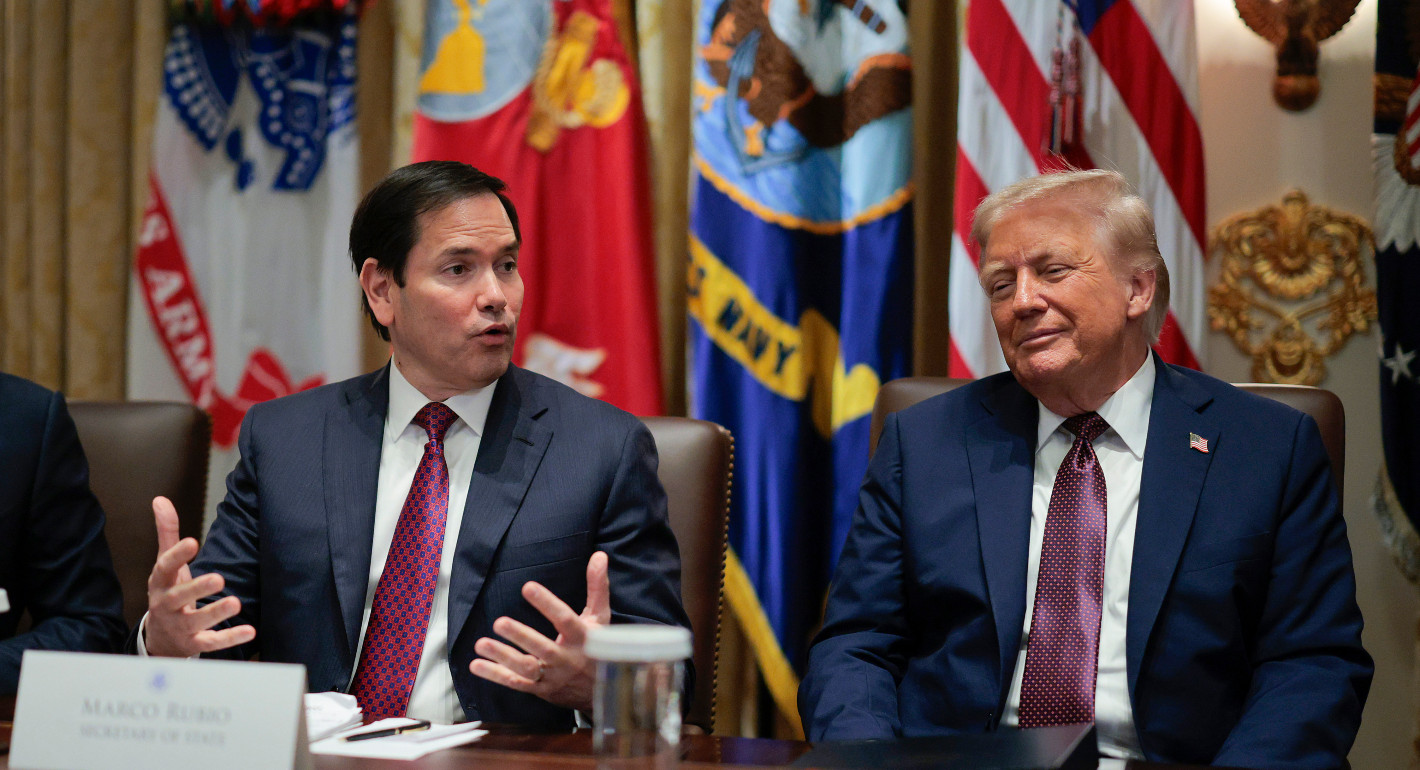
Yet despite Trump’s ultra-realist framing of his “America first” foreign policy, senior administration officials, especially Secretary of State Marco Rubio, have nevertheless regularly expressed an interest in or concern about the state of democracy in different parts of the world. How should such statements be understood? Are they policy marginalia reflecting a vestigial reflex of some U.S. government officials to talk about values in foreign policy, or are they an indication that the president’s ultra-realism is not a full portrayal of his foreign policy in practice?
A closer look reveals that the administration’s statements about democracy abroad fall into three categories. Some are statements for which one can find some corresponding policy substance behind the words; some appear to be rhetoric alone; and others use pro-democracy language to justify what are actually policies or stances in support of illiberal or anti-democratic actors in other countries. The resulting picture is one of sharply conflicting impulses and directions, a defining characteristic of multiple major elements of Trump’s foreign policy.
The most frequent administration statements of support for democracy in other countries have concerned the Western Hemisphere, especially Cuba, Nicaragua, Venezuela, and Haiti. While administration engagement in those four cases has been varied and motivationally complex, some pro-democracy actions have followed pro-democracy words.
At various times last year, U.S. officials declared an intent to support democracy in Cuba, such as a November 5 State Department statement noting that “Secretary Rubio reaffirmed the United States’ commitment to supporting the Cuban people’s pursuit of democracy, prosperity, and fundamental freedoms.” In concert with this rhetoric, the administration took what it described as “tough action” against Cuban officials for violating human rights in Cuba, primarily by restricting their visas and issuing a national security memorandum with steps to help bolster those in Cuba fighting for rights. Trump has significantly ratcheted up pressure on the Cuban government since the U.S. intervention in Venezuela in early 2026. On January 29, he declared a national emergency relating to Cuba and established a new tariff system to be applied to goods from countries that provide oil to Cuba. The administration has come close to shutting off Cuba’s access to oil entirely, putting the Cuban government under enormous stress.
Similarly, administration officials have spoken on several occasions on behalf of democracy in Nicaragua, such as on Nicaraguan Independence Day, September 15, when Rubio issued a statement averring that “the United States will continue to support your demands for a free, fair, and democratic Nicaragua so that you might again live without fear of persecution or reprisal.” Trump also extended the National Emergency With Respect to the Situation in Nicaragua in November, citing “the Ortega-Murillo regime’s continued systematic dismantling and undermining of democratic institutions and the rule of law.” Here, too, the administration imposed visa restrictions on officials for their undemocratic actions, such as its April announcement of “restrictions on more than 250 regime officials of the Nicaraguan dictatorship.”
The administration shifted rationales for its growing interventionism in Venezuela last fall, first stressing drug trafficking then moving on to oil. But at multiple times in 2025, Rubio articulated support for “the restoration of democracy in Venezuela.” And after the capture of Maduro, he publicly declared that “the end state here is . . . we want to reach a phase of transition where we are left with a friendly, stable, prosperous Venezuela, and democratic, in which all elements of society are represented in free and fair elections.” Rubio, at least, appears not to have given up on his hope of using the ouster of Maduro and the new quasi-protectorate over Venezuela’s oil sector as part of a longer-term effort to achieve a political opening in the country, even if Trump himself shows little interest in anything more than economic gain for America. It remains to be seen, of course, whether Rubio will manage to convert those intentions into meaningful actions.
Language from the Trump team about democracy in Cuba, Nicaragua, and Venezuela is likely viewed by more than a few observers as simply a values cover for strategically driven hostility.
All three of these cases—Cuba, Nicaragua, and Venezuela—entail pressure against regimes that the administration, and many others in the U.S. policy community, have considered to be geopolitical adversaries for years. Thus, language from the Trump team about the democracy issue in these countries is likely viewed by more than a few observers as simply a values cover for strategically driven hostility, not a reflection of any deep-seated commitment to democratic principles. At the same time, it is equally likely that if Rubio were presented with such an argument, he would reply that the strategic interests and democratic principles are naturally aligned in these cases.
On Haiti, administration statements relating to the local political scene have emphasized the need to achieve stability more than democracy—yet have at times included support for “a secure process that allows Haitians to elect their leaders.” And while the administration has not tried to insert itself deeply in Haiti’s profoundly troubled governance, it has imposed visa restrictions and engaged in a significant amount of multilateral diplomacy aimed at restoring democratic governance.
Beyond the hemisphere, the cases of Iran, Belarus, and Hong Kong are also cases of pro-democracy rhetoric backed by some actions, albeit only relatively weak ones. When anti-government protests erupted in Iran in December, for example, Trump spoke forcefully about his determination to support the protesters, warning the Iranian government that the United States was “locked and loaded and ready to go” if it killed protesters. After the Iranian government proceeded to massacre thousands of protesters, the administration imposed sanctions against several Iranian entities but did not take decisive military action. As the negotiations with Iran over its nuclear program and missile capacities have resumed in recent weeks, Rubio stated that “the topic of those discussions . . . will have to include certain things,” including Iran’s “treatment of their own people.” Yet it remains deeply uncertain what place, if any, Iran’s domestic political behavior ends up occupying in the administration’s actual agenda in the negotiation process.
Administration officials have repeatedly called on the government of Belarus to release political prisoners and have engaged in active diplomacy to further that goal. In June, for example, Trump issued a continuation of the National Emergency With Respect to Belarus, citing the “actions and policies of certain members of the Government of Belarus and other persons to undermine Belarus’s democratic processes or institutions,” such as through political repression “including detentions and disappearances.” Belarus has released more than 100 prisoners in exchange for the lessening of sanctions from the United States, although many more remain incarcerated. From one point of view, this pressure campaign can be understood as an example of the Trump administration standing up for human rights in another country. Yet it is in service of a larger policy to improve ties with Belarus’s dictatorial president Aleksandr Lukashenko and counterbalance Russia’s dominant position in the country.
On Hong Kong, the administration has made several statements condemning repressive actions by Hong Kong authorities. It has buttressed these statements in at least one instance with property-related sanctions against some of the responsible authorities, citing a “commitment to hold to account those responsible for depriving people in Hong Kong of protected rights and freedoms.” At the same time, this stance is a minor part of a wider overall picture of low emphasis by the administration on rights abuses by the Chinese government.
Alongside the cases where the Trump team has followed up pro-democratic statements with some concrete actions are a number of cases where the administration has made pro-democratic statements that appear to be simply free-standing rhetoric. In some instances, the administration issued statements amid a new moment of attempted democratic transition in a country but did not back its speech with substantial material assistance or support to help that transition.
Bangladesh is one such example. On several occasions, administration officials have declared U.S. support for the country’s fraught but potentially promising transition from authoritarian rule, such as Rubio’s statement last May that “the United States supports Bangladesh in its journey toward a bright and democratic future.” Yet those declarations have been rendered hollow by the absence of substantial supportive actions by the administration and by the abrupt, massive cuts to U.S. aid to Bangladesh, with more than $500 million of aid projects suspended as part of the USAID closure in 2025.
Nepal is another. After mass protests in Nepal last September led to the ousting of the country’s leadership, the Trump administration released a statement that “the United States supports the Nepali people’s aspirations for a transparent government that adheres to the country’s Constitution, which is essential for achieving a democratic solution as you prepare for elections in the coming months.” However, the administration has not paired this rhetorical support with a surge of material support aimed at helping this transition succeed.
The administration has made statements celebrating or calling for democratic principles within a country only to hold back from deeper pro-democratic engagement when serious democratic challenges arise.
In other cases, the administration has made statements celebrating or calling for democratic principles within a country only to hold back from deeper pro-democratic engagement when serious democratic challenges arise. Tanzania is such an example. After the Tanzanian government cracked down viciously against protesters objecting to fraud in the October 2025 elections, the United States released a statement condemning the anti-democratic practices and violence and noting that it was “comprehensively reviewing our relationship with the Government of Tanzania.” Yet thus far at least, the Trump administration has not followed up with any substantial actions, whether punitive measures such as sanctions or aid to civil society groups.
Türkiye is another. Although the relationship between the Trump administration and Türkiye’s autocratic president, Recep Tayyip Erdoğan, has been friendly, when Turkish authorities arrested over 1,000 individuals—including Istanbul’s mayor—in March 2025, Rubio released a brief statement after meeting with his Turkish counterpart in which he “expressed concerns regarding recent arrests and protests in Türkiye.” However, there were no further statements or criticisms from any other leaders in the Trump administration, nor were these stated concerns paired with any publicized policy action or material pressure on Erdoğan with respect to his ever-tightening noose around opposition and rights in Türkiye. In fact, Trump has continued to put his close relationship with Erdoğan on display, including meeting him at the White House last September.
Finally, there are a number of countries where senior Trump officials have made statements about defending democracy, but that in fact signal efforts to boost the political fortunes of illiberal leaders or to push back against democratic governments or courts trying to exercise democratic accountability and uphold democratic norms.
Europe is the principal theater for such actions. The Trump administration has repeatedly employed pro-democracy language, especially relating to free speech, to describe what many in multiple European democracies consider to be illegitimate interventions in their countries’ domestic affairs, interventions they see as aimed at furthering the political fortunes of illiberal, far-right friends of the Trump team or of U.S. business interests. For example, commenting on the Romanian government’s decision to delay its November 2024 presidential elections amid concerns about a surge in Russian election interference, Vice President JD Vance in February 2025 blamed the move on “flimsy suspicions” against far-right candidate Călin Georgescu.
When European regulators have taken steps to increase accountability of U.S. technology firms operating in Europe, Trump officials have lashed out repeatedly, accusing Europe of eroding freedom of speech and turning away from democratic principles. In December 2025, for example, Rubio cautioned on social media that “the days of censoring Americans online are over” after the European Commission fined Elon Musk’s X platform for violations of the Digital Services Act, created to ensure online protections and transparency.
The administration has backed up some of these critical stances through tariffs and other means, like rescinding Romania’s admission to a beneficial U.S. visa waiver program or imposing visa restrictions “barring five Europeans closely associated with content moderation activities from entry into the United States.” And in its National Security Strategy, the administration signaled that such efforts would continue to be a priority, writing that it intended to “oppose elite-driven, anti-democratic restrictions on core liberties in Europe,” with the goal of helping “Europe correct its current trajectory.”
Latin America has also seen some of this democracy-in-name but anti-democracy-in-substance engagement.
Latin America has also seen some of this democracy-in-name but anti-democracy-in-substance engagement. Trump and his team presented as pro-democratic their efforts to punish Brazilian authorities for holding former president Jair Bolsonaro to account for his efforts to support a coup in the wake of his 2022 electoral defeat. The administration cast its campaign to interfere in Honduras’s December 2025 presidential election on behalf of a right-wing candidate it preferred as an effort to preserve the integrity of the process. Similarly, administration officials framed their support for the El Salvadoran government’s August 2025 abolition of presidential term limits (to allow Bukele to potentially extend the duration of his repressive rule) as a defense of “El Salvador’s democratically based and constitutionally sound legislative process.” This support included a payment to El Salvador of $4.76 million to detain alleged Venezuelan gang members deported from the United States.
The main storylines regarding Trump and global democracy are his obvious lack of interest in supporting democracy internationally, his equally obvious admiration for prominent autocratic leaders on multiple continents, and the pressure he is putting on democracy at home—with all the negative demonstration effects that has around the world. Yet at the same time, statements of concern about democracy in specific countries have been emanating from his administration, especially from Marco Rubio. Although they hardly signal a significant amount of democracy support, they nevertheless indicate that, contrary to what many observers and analysts both in the United States and abroad often assume, democracy talk is not entirely off the Trump foreign policy table. Thus far, these statements constitute a confusing tangle that includes talk matched by some genuine supporting actions, multiple doses of empty rhetoric, and the frequent use of pro-democracy language to describe policies aimed at bolstering illiberal actors and norms. How this tangled talk evolves as the administration continues to assert itself all around the world is worth watching, even amid what will almost certainly be an unfolding series of large-scale foreign policy actions primarily defined by a searingly transactional and narrowly defined conception of U.S. interests abroad.

Harvey V. Fineberg Chair for Democracy Studies; Director, Democracy, Conflict, and Governance Program
Thomas Carothers, director of the Carnegie Endowment for International Peace’s Democracy, Conflict, and Governance Program, is a leading expert on comparative democratization and international support for democracy.

Research Assistant, Democracy, Conflict, and Governance Program
McKenzie Carrier is a research assistant in the Democracy, Conflict and Governance Program.
Carnegie India does not take institutional positions on public policy issues; the views represented herein are those of the author(s) and do not necessarily reflect the views of Carnegie, its staff, or its trustees.

This piece argues that India’s central challenge is not managing a single flashpoint but resolving the underlying tension between expansion and institutional coherency of the BRICS grouping.

Vrinda Sahai

A partnership between India, a country of subcontinental size, and Africa, a continent of fifty-four countries, may seem asymmetric until one notes that both are home to nearly the same number of people—1.4 billion. This essay spells out the existing challenges to the partnership, its optimal potential, and the possible pathways to realize it over the next quarter-century.

Rajiv Bhatia

The U.S.–India semiconductor cooperation story is well-stocked with top-level strategic intent. What remains unresolved, however, are some underlying challenges that will determine whether the cooperation actually functions. Three such friction points stand out.

Shruti Mittal

The India–EU Free Trade Agreement (FTA) is shaping up to be one of the most consequential trade negotiations, both economically and strategically. But, what’s in the agreement, what’s missing, and what will determine its success in the years ahead
Vrinda Sahai, Nicolas Köhler-Suzuki

Trump 2.0 has unsettled India’s external environment—but has not overturned its foreign policy strategy, which continues to rely on diversification, hedging, and calibrated partnerships across a fractured order.



Milan Vaishnav, ed., Sameer Lalwani, Tanvi Madan, …