

Commentary
There is a disturbing structural parallel between the old global energy economy and the new green transition.
Angie Omar
{
  "authors": [
    "Tobias Lang"
  ],
  "type": "commentary",
  "blog": "Diwan",
  "centerAffiliationAll": "",
  "centers": [
    "Carnegie Endowment for International Peace"
  ],
  "collections": [],
  "englishNewsletterAll": "",
  "nonEnglishNewsletterAll": "",
  "primaryCenter": "Carnegie Endowment for International Peace",
  "programAffiliation": "",
  "programs": [],
  "projects": [],
  "regions": [
    "Middle East",
    "Syria"
  ],
  "topics": []
}
Source: Getty
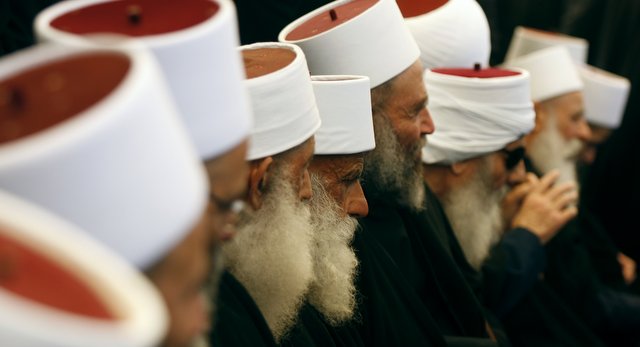
The regime's removal of a military intelligence chief of the southern Syrian city of Sweida after protests led by Druze religious sheikhs indicates that the position of the regime in the city is not as strong as it once was.
Protests led by Druze religious sheikhs erupted in the city of Sweida in southern Syria around April 9. The province of Sweida has an overwhelming majority of Druze, a small religious minority that makes up around 3 percent of Syria’s population.
Few Druze have so far participated in the protests against Syrian President Bashar al-Assad, and the Sweida region has accordingly been spared the worst of the civil war, even though fighting seems to have increased recently. At the beginning of the uprising, the Druze of Sweida generally adopted a more neutral stance. But with the growing prominence of Islamist forces within the opposition, attacks on Druze civilians by rebels, and sectarian manipulation by the regime, the Druze community has been increasingly pushed over to the regime’s side.
There has not been a worldly leader of the Druze in Syria since of the death of Sultan al-Atrash, the hero of the uprising against the French colonial occupation in 1925–1927. This vacuum has led to the relative prominence of the three so-called sheikhs al-aql, who represent the sect vis-à-vis the state authorities, although, contrary to widespread belief, the sheikhs al-aql are not the highest spiritual authority per se.
Two of the sheikhs al-aql have died since the start of the uprising against Assad in March 2011 and been replaced by younger relatives. The remaining sheikh al-aql from the older generation is Hammud al-Hinnawi, who “is today the most influential Syrian Druze public figure,” according to Gary Gambill of the Foreign Policy Research Institute. Overall, Hinnawi has so far presented himself as a rather moderate figure in political terms, without taking a stance against the regime.
Sweida has witnessed antigovernment protests before, but they were not as large as in other parts of Syria, nor were they as brutally repressed. This does not mean that a Druze opposition does not exist—it does, and online activists have published a whole list of Druze Syrians killed in prison.
Yet, the current protests are different because they are not led by political activists but by parts of the clergy. According to the Lebanese newspaper Daily Star and the pro-opposition news site Zaman al-Wasl, the initial reason for the protests was that a rally for the upcoming presidential election had featured a dancing woman in a traditional Druze dress holding a picture of Assad. The Daily Star cites an activist according to whom “the [sheikhs], some of whom were armed, assaulted the gathering, wrecked the tent and audio equipment and escorted the woman away.”
According to Zaman al-Wasl, the protests intensified and demanded the ouster of Wafiq Nasser, head of the Military Intelligence Directorate’s local branch in Sweida, after one of the sheikhs leading the protests had been arrested. The reports of armed sheikhs protesting are confirmed by footage circulating on social media and opposition websites.
Druze society is conservative, and many traditional members of the community would see the use of their cultural or religious symbols in an election campaign as a major sign of disrespect, especially if a female is involved. That this would lead to a popular backlash is only normal by Druze standards——even more so because one of the protesting sheikhs was briefly arrested. Neither should the brandishing of guns be overstated in this context. Purely ceremonial shooting in the air is not uncommon and, according to the available reports, no one was seriously wounded.
It is important to realize that while there is a tradition of rebellion in Druze history, it does not necessarily signify complete confrontation with the regime. Sultan al-Atrash’s leadership of the anti-French revolution in the 1920s is a well-known event in Syrian history, and it invariably colors contemporary debate, with any type of Druze protest often labeled a “Druze revolt.” But even if demonstrations turn violent, it would not mean that the Druze would automatically seek to overthrow the regime. Recent examples of local “Druze revolts” in Syria include the protests in Jaramana in 1993 or the sectarian unrest in Sweida in 2000. Neither of these popular mobilizations escalated to a point where they would have seriously challenged the government. Rather, both of these conflicts were defused after mediation by the sheikhs al-aql or government officials.
The current protests were clearly driven by the violation of Druze traditions, not by an agenda to topple the regime. However, my colleague Rami Abou Diab rightfully points out that there is rarely a clear-cut border between defending traditional values and political protest—especially among the Druze. Syrian history provides ample evidence of how parochial concerns can transform into political movements. For example, in a 1922 incident, the French authorities arrested a guest at Sultan al-Atrash’s house, an act perceived as a grave violation of Druze hospitality customs. The month-long clashes that followed could be interpreted as the attempt of a tribal leader to restore his honor but also as an early attempt to start an uprising against the French—which Atrash would in fact do three years later.
According to credible reports from Sweida, the protests are already over and the controversial military intelligence chief, Wafiq Nasser, has been removed from his position. The sheikhs al-aql did not support the protesters but rather tried to appease them. The mechanisms of mediation between the regime and the sheikhs al-aql seem to be working, just as they did during the unrest in 2000.
In turn, Assad and his associates seem to have compromised early on by removing Nasser. The regime could ill-afford a weakening of Druze support: Sweida is an essential area for Assad’s government, protecting its southern flank.
In sum, there is no strong evidence supporting the hypothesis of a major Druze uprising at this stage, but that does not mean the protests lack significance. Even though only a change in the stance of the sheikhs al-aql or the emergence of new independent leaders could potentially alter the relationship of the wider Druze community to the regime, there are in fact some unconfirmed reports of such new leaders emerging—and the quick decision to sacrifice Nasser indicates that the position of the regime in Sweida is not as strong as it once was.
It seems clear that under these circumstances, Druze self-confidence and a sense of political particularism will grow, including toward the regime. The question is to what extent Assad will be able to control this trend.
Tobias Lang is a political analyst based in Vienna, Austria, and the author of Die Drusen in Libanon und Israel (The Druze in Lebanon and Israel). He operates the blog MENA Minorities and tweets under @tob_la. He previously wrote for Syria in Crisis about the situation of the Syrian Druze in the Golan Heights since 2011.
Tobias Lang
Carnegie does not take institutional positions on public policy issues; the views represented herein are those of the author(s) and do not necessarily reflect the views of Carnegie, its staff, or its trustees.
There is a disturbing structural parallel between the old global energy economy and the new green transition.

Angie Omar
Any move by the United States to make good on Trump’s suggestion that Washington persuade Damascus to confront Hezbollah militarily would have catastrophic consequences.

Kheder Khaddour
In an interview, Elizabeth Thompson recalls how the country formulated a liberal constitution in 1920, before being denied by France and Britain.

Michael Young
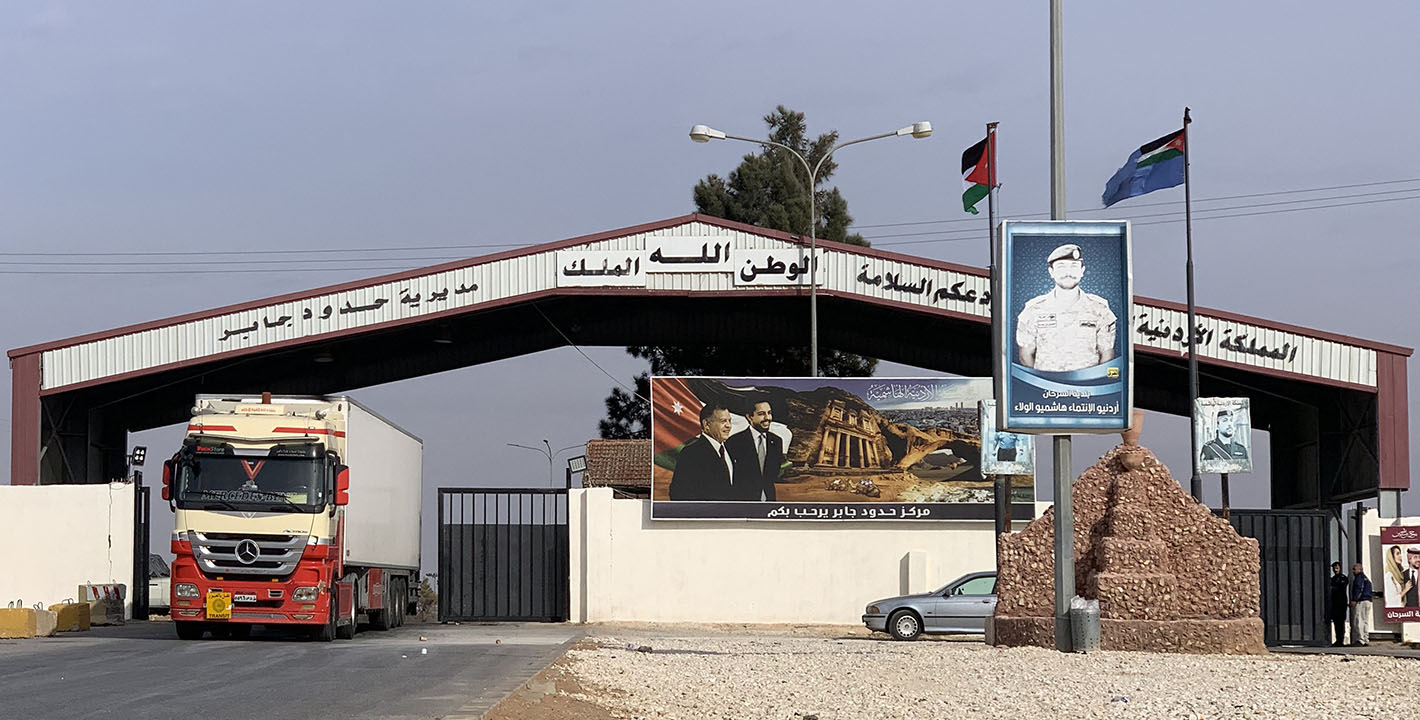
Trade statistics show why Amman has more reason than Damascus to welcome the improvement in bilateral commerce.

Armenak Tokmajyan
In an interview, Kheder Khaddour explains that Damascus is trying to stabilize its borders, but avoiding war isn’t guaranteed.
Michael Young