

Commentary
Amr Hamzawy
{
  "authors": [
    "Amr Hamzawy"
  ],
  "type": "commentary",
  "blog": "Diwan",
  "centerAffiliationAll": "dc",
  "centers": [
    "Carnegie Endowment for International Peace",
    "Malcolm H. Kerr Carnegie Middle East Center"
  ],
  "collections": [],
  "englishNewsletterAll": "menaTransitions",
  "nonEnglishNewsletterAll": "",
  "primaryCenter": "Malcolm H. Kerr Carnegie Middle East Center",
  "programAffiliation": "MEP",
  "programs": [
    "Middle East"
  ],
  "projects": [],
  "regions": [
    "North Africa",
    "Egypt"
  ],
  "topics": [
    "Political Reform"
  ]
}
Source: Getty
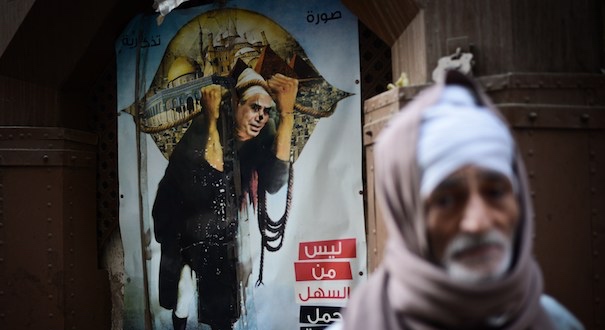
The ruling establishment claims to defend the people even as its actions target the people.
After the July 2013 coup that removed President Mohammed Morsi, Egypt’s old-new ruling establishment, centered around military and security generals, depended increasingly on religious populism and nationalistic populism. This allowed Egypt’s rulers to tighten their grip on many aspects of life in the country, under the pretense that that they were governing on behalf of ordinary citizens, to whose needs they were attentive.
Religious populism elevates the ruler to the level of a moral paragon who has the right to speak in the name of religion not just in the public and political spheres, but also in terms of its impact on private life and ethics. Nationalistic populism, in turn, is used to justify the ruling establishment’s monopoly over power. It allows the ruling general, Abdel Fattah al-Sisi, to claim to be aligning himself with national interests and national security, enabling him to undertake the role of “protector of the masses.”
Egypt’s military and security generals use official Islamic and Christian institutions to impose their own interpretations of religion in everyday life. These interpretations appear in three interrelated ways. First, by framing obedience to the ruler and the approval of government policies as a religious duty. Second, by claiming that the government-promoted understanding of religion is moderate, so that anything that goes against this can be labeled extremist. And third, by depicting the ruler as a protector of “dignified morals and values,” so that divergent moral conceptions can be denounced as “inappropriate for Egypt.”
Exploiting the nationalistic strain of populism, the ruling establishment depicts itself as guarantor of stability and a protector of ordinary citizens—as has been the case since officers ascended to power after the Egyptian revolution in 1952, and were somehow considered foster parents to an infant nation. Thus, nationalistic populism opens a door to ridiculing politics and civilian politicians. The latter are characterized by the military and security generals as not having the capacity to provide for the real welfare of the country, or as insular groups that seek only to further their own interests.
As politics and politicians are derided, the ruling establishment justifies filling the void with military and security officers, as representatives of the only institutions capable of safeguarding the nation and providing for the basic needs of citizens.
Nationalistic populism, further, creates a governing framework that is in clear contradiction to the rule of law and good governance. Military institutions, which benefit from such populism, obtain constitutional, legal, and political immunity from all forms of accountability. This undermines the power of the legislative and judicial branches of government, therefore limits the checks and balances in the system and neutralizes monitoring agencies such as the Central Auditing Organization.
The 2014 constitution enshrines a special status for the military. Its budget cannot be discussed in a transparent manner, mechanisms for oversight of the armed forces are eliminated, and civilians are subjected to military courts whenever the generals decide. In the past three years, thousands of Egyptians, including university students, young activists, and workers, have faced trials before military tribunals. Capitalizing on its special status enshrined in the constitution, the military institution has also increased its economic and social role. For example, in 2015 a presidential decree gave the armed forces the power to establish profit-seeking companies and investment firms with both Egyptian and foreign partners.
In the public arena, nationalistic populism silences the free voices that demand democratic change and the social movements that try to defend human rights and freedoms. The ruling establishment has sought to discredit those voices and movements, to break any conceptual link between democracy, human rights, and the interests of ordinary people. Government-controlled media have attacked pro-democracy activists and industrial workers demanding legitimate wage increases, accusing them, without any evidence, of corruption, treason, and conspiring with the “enemies of the nation.” Independent nongovernmental organizations and professional associations, critical of widescale human rights abuses and of economic and social policies, have also been subjected to systematic defamation campaigns in media outlets. The generals’ aim is to put in place an environment that facilitates repressive measures and silencing tactics.
This has created an Orwellian paradox. In the name of the people, the Egyptian regime has effectively engaged in behavior directed primarily against the people. Nationalistic populism has been used by the ruling establishment to dismantle any infrastructure that supports the rule of law. Today in Egypt, legal changes that contradict the principles of justice and equality have been introduced under the guise of defending the nation and bolstering national security. Claiming to wage a “war on terror” with the aim of restoring stability and defending the state’s territorial integrity, the military and security forces have engaged in unlawful surveillance while constantly threatening citizens’ rights and freedoms.
A clear case of undemocratic legal measures is the amendment of Article 78 of the Penal Code. It criminalizes foreign funding for all purposes, and in so doing make pro-democracy activists and independent nongovernmental organizations subject to harsh government retribution.
Furthermore, nationalistic populism often creates an environment allowing for the dismissal of universal standards of rule of law, democracy, and human rights as Western practices that do not apply to Egypt and are not binding on the government. Indeed, in the worldview inspired by nationalistic populism the rule of law and democracy are Trojan horses pushed by internal and external “enemies of the nation” to undermine its stability. Enforced disappearances, torture, extrajudicial killings, and various rights abuses are all committed under the banner of protecting the nation and defending the interests of ordinary Egyptians.
The ruling establishment controlled by the military and the security forces has not implemented sound public policy, nor laid the foundations for economic growth. Instead, it has exploited nationalistic populism to ignore facts, deny the free flow of information, and belittle the value of knowledge and scientific thinking in public policy matters. Such hostility stems from the ruling establishment’s tendency to deny crises, blame others for the negativity rampant in society today, suggest to citizens that their duty is only to obey, and use its disdain for policy details to propagate haphazard solutions to Egypt’s many hardships. As if the country could be saved while human rights violations, the excessive economic role of the military, and the lukewarm fight against corruption continue.
Against a background of growing economic and social crises, rising political tensions, ineffective public policies, and the dwindling approval ratings of the president, the use of both religious and nationalistic populism has become one of two prime strategies used by the ruling establishment to maintain its control over Egypt. The other is outright repression.

Director, Middle East Program
Amr Hamzawy is a senior fellow and the director of the Carnegie Middle East Program. His research and writings focus on Egypt’s and other middle powers’ involvement in regional security in the Middle East, particularly through collective diplomacy and multilateral conflict resolution
Recent Work
Amr Hamzawy
Amr Hamzawy
Carnegie does not take institutional positions on public policy issues; the views represented herein are those of the author(s) and do not necessarily reflect the views of Carnegie, its staff, or its trustees.

In Egypt’s dense cities, the disappearance of foliage has health implications and punishes daily commuters.

Angie Omar

Huawei pushed hard to enter the Egyptian data centers market, until the Americans made a better offer.
Angie Omar
There is a disturbing structural parallel between the old global energy economy and the new green transition.
Angie Omar

This will be the region’s most representative tournament, amid broad changes in its footballing landscape.

Issam Kayssi
Cairo’s efforts send a message to the United States and the region that it still has a place at the diplomatic table.
Angie Omar