

Research
- +6
Yasmine Farouk, Nathan J. Brown, Maysaa Shuja Al-Deen, …
{
  "authors": [
    "Michele Dunne"
  ],
  "type": "commentary",
  "blog": "Diwan",
  "centerAffiliationAll": "dc",
  "centers": [
    "Carnegie Endowment for International Peace",
    "Malcolm H. Kerr Carnegie Middle East Center"
  ],
  "collections": [],
  "englishNewsletterAll": "menaTransitions",
  "nonEnglishNewsletterAll": "",
  "primaryCenter": "Malcolm H. Kerr Carnegie Middle East Center",
  "programAffiliation": "MEP",
  "programs": [
    "Middle East"
  ],
  "projects": [],
  "regions": [
    "North Africa",
    "Egypt",
    "United States",
    "North America"
  ],
  "topics": [
    "Political Reform",
    "Economy"
  ]
}
Source: Getty
The United States is probably not going the way of Egypt, despite some similarities.
In the chaos of the U.S. election results on November 7, a fellow Middle East specialist tweeted: “US going full Egypt at the moment.” While sharing his dismay (and understanding the limits of expression on Twitter), I objected to the judgment viscerally. But it’s worth entertaining the question: Is the United States on a populist trajectory toward polarization and authoritarianism similar to that of Egypt?
There were some common factors—particularly a sense of government deafness to citizens’ concerns—that motivated Egyptians in 2013 and Americans in 2016 to, in American parlance, “throw the bums out.” Egyptians went out into the streets in 2013—not only on June 30, but months before that in Port Said and other locations—because they felt that the government of president Mohammed Morsi was ignoring their concerns. The economic situation was not good, but even more than that there was a widespread sense that the Morsi government was bullheadedly pursuing its own agenda—through a constitutional declaration, an amended constitution, a law curbing judicial independence, and police repression of demonstrators—heedless of growing public dissatisfaction.
There is much more to the story, but ultimately millions of Egyptians were content to put the fate of their country into the hands of then-defense minister Abdel Fattah al-Sisi, who promptly headed a military coup and ended the democratic transition.
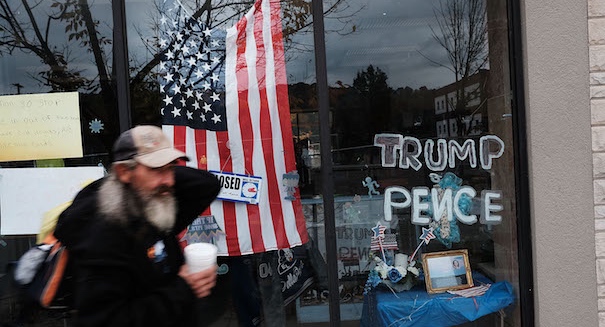
The election of Donald J. Trump was not a revolution or a counterrevolution. In fact, not even a majority of American voters chose him, but rather just enough voters in key states (due to the vagaries of the American electoral college). Still, there were enough votes for Trump to constitute a stunning rebuke of the political elite—not just of President Barack Obama, but of the Republican as well as Democratic leaders who have presided over the country for the last several decades.
Those were decades of economic change that left millions of Americans disappointed with their lot and prospects. There has been much discussion of the loss of manufacturing jobs in the United States due to global trade and automation, not to mention the troubling shift in wealth distribution over time. A recent series in the Washington Post, “Unnatural Causes: Sick and Dying in Small Town America,” which exposed the increased death rate among middle class white women due to drugs, alcohol, and suicide in recent years, or viewing the devastating 2010 film “Winter’s Bone,” brought home the dire consequences outside major urban areas.
Such reports only put numbers to what I had observed with my own eyes. Socioeconomic conditions for the working class deteriorated seriously after the 1980s. When I went home to visit relatives in my native state of Connecticut and upstate New York, I was frankly shocked at what I saw. Relatives who had once held reasonably lucrative positions in manufacturing—my uncle on an assembly line in a gun factory, for example—were forced into service-sector positions such as stocking supermarket shelves. They had little job security and could no longer count on benefits such as health insurance and paid vacations. Between the 1990s and the 2000s, I saw small cities and towns that used to be bustling and prosperous turn depressed and shabby. When I went to a cousin’s wedding in upstate New York in 2015 I was stunned at the Appalachia-style poverty I saw in hamlets just north of Albany, the state capital.
My siblings and I, as well as a few of our cousins, escaped during the 1980s and 1990s to places south, where job prospects were better and the cost of living lower. When we returned north, the conversation, whether at celebrations or funerals, was often about closing manufacturing plants, young adults unable to establish financial independence, unreasonably high taxes, and pervasive substance abuse problems. Wild conspiracy theories about what went on in Washington made me realize how far away from decisionmakers my relatives felt. So during my visits in 2016 I was not at all surprised to hear from uncles, aunts, and cousins that “Trump makes a lot of sense to us.”
And Sisi made sense to quite a few Egyptians when they facilitated his rise to power. He courted women and Christians, many of whom had been worried that their rights would be circumscribed by a president from the Muslim Brotherhood. He also set about assiduously intimidating and silencing all critics—not just Islamists, but also the liberal and leftist youths who had been in the forefront of the 2011 revolution. Sisi used his power as president (and that of Adly Mansour, the interim president who took over immediately following the coup) to issue hundreds of decrees, including draconian anti-protest and counterterrorism laws, in the absence of parliament.
Sisi also resorted to a degree of brutality not seen in Egypt before to break up demonstrations, and banned his main political rivals—the Muslim Brotherhood but also the liberal April 6 Youth Movement—making membership in both a punishable offense. Since then, Egypt has seen an era of unprecedented human rights abuses and even narrower margins in political life than that permitted under deposed president Hosni Mubarak.
But Americans who voted for Trump, while dissatisfied with leadership in both parties, did not intend to toss their two-century-old democracy into the dustbin as happened in Egypt. While Trump supporters might want a different ideological balance in the Supreme Court to be achieved by attrition and replacement, and hope to use the Republican administration and Congress to pass laws, it is not about undermining the function of those institutions. It was extremely troubling that Trump supporters chose to overlook offensive remarks of various kinds from the candidate and his advisors, enflaming social alienation and polarization, but there are still impartial institutions such as the courts to settle ensuing disputes.
Perhaps Egyptians who came out against Morsi did not intend to undermine their nascent democracy either—remember that they were calling for an early presidential election rather than a complete sidelining of democratic procedures—but their transition was in its infancy in 2013. Parliament had been partially dissolved and the judiciary had become politicized, meaning that neither of these branches of government was in a position to stand up to an executive branch dominated by the military.
As I told my aunt and uncle some months ago, I think they will be disappointed in how much president-elect Trump, a political outsider with a questionable record in business, will do about their very legitimate and longstanding economic grievances. Just ask Egyptians. They empowered Sisi through a coup, and later a presidential election, in order to improve the state’s functioning and get the economy moving. What they have three years later is a state that is not accountable to citizens in any meaningful way—as all competitors and alternatives have been eliminated—and an economy that is in much worse shape than it was in 2013.
At least by the time Americans figure this out, they will still have a political system that allows them to throw the bums out—once again.

Former Nonresident Scholar, Middle East Program
Michele Dunne was a nonresident scholar in Carnegie’s Middle East Program, where her research focuses on political and economic change in Arab countries, particularly Egypt, as well as U.S. policy in the Middle East.
Recent Work



Yasmine Farouk, Nathan J. Brown, Maysaa Shuja Al-Deen, …

Robert Springborg, Emile Hokayem, Becca Wasser, …
Carnegie does not take institutional positions on public policy issues; the views represented herein are those of the author(s) and do not necessarily reflect the views of Carnegie, its staff, or its trustees.

In an interview, Rozina Ali discusses her new book on the rise and manifestations of Islamophobia in the United States.

Michael Young

In an interview, Ian Lustick and Eli Clifton discuss their new book on why a prominent ally has so much influence in America.
Michael Young

As the U.S. stumbles in its war with Iran, we are likely to see an acceleration of its disengagement from the region.
Michael Young

Middle Eastern states should welcome an accelerated U.S. disengagement from their region.
Michael Young

In an interview, former ambassador Charles Freeman assesses the Trump administration’s war against Iran.
Michael Young