

Research
- +6
Yasmine Farouk, Nathan J. Brown, Maysaa Shuja Al-Deen, …
{
  "authors": [
    "Michele Dunne"
  ],
  "type": "commentary",
  "blog": "Diwan",
  "centerAffiliationAll": "dc",
  "centers": [
    "Carnegie Endowment for International Peace",
    "Malcolm H. Kerr Carnegie Middle East Center"
  ],
  "collections": [],
  "englishNewsletterAll": "menaTransitions",
  "nonEnglishNewsletterAll": "",
  "primaryCenter": "Malcolm H. Kerr Carnegie Middle East Center",
  "programAffiliation": "MEP",
  "programs": [
    "Middle East"
  ],
  "projects": [],
  "regions": [
    "North Africa",
    "Egypt",
    "United States"
  ],
  "topics": [
    "Political Reform"
  ]
}
Source: Getty
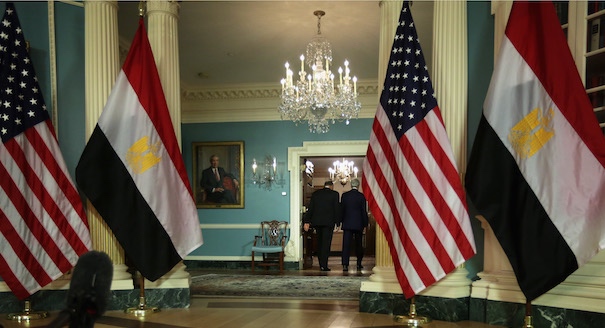
Donald Trump would lose by giving Abdel-Fattah al-Sisi what he wants.
As is traditional at this time of year, people are hinting about gifts they hope to receive. In Washington what this means is not Christmas, however, but rather the November-to-January interregnum between one U.S. administration and another. U.S. allies line up at this time to request from the incoming U.S. president whatever the predecessor denied them. That is normal and to be expected.
What is also normal is that the new U.S. president and his staff agree to at least some demands from other governments, wanting to spread goodwill as they enter office as well as correct what they perceive as the policy errors of their predecessors. But gifts given in haste, before a new administration fully appreciates their cost, are often repented at leisure.
Egyptian Foreign Minister Sameh Shoukry recently completed a visit to Washington, following on President Abdel Fattah al-Sisi’s alacritous November 9 call to congratulate president-elect Donald Trump on his election victory. Sisi appeared eager to cash in on Trump’s promise to be a “loyal friend and ally” to Egypt, particularly in its fight against terrorism, made during their meeting in September at the start of the United Nations General Assembly session. Egypt’s wish list, according to several sources, among them a publication closely connected with the government, includes a Sisi visit to Washington, a Trump visit to Cairo, increased military assistance, delivery of unspent economic assistance in cash, provision of several billion dollars in loan guarantees, designation of the Muslim Brotherhood as a terrorist organization, and extradition of Egyptians wanted by the government from the United States.
Among this list of desired goodies, some—particularly the head-of-state visits to Washington and Cairo—are of the variety the new U.S. administration will be free to dispense without asking the permission of any other parts of government. Most of the list, however, will require the cooperation of the legislative or judicial branches. For example, Congress would have to sign off on aid increases or the lifting of conditions related to human rights that have been imposed on security assistance in recent years. Courts, in turn, would have a say about extraditions. And this is where Sisi might be miscalculating.
In particular, the ongoing campaign against Egyptian civil society organizations—which has escalated notably since Trump’s victory in the U.S. elections—might well interfere with Sisi getting his entire wish list. Egypt’s draconian new NGO bill, passed by parliament and expected to be endorsed by Sisi shortly, marred the recent Shoukry visit to Washington. Members of the U.S. Congress have never quite gotten over Case 173, in which American and Egyptian employees of U.S.-funded non-governmental organizations were convicted of carrying out work without permits in 2013, and which has now been revived as a case against Egyptian NGOs that have received foreign funding.
And then there is the case of Aya Hegazy, one of several American citizens held for long periods of time in Egyptian prisons on artificially-constructed grounds related to protests that followed the 2013 military coup. Moreover, as soon as Shoukry left town, the news broke of the detention of women’s rights activist Azza Soliman, the first person to be arrested in the new chapter of Case 173 (she was subsequently released on bail but will be prosecuted).
Shoukry received a mixed reception in Washington. Vice president-elect Mike Pence met Shoukry but several senior Republican members of Congress refused to do so, while others received him but strongly expressed their concerns about civil society issues. Before meeting with Shoukry, Senators Lindsey Graham (chairman of the Appropriations Committee) and John McCain (chairman of the Armed Services Committee) issued a statement on their intention to “strengthen democratic benchmarks and human rights conditions” on future aid to Egypt. Shoukry also got tough questions about human rights during his two major media interviews.
The fact that the Egyptian regime saw the election of Trump as a green light to sharpen its persecution of peaceful civil society activists, and that Shoukry heard some tough words in Washington, should occasion rethinking on both sides about how to conduct the bilateral relationship as the Trump administration prepares to take office. The Egyptian government should understand that it has overreached. The fact that Trump apparently admires Sisi should not be taken to mean that Egypt can now do whatever it likes with no pushback from Washington. In fact, Egypt probably could have obtained all or most of its wish list, with little or no resistance from Congress, had Sisi not seized what he apparently thought was an opportunity to finish off civil society. He can still reverse course.
For the incoming Trump administration, this episode should teach two lessons. First, senior members of Congress will resist giving Sisi all he wants if human rights and civil society conditions in Egypt do not improve, even with a Republican in the White House. And second, Sisi is likely to take whatever gifts of status or funding that Trump gives him and use them for entirely the wrong purposes—not for fighting terrorism, but for pursuing petty, vindictive political agendas against peaceful activists.
In addition, the incoming Trump administration should see that the more the United States gives Sisi without getting something in return, the more Sisi is likely to demand. Egypt’s bullying regime will continue to bully its own citizens, but it is more than capable of turning the bullying toward foreign patrons as well. Ask Saudi Arabia.
So will president-elect Trump, who prides himself on his negotiating skills, be a tough bargainer with allies such as Egypt as he has said he would be with American corporations? Will he weigh each of Egypt’s requests against U.S. interests and the likelihood of positive results in counterterrorism? Or will he hastily shower Sisi with gifts just to reverse the policies of Barack Obama? Stay tuned.

Former Nonresident Scholar, Middle East Program
Michele Dunne was a nonresident scholar in Carnegie’s Middle East Program, where her research focuses on political and economic change in Arab countries, particularly Egypt, as well as U.S. policy in the Middle East.
Recent Work



Yasmine Farouk, Nathan J. Brown, Maysaa Shuja Al-Deen, …
Robert Springborg, Emile Hokayem, Becca Wasser, …
Carnegie does not take institutional positions on public policy issues; the views represented herein are those of the author(s) and do not necessarily reflect the views of Carnegie, its staff, or its trustees.
In an interview, Hamidreza Azizi discusses how Tehran has adapted in real time to the conflict with the United States and Israel.

Michael Young
The simple conclusion is that the scheme will bring neither peace nor prosperity, but will institutionalize devastation.
Nathan J. Brown
In an interview, Roger Diwan discusses where the global economy may be going in the third week of the U.S.-Israeli war with Iran.

Nur Arafeh
In an interview, Andrew Leber discusses the impact the U.S. and Israeli war against Iran is having on Arab Gulf states.
Michael Young
In an interview, Sergei Melkonian discusses Armenia’s and Azerbaijan’s careful balancing act among the United States, Israel, and Iran.

Armenak Tokmajyan