

Commentary
Sarah Yerkes
{
  "authors": [
    "Sarah Yerkes"
  ],
  "type": "commentary",
  "blog": "Diwan",
  "centerAffiliationAll": "dc",
  "centers": [
    "Carnegie Endowment for International Peace",
    "Malcolm H. Kerr Carnegie Middle East Center"
  ],
  "collections": [],
  "englishNewsletterAll": "menaTransitions",
  "nonEnglishNewsletterAll": "",
  "primaryCenter": "Malcolm H. Kerr Carnegie Middle East Center",
  "programAffiliation": "MEP",
  "programs": [
    "Middle East"
  ],
  "projects": [
    "Tunisia Monitor"
  ],
  "regions": [
    "North Africa",
    "Tunisia",
    "Maghreb"
  ],
  "topics": [
    "Political Reform"
  ]
}
Source: Getty
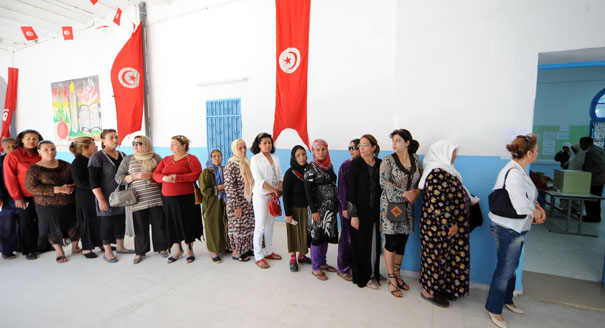
The successful outcome of Tunisia’s municipal elections next December is not guaranteed.
On April 3, the Tunisian government officially set a date for the country’s first democratic municipal elections. After numerous postponements, officials agreed to hold the elections on December 17, 2017, the seventh anniversary of the self-immolation of Mohammed Bouazizi, the literal spark that began the Arab uprisings. However, the decision to tie the date of the elections to an event with such political and emotional significance may be setting expectations too high. For the elections to succeed, the Tunisian government and international donors should work to manage the public mood before and after the elections.
The Tunisian government is placing a tremendous amount of pressure on the municipal elections to address Tunisia’s long history of regional inequality—one of the primary drivers of the 2010–2011 uprising. The goal of decentralization is to provide local actors, who have a deep knowledge of the needs in their municipalities, with the tools to address them and provide Tunisian citizens with a direct link to their decisionmakers. Particularly in the neglected interior regions, the newly elected local officials will be expected to secure adequate resources to correct longstanding regional economic disparities and address the social grievances that have plagued their residents for decades.
Additionally, the Tunisian government is counting on the elections to attract the young, who have been increasingly disengaging from formal politics. Through marketing campaigns and programs targeting youth, the national government is hoping that large numbers of young Tunisians turn out to vote and run for office.
The decentralization process is also highly symbolic. Many view municipal elections as the last stage of Tunisia’s democratic transition, hence the decision to schedule them on the anniversary of Bouazizi’s act. With much at stake, there are yet four reasons why there is a strong chance that the decentralization process will fail to accomplish its goals.
First, for the elections to take place, the government must complete a number of major tasks in a short time window: approve a local authorities code, which sets the legal structure governing the role of local officials; dissolve the special delegations that have served as municipal government placeholders since 2011; and finalize the electoral districts. Should the government fail to accomplish these three tasks in time and postpone the elections yet again, it would provoke further frustration among a Tunisian public already running out of patience with its elected leaders.
Second, the election outcome is not likely to dramatically alter the political landscape in Tunisia, where only 12 percent of people trust political parties to a great or medium extent. While new parties are cropping up, most notably a “non-ideological” party led by former prime minister Mehdi Jomaa, these tend to reinforce rather than reduce the fracturing of the political landscape. And among some Tunisians there is a fear that the local elections will further enrich and empower influential individuals and families.
Third, Tunisians might simply not participate in the elections. According to a recent survey by the U.S. National Democratic Institute, many Tunisians are unaware of the elections. Additionally, Tunisia does not have a strong track record of voter participation. At the national level, voter participation is on the decline, with 69 percent of Tunisians reporting that they voted in the 2011 parliamentary elections and only 57 percent in 2014. Those numbers were significantly lower for those 29 years of age and under—55 percent and 44 percent, respectively. And because many Tunisians are so disillusioned by the failure of the post-revolution government to achieve its goals, particularly in the economic realm, we should not expect a high voter turnout.
And fourth, even if the decentralization process is carried out in an efficient and equitable manner, the dividends of decentralization will not pay off for many years. The problem will likely be worse in the interior and traditionally disadvantaged regions, which view the decentralization process as a silver bullet to address their myriad economic challenges.
To guard against these challenges, it is crucial for the government, civil society, and international donors to engage in a multilevel voter education campaign beginning today. The first goal of the campaign should be to manage expectations. Tunisian government officials and the public hope that the decentralization process will make it easier for citizens to express their views and make requests of their elected officials. That may be true, but Tunisians must understand that at the local level too change takes time. Even if the local councils can secure the necessary funds to improve infrastructure or develop the institutional framework to be responsive to their constituents, the impact of decentralization will not be anywhere close to immediate.
A second goal is to encourage youth participation at all stages of the election, but, most crucially, in running for office. The barriers to entry at the local level are far lower for inexperienced youths than at the national level. Moreover, young people who are eager to lead might find local politics more fulfilling than parliament. In an interview I conducted with the Tunisian Ministry of Youth and Sports last summer, it was clear that the government was counting on the municipal elections to draw youth back to formal politics. At the same time, last summer youths expressed skepticism that the elections would have much of an impact on their lives, with many stating that they did not intend to participate.
A youth quota of sorts exists to help ensure some level of youth representation on the electoral lists. More importantly, political parties should recruit influential youth—the best and brightest—to take ownership of local government. Tunisians of all ages are increasingly disengaging from formal politics, in part because of dissatisfaction with a government that has failed to deliver on the promises of the uprising. The municipal elections are an opportunity to better connect the Tunisian people to the levers of power. But officials should be careful not to oversell the elections or portray them as the bookend to the events of 2010–2011. Setting the bar too high could lead to further disenchantment with the political system, when the success of Tunisia’s democratic transition requires more, not less, public participation.

Senior Fellow, Middle East Program
Sarah Yerkes is a senior fellow in Carnegie’s Middle East Program, where her research focuses on Tunisia’s political, economic, and security developments as well as state-society relations in the Middle East and North Africa.
Recent Work
Sarah Yerkes
Carnegie does not take institutional positions on public policy issues; the views represented herein are those of the author(s) and do not necessarily reflect the views of Carnegie, its staff, or its trustees.

The recent African Cup of Nations tournament in Morocco touched on issues that largely transcended the sport.


Issam Kayssi, Yasmine Zarhloule
Mustaqbal Misr has expanded its portfolio with remarkable speed, but a lack of transparency remains.

Yezid Sayigh
The burden of environmental degradation is felt not only through physical labor but also emotional and social loss.
Yasmine Zarhloule, Ella Williams
The country’s youthful protest movement is seeking economic improvement, social justice, and just a little hope.
Yasmine Zarhloule
The Moroccan-Algerian rivalry is playing itself out in ties with Burkina Faso, Niger, and Mali.
Yasmine Zarhloule