• Research
  • Diwan
  • About
  • Experts
Carnegie Middle East logoCarnegie lettermark logo
LebanonIran
{
  "authors": [
    "Maha Yahya"
  ],
  "type": "commentary",
  "blog": "Diwan",
  "centerAffiliationAll": "dc",
  "centers": [
    "Carnegie Endowment for International Peace",
    "Malcolm H. Kerr Carnegie Middle East Center"
  ],
  "collections": [
    "Conflict and Refugees"
  ],
  "englishNewsletterAll": "menaTransitions",
  "nonEnglishNewsletterAll": "",
  "primaryCenter": "Malcolm H. Kerr Carnegie Middle East Center",
  "programAffiliation": "MEP",
  "programs": [
    "Middle East"
  ],
  "projects": [
    "Triggers of Return"
  ],
  "regions": [
    "Levant",
    "Syria",
    "Jordan",
    "Middle East"
  ],
  "topics": [
    "Political Reform",
    "Civil Society"
  ]
}

Diwan English logo against white

Source: Getty

Commentary
Diwan

Photo Essay: A Syrian City in Jordan

The Zaatari Camp is taking on characteristics of permanence, raising doubts about a refugee return.

Link Copied
By Maha Yahya
Published on May 8, 2017
Diwan

Blog

Diwan

Diwan, a blog from the Carnegie Endowment for International Peace’s Middle East Program and the Malcolm H. Kerr Carnegie Middle East Center, draws on Carnegie scholars to provide insight into and analysis of the region. 

Learn More
REQUIRED IMAGE

Project

Triggers of Return

The Triggers of Return Project run by the Carnegie Middle East Center in 2016-2018 aims to improve understanding of the predicament of Syrian refugees, and to uncover the political, social, economic, and other conditions that would trigger their voluntary return to their homeland.

Learn More
Zaatari was established in 2012 by the Jordanian government, in coordination with the United Nations High Commissioner for Refugees (UNHCR), to house the increasing influx of Syrians fleeing the conflict at home. Most of its inhabitants originate from Der‘a governorate, in southern Syria. The camp is located just 12 kilometers away from the Syrian border and covers an area of 5.3 square kilometers. According to the UNHCR, around 60 percent of the inhabitants are youths.
 
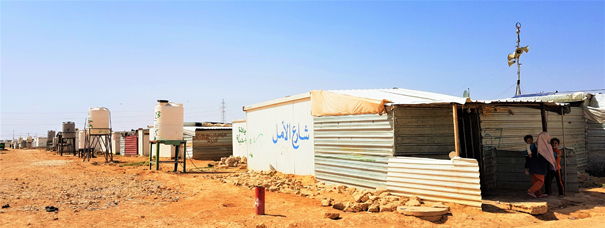
All construction in the camp is of a temporary nature, with homes built of one-room prefabricated housing units given to refugees by donors instead of tents. These are constructed as mobile caravans. Refugee families use corrugated iron as a roof linking two caravans and establish a private entrance and internal courtyard for their homes.
 
A new business has been created in Zaatari: caravan hauling. Residents use it to move their caravan homes between districts, moving to sites of their own choosing, often disrupting the original grid plan created for the camp. There also happens to be a trade in caravans for refugees who no longer need them.
 
Passage in and out of the camp, as well as through various zones inside the camp, takes place through gates, barbed wire, surveillance towers, and checkpoints. These demarcate Zaatari’s boundaries and isolate its inhabitants from their immediate surroundings.
 
All major institutions in Zaatari, whether schools, hospitals, clinics, or supermarkets, are surrounded by barbed wire, transforming the camp into an endless warren of enclosed spaces abutting one another.
 
Life continues amid the barbed wire.
 
Zaatari is also a branded city. The camp is sustained by a variety of donors, both international organizations, including United Nations agencies, and countries such as Saudi Arabia, Qatar, Kuwait, Oman, Bahrain, and the United Arab Emirates. Walking through Zaatari is like moving through a giant advertising campaign for those organizations and countries. Entire residential quarters are stamped and named with the logos or flags of donors.
 
Logos are also prominent on services structures, including schools, health clinics, and recycling plants.
 
Branding also extends to the smallest levels of daily life including children’s backpacks. These serve as a constant reminder of the precarious nature of life in the camp because of its constant dependence on the kindness of strangers.
 
Even garbage bins are branded.
 
Life inside the camp is thriving. Zaatari’s main thoroughfare, or souk, is dubbed the Shams-Elysees, a pun on the Arabic term “Sham,” for Damascus or Syria, and the Champs Elysees in Paris. It is a bustling street with shops offering diverse goods and services—including tailors, blacksmiths, minimarkets, as well as stores to repair electronics or selling used washing machines, wedding dresses, perfume, and other products needed for daily life.
 
Some of the businesses on the Shams-Elysees have also become a destination for residents in nearby Mafraq, where another 79,000 Syrians, also refugees, live. Along with Jordanians, and through networks of friends and relatives, they seek to purchase cheaper goods in the camp’s informal economy.
 
There are an estimated 2,500 shops and businesses operated by refugees in Zaatari. Some children make a living by using wheelchairs and baby carriages to transport purchased goods to people’s homes.
 
Jordanian businesses have also been allowed into the camp in the form of two principal supermarkets for refugees. In this photo, Safeway which is part of the Kuwaiti TSC chain operates a large supermarket where residents can either pay in cash or use food vouchers distributed by UN agencies.
 
Zaatari is also part of the global economy. Fruits and vegetables, available at the TSC supermarket include imported apples from Italy, bananas from Lebanon, and oranges from Spain.
 
Social life in the camp revolves around three different kinds of spaces: the market, the coffee shop, and communal kitchens. While the first two remain the domain of men for the most part, the latter are where women gather to socialize.
 
Makeshift mosques have also been established in every residential quarter. Men in particular congregate there for Friday prayers.
 
A police station manned by Jordanian police exists in the camp to address legal disputes and different kinds of infractions. They work with local “street leaders” of different districts. Most of these are either self-declared or appointed by the international or local agencies. In rare instances, they are chosen by their immediate community. In addition, local courts run by a Jordanian nongovernmental organization, Arab Renaissance and Development, are in operation to address legal disputes and register births and marriages.
 
Movement within the camp is difficult, particularly for women. A few minivans operating as public transportation vehicles pick up passengers at bus stops such as this one, called the “Bus Station of Flowers.”
 
Rather than riding in minivans, where they feel unsafe, some women prefer to be transported by bicycle. However, there is a small movement to encourage women to ride bicycles independently. Given the conservative nature of the society, this represents a quiet revolution in the making.
 
Other forms of transportation include donkey-driven pull carts. These are used to transport goods from the market to residential areas, where they are sold.
 
Some 1,500 refugees work in the camp with local or international nongovernmental organizations, especially the women. Most men, in turn, seek seasonal work outside the camp in agriculture or have created small businesses. Refugees seeking to leave the camp, whether for work or other business, apply for a special permission called “vacation.” Here refugees return after a day of working in the fields close to the camp.
 
One in five households in Zaatari is headed by a female. These women, most of whom come from rural areas, form the backbone of the camp’s social structures. Many are the primary bread winners in the family and are employed through cash-for-work programs initiated by nongovernmental organizations operating in the camp. This exposes them to challenges rarely experienced in their hometowns. Men, in turn, tend to work in local camp-based businesses.
 
Most families plant vegetables in their front or back yard for family consumption. This helps to make a very arid environment green.
 
Three generations of refugees are now growing up and growing old in a camp where every individual has witnessed one form of trauma or another. While all yearn to return to Syria, for many going back remains impossible without significant guarantees and a change in regime. Meanwhile, they fear that their exile may extend for generations as the prospect of return becomes an increasingly distant dream.
 

Zaatari, the Syrian refugee camp in northern Jordan, has a population of approximately 80,000 people, most from southern Syria. It is often dubbed Jordan’s fifth largest city. However, it is also an agglomeration that functions as an extraterritorial space, an open-air enclosure, but also a giant prison to an extent, where multiple states of order prevail. The conflict in Syria has upended the lives of Zaatari’s inhabitants, however as the war grinds on, the camp is gradually taking on characteristics of permanence. Yet this permanence, as camp residents are reminded constantly, is one dependent on the kindness of strangers.

I visited the camp on April 23. The resilience of camp inhabitants, especially the women, is remarkable. Despite the arid landscape and the temporary nature of the dwellings, camp residents are slowly building their lives anew. Many of the women work while also tending to homes and children, including extended families. There is a strong sense of community and social solidarity.

Small businesses have also emerged across this sprawling horizontal city, as connections to the state infrastructure are being put in place. Flourishing businesses have allowed a class structure to emerge within the camp. A recognizable order has been put in place, albeit an informal one that consists of self-appointed “street leaders” liaising with camp officials and the security services. By some accounts, this system has also enabled the advent of local street bosses who control access to services and demand protection money from destitute refugees.

For refugees, life in Zaatari is all that they have. Jamila, one of the camp’s residents, escaped to Jordan in 2012. Her daughter was killed and her grandchildren injured in fighting in Der‘a, the “province of the uprising” as she told me. “We had to escape to safety. And without safety we cannot go back with children who cannot fend for themselves. I yearn to go home, and one day I left the camp intending to walk back to Der‘a, but the security guard at the gate invited me in for a coffee to share my troubles. Once we were done chatting I felt better and walked back in. For better or worse we have made new lives for ourselves here.”

She was not alone in feeling a sense of uncertainty. Many women expressed a similar desire to return, but noted that their homes had been destroyed. However, they did not want to emigrate to Europe, as the culture there is very different. They feared that once their sons turned eighteen they would no longer have any authority over them, while their daughters would be lost. This effort to cling to some kind of family hierarchy and social tradition could have seemed ironic among people who have faced a cataclysmic social breakdown. Yet it also underlined that Zaatari is more than a refugee camp. It is also a place where Syrians try to hang on to a life suddenly shattered.

About the Author

Maha Yahya

Director, Malcolm H. Kerr Carnegie Middle East Center

Maha Yahya is director of the Malcolm H. Kerr Carnegie Middle East Center, where her research focuses on citizenship, pluralism, and social justice in the aftermath of the Arab uprisings.

    Recent Work

  • Commentary
    Israel Goes to War with Iran

      Maha Yahya

  • Commentary
    Joseph Aoun Has Been Elected President of Lebanon

      Maha Yahya

Maha Yahya
Director, Malcolm H. Kerr Carnegie Middle East Center
Maha Yahya
Political ReformCivil SocietyLevantSyriaJordanMiddle East

Carnegie does not take institutional positions on public policy issues; the views represented herein are those of the author(s) and do not necessarily reflect the views of Carnegie, its staff, or its trustees.
More Work from Diwan

  • Commentary
    Diwan
    Israel Strikes Hezbollah’s Muslim Brotherhood-Affiliated Allies

    The Jamaa al-Islamiyya is the local Lebanese dimension of a broader struggle involving rival regional powers.

      Issam Kayssi

  • Commentary
    Diwan
    Syria Skirts the Conflict With Iran

    In an interview, Kheder Khaddour  explains that Damascus is trying to stabilize its borders, but avoiding war isn’t guaranteed. 

      Michael Young

  • Commentary
    Diwan
    Israel’s Forever Wars

    The country’s strategy is no longer focused on deterrence and diplomacy, it’s about dominance and degradation.

      Nathan J. Brown

  • Commentary
    Diwan
    An Extension Under Fire

    The decision of Lebanon’s parliament may look exceptional, but in reality it is not.

      Issam Kayssi

  • Commentary
    Diwan
    Firepower Against Willpower

    In an interview, Naysan Rafati assesses the first week that followed the U.S. and Israeli attack on Iran.

      Michael Young

Get more news and analysis from
Malcolm H. Kerr Carnegie Middle East Center
Carnegie Middle East logo, white
  • Research
  • Diwan
  • About
  • Experts
  • Projects
  • Events
  • Contact
  • Careers
  • Privacy
  • For Media
Get more news and analysis from
Malcolm H. Kerr Carnegie Middle East Center
© 2026 Carnegie Endowment for International Peace. All rights reserved.