

Commentary
As the U.S.-led Coalition withdraws, the Kurds’ reliance on Baghdad, and on themselves, will only increase.
Wladimir van Wilgenburg
{
  "authors": [
    "Natacha Danon"
  ],
  "type": "commentary",
  "blog": "Diwan",
  "centerAffiliationAll": "",
  "centers": [
    "Carnegie Endowment for International Peace",
    "Malcolm H. Kerr Carnegie Middle East Center"
  ],
  "collections": [
    "Diwan Dispatches"
  ],
  "englishNewsletterAll": "",
  "nonEnglishNewsletterAll": "",
  "primaryCenter": "Malcolm H. Kerr Carnegie Middle East Center",
  "programAffiliation": "",
  "regions": [
    "Syria",
    "Levant"
  ]
}
Source: Getty
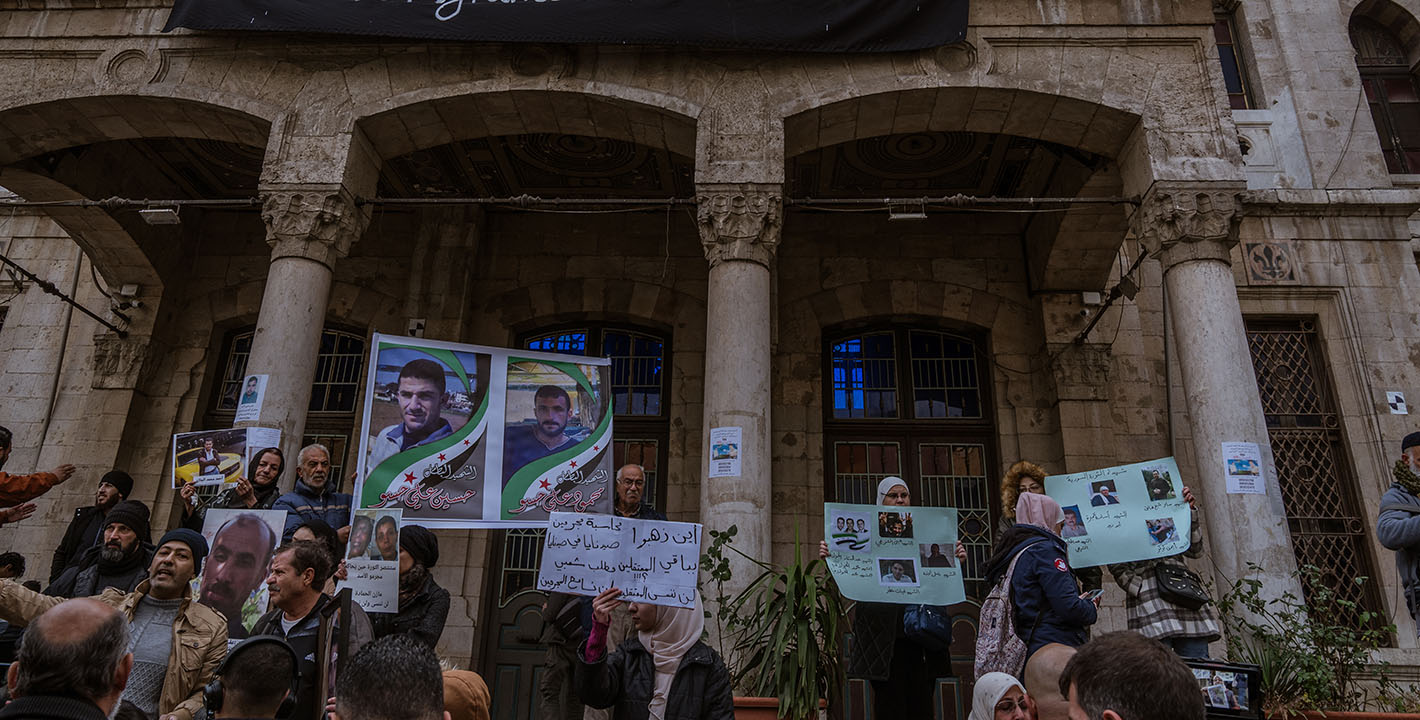
Reconciliation councils are emerging throughout the country to mediate in intracommunal disputes, many from the war years.
Transitional justice is quickly becoming little more than an abstract buzzword in Syria’s post-Assad political space. Barring a handful of highly mediatized trials, most of the worst culprits of the former Assad regime have yet to face accountability, having fled abroad or received temporary immunity from the transitional government. As commentators and civil society actors continue to debate the applicability of the Rwandan and South African models, protests and riots, sometimes sectarian in nature, have erupted demanding accountability and threatening the country’s fragile post-conflict transition.
The vast majority of perpetrators are not major war criminals; they are embedded within local communities. They include informants who reported on their neighbors, or even family members, to the intelligence services. Others acquired or occupied property that had been expropriated on political grounds, or that had been entrusted to them by displaced members of their community. Still others took advantage of the absence of their displaced neighbors to reconstruct entire apartment buildings. As millions of Syrians return to their areas of origin, communities are having to grapple with each other after years of living apart.
Reconciliation councils are now quietly popping up across the country to mediate in intracommunal disputes, many of which are byproducts of the conflict. These councils, some quasi-official and overseen by the state and others informal, are particularly prominent in tribal areas, where community notables serve as mediators. Drawing on a mix of Islamic jurisprudence (sharia), customary tribal law (urf), and elements of statutory law, they operate at the intersection of local, informal mediation and formal state authority. But with an increasing dependence on Islamic law for conflict resolution—now under the umbrella of the state—some fear the secular nature of the court system is being increasingly bypassed and undermined.
Reconciliation councils can be traced back to the early days of the Syrian conflict. Across rebel-held areas, tribal and clan councils—often featuring shura advisory bodies—emerged to fill the vacuum left behind by the state, focusing on service delivery and community mediation. In the besieged pocket of Idlib Governorate, the influx of displaced populations created a volume of cases that local courts could not process. To deal with the pressure on the judiciary, the Hay’at Tahrir al Sham-affiliated Syrian Salvation Government appointed a Tribal and Clan Council. The council, in turn, established the General Reconciliation Council in 2019 to handle cases in urban and rural areas alike, expanding beyond its original mandate of addressing tribal issues.
After the fall of the Assad regime in December 2024, reconciliation councils at the governorate level and committees at the village level were rolled out across Syria to deal with the fallout of the war locally. The councils are composed of over 7,000 volunteers across the country, with the exception of the Idlib-based umbrella entity, the General Reconciliation Council, which receives government salaries. Today, governorate reconciliation councils and village-level committees manage cases ranging from property and financial claims to personal-status matters and blood disputes. Crucially, they do not deal with security-related cases or hudoud, Islamic punishments for major crimes.
In the post-Assad order, reconciliation councils are emerging as a viable alternative to the formal legal system, which remains debilitated. Syria’s judiciary is severely overburdened and understaffed, while its legitimacy has been undermined by deep-seated corruption. The transitional government’s dismissal of hundreds of judges associated with the former regime has created a deficit in legal cadres, even as officials scramble to appoint new magistrates. To date, many court buildings have yet to be rehabilitated and many court registries have been destroyed or are missing.
Cases brought before quasi-official reconciliation councils are typically heard by a panel of three arbitrators—a religious sheikh and two individuals meant to provide legal grounding. However, legal practitioners raise serious concerns regarding the qualifications of these panels. According to Douaa al-Khoder, a lawyer from Raqqa who has clients who have resorted to the local reconciliation council, these individuals lack legal expertise, with judges and lawyers entirely absent.
“In Raqqa, these mediators lack an understanding of the law, especially those related to property disputes, and are often too rushed, leading some plaintiffs to lose some of their rights in the name of expediency,” she says. “With greater formal legal representation, these councils would have less of an Islamic color,” Khoder adds. While Syria’s Personal Status Act is derived from Islamic law, namely for marriage, divorce, and inheritance, Syrian law is predominantly civil in nature.
Representation also remains uneven across gender lines. In Raqqa, women are absent among committee mediators, although officials say female mediators exist elsewhere in the country. “Women’s cases have their own sensitivities,” Khoder remarks. “Female litigants may be embarrassed to discuss certain issues in front of men, such as those related to sexual harassment and assault.”
Despite these perceived shortcomings, the councils are in high demand because of their speed and accessibility. “The [formal] courts are weak and take time, whereas reconciliation councils are more efficient,” Mohammed Khattab, the diwan president of the General Reconciliation Council, says. Most cases take three days, with the maximum duration generally being one month. In a country in which 90 percent of the population lives below the poverty line, reconciliation councils offer another critical advantage: they provide dispute resolution free of charge, unlike the court system.
Khaled al-Hajj, head of the Raqqa Reconciliation Council, which was established after the withdrawal of the Kurd-dominated Syrian Democratic Forces earlier this year, stresses that participation is voluntary: “Two parties enter the process by mutual consent, and outcomes require consensus. If a party rejects the proposed settlement, the case is referred to the judiciary.” In Raqqa, a majority of the cases that have been treated since the council’s inception have been related to financial disputes, followed by altercations, property disputes, civil status issues, and killings. Only a minority of cases—sixteen out of 432 cases—have been referred to the judiciary due to a mutual settlement not being reached.
While these reconciliation councils have no official status, given that they do not yet have a legal basis, they coordinate directly with the courts. If a financial settlement is reached via the reconciliation council and one of the parties reneges on his or her financial commitment, the court can uphold the council’s ruling. Consequently, the rulings of these quasi-official councils already have de facto legal standing.
Raqqa, like vast areas elsewhere in Syria, was ruled by successive armed groups, with deleterious effects on the local communities in which they were embedded. “Social divides were deepened with every actor that ruled Raqqa,” Hajj says. The governorate was intermittently controlled by the Free Syrian Army, Ahrar al-Sham, Jabhat al-Nusra (which later morphed into Hay’at Tahrir al-Sham), the Islamic State, and the Syrian Democratic Forces. “However, our role is to calm tensions not to resolve them,” Hajj notes. “Ultimately, we are a band aid solution; we are treating cases until a legal framework for transitional justice is in place.” Pending such legislation, the reconciliation committees are buying time, and potentially saving lives in the face of the looming prospect of mass revenge killings.
At present, the Raqqa council is referring cases related to enforced disappearance and other war crimes committed by the Islamic State and the Syrian Democratic Forces to the National Commission of Transitional Justice. The commission was appointed by the government in 2025, but is nominally independent in its decisionmaking. The commission is drafting legislation to be voted by parliament.
A transitional justice framework could empower reconciliation councils to undertake community-based mediation. “Reconciliation councils can contribute to bridging perspectives, opening channels of dialogue among affected communities, resolving certain local disputes, and helping rebuild trust among community members,” Hajj says. These councils are currently seeking legal recognition by parliament and are set to be integrated into the Syrian government’s forthcoming transitional justice framework.
Local reconciliation councils could provide a pathway to justice in a country grappling with a staggering number of wartime-related disputes, many of which extend beyond war crimes. However, integrating these councils into the state presents a dilemma as Syria has limited resources and cannot add thousands of employees to the state’s payroll. While community mediation can foster community dialogue and help bridge divides amicably, relying on councils that lack formal legal expertise also risks entrenching Islamic jurisprudence at the expense of civil law. If the government privileges reconciliation councils over the rehabilitation of formal courts, this could erode the secular nature of the judiciary system and establish religiously grounded mediation as the predominant legal model in postwar Syria.
Natacha Danon
Natacha Danon is a journalist and researcher who works on Syria.
As the U.S.-led Coalition withdraws, the Kurds’ reliance on Baghdad, and on themselves, will only increase.
Wladimir van Wilgenburg
The Zaidi government’s objective to collect weapons is constrained by regional conflict, but it can take certain measures at home.
Ali Al-Mawlawi
In an interview, Sohaib Jawhar analyzes the profound changes in the ties between the neighboring countries.

Michael Young
Any move by the United States to make good on Trump’s suggestion that Washington persuade Damascus to confront Hezbollah militarily would have catastrophic consequences.
Kheder Khaddour
As talks begin between Washington and Tehran, Beirut has an opening to advance a regional plan for the party’s disarmament.
Michael Young