

Commentary
Michael Young
{
  "authors": [
    "Michael Young"
  ],
  "type": "commentary",
  "blog": "Diwan",
  "centerAffiliationAll": "dc",
  "centers": [
    "Carnegie Endowment for International Peace",
    "Malcolm H. Kerr Carnegie Middle East Center"
  ],
  "collections": [],
  "englishNewsletterAll": "menaTransitions",
  "nonEnglishNewsletterAll": "",
  "primaryCenter": "Malcolm H. Kerr Carnegie Middle East Center",
  "programAffiliation": "MEP",
  "programs": [
    "Middle East"
  ],
  "projects": [],
  "regions": [
    "Levant",
    "Iraq",
    "Middle East"
  ],
  "topics": [
    "Political Reform"
  ]
}
Source: Getty
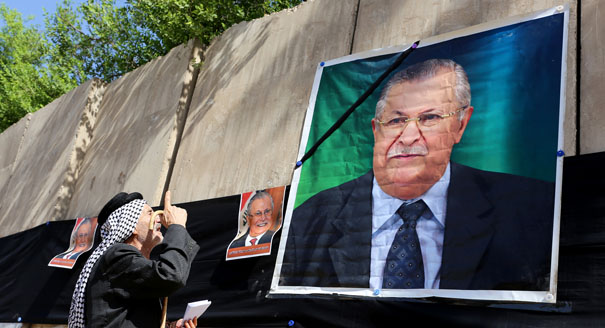
In an interview, Kurdish journalist Fazel Hawramy discusses the legacy of the late Jalal Talabani.
Fazel Hawramy is an independent journalist based in Iraqi Kurdistan. A graduate of the School of Oriental and African Studies at the University of London, he is a regular contributor to The Guardian, as well as Al-Monitor. Until 2014 he worked for the independent Kurdish newspaper Hawlati, in Suleimaniyya, Iraqi Kurdistan. Diwan caught up with Hawramy to get his views on the death this week of Jalal Talabani, the former leader of the Patriotic Union of Kurdistan.
Michael Young: What should we remember most about Jalal Talabani?
Fazel Hawramy: Talabani was a shrewd negotiator, a wily Peshmerga fighter, and a charismatic leader who was able to balance competing national, regional, and international interests in Iraq and further the Kurdish cause. Despite being at the vanguard of the Kurdish nationalist movement, he believed Kurds and Arabs should work together in Iraq. The tributes that poured in from across the Iraqi political spectrum after his death are evidence of his being a unifying force in a country plagued by divisions. Many in Iraq believe that had Talabani not fallen ill in December 2012, the rift between Kurdish political leaders and the central government in Baghdad would not have grown so wide, and that the dysfunction in the Kurdish political system would not have stagnated. Talabani had a keen sense of humor and was always ready to bend his principles in the interest of negotiations and to avoid war.
MY: His death came right after Kurdistan had voted in favor of independence. How might Talabani have reacted?
FK: “Peace, Democracy, Human Rights, and Self-Determination” reads the motto inscribed on the flag of the Patriotic Union of Kurdistan (PUK) party that Talabani founded in 1975. There is no doubt that he believed in the Kurds’ right to determine their own future. But Talabani was also a pragmatist and knew that Iran, Turkey, Syria, and the Iraqi central government could cut off and choke the Kurds if ever they decided to go for independence. Had Talabani been around, he might have pressed for a compromise with Baghdad instead of forging ahead with the referendum and risking a backlash from the Kurds’ neighbors and allies.
Like many of the members of his party today, Talabani would have agreed with the independence vote in principle but perhaps favored different timing. It may be that the conditions—both national and international—that ultimately drove the Kurds to call for a referendum this year would not have been present had Talabani been around to defuse tensions with the federal government, as he so often did.
MY: Who will replace Talabani in the part of Kurdistan that he dominated?
FK: Kurds of all political stripes agree that Talabani is irreplaceable. His party, the PUK, has fallen into disarray since Talabani was incapacitated by a stroke in 2012. Formed of several different factions in 1975, the PUK was held together by Talabani, who was the party’s glue. It is now divided into three wings. The first is led by Talabani’s wife Hero Ibrahim Ahmad, the most powerful figure within the group that controls most of the party finances and security forces. However this group also lacks popularity. A second faction is headed by legendary PUK commander Kosrat Rasul, and a third is led by a former prime minister of the Kurdistan Regional Government, Barham Salih, who recently broke away to form his own electoral coalition, further fragmenting the Kurdish political landscape.
Salih is probably the most popular Kurdish politician in Iraqi Kurdistan and his time in office, from 2009 to 2012, is remembered as an era of plenty by ordinary Kurds. Salih has good relations with Tehran, Ankara, Washington, and most importantly is on good terms with other political groups in Baghdad. He has criticized the political elite for corruption and mismanagement of the economy. If elections go ahead, Salih may be able to form an even larger coalition to challenge the main ruling parties.
On Tuesday night, as hundreds of people gathered at the main PUK office in Suleimaniyya after the news of Talabani’s death was announced, a number of angry mourners blasted the leadership for weakening the party after Talabani became ill. “Either you’ll unite or you’ll be disgraced by the people,” one woman screamed.
MY: Talabani was a man of many contradictions. How did he manage to reconcile them?
FK: When Talabani was asked by an American official about his close relations with Iran, he responded: “People can choose their friends but not their neighbors.” As a leader in a landlocked region, Talabani was forced to deal with neighboring states that had denied the existence of the Kurdish people, bombarded them with chemical weapons, and killed some of his closest companions. And yet he sat at the table with those who had committed genocide against Kurds and kissed them on their cheeks.
Talabani had to swallow his pride and sit with those responsible for the assassination of his close friend Abdul Rahman Qassemlou, the leader of the Kurdish movement in Iran, who was killed in Vienna in 1989 in a plot hatched by officials in Tehran. He must have reconciled himself with that position by believing that what he did was in the higher, long-term interests of the Kurds. In his memoir published earlier this year by one of his friends, Talabani lamented the mistakes he made, including his involvement in the Kurdish civil war that lasted intermittently for over three decades.

Editor, Diwan, Senior Editor, Malcolm H. Kerr Carnegie Middle East Center
Michael Young is the editor of Diwan and a senior editor at the Malcolm H. Kerr Carnegie Middle East Center.
Recent Work
Michael Young
Michael Young
Carnegie does not take institutional positions on public policy issues; the views represented herein are those of the author(s) and do not necessarily reflect the views of Carnegie, its staff, or its trustees.

As the U.S. stumbles in its war with Iran, we are likely to see an acceleration of its disengagement from the region.
Michael Young
The Zaidi government’s objective to collect weapons is constrained by regional conflict, but it can take certain measures at home.
Ali Al-Mawlawi

Huawei pushed hard to enter the Egyptian data centers market, until the Americans made a better offer.

Angie Omar

The accord represents a pivotal moment in the region to avert a security vacuum in the Gulf.


Azeema Cheema, Mohanad Hage Ali

In an interview, Jason Burke discusses his sweeping account of the “revolutionists” who so shaped the 1970s and early 1980s.
Michael Young