

Commentary
In an interview, Ian Lustick and Eli Clifton discuss their new book on why a prominent ally has so much influence in America.
Michael Young
{
  "authors": [
    "Ghida Tayara"
  ],
  "type": "commentary",
  "blog": "Diwan",
  "centerAffiliationAll": "dc",
  "centers": [
    "Carnegie Endowment for International Peace",
    "Malcolm H. Kerr Carnegie Middle East Center"
  ],
  "collections": [
    "Three Question Time"
  ],
  "englishNewsletterAll": "menaTransitions",
  "nonEnglishNewsletterAll": "",
  "primaryCenter": "Malcolm H. Kerr Carnegie Middle East Center",
  "programAffiliation": "MEP",
  "programs": [
    "Middle East"
  ],
  "projects": [],
  "regions": [
    "Iran",
    "North America",
    "United States",
    "Middle East"
  ],
  "topics": [
    "Political Reform"
  ]
}
Source: Getty
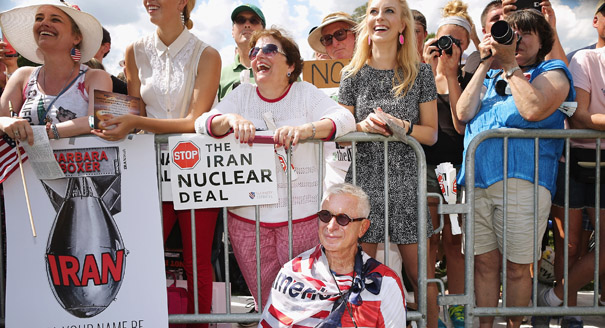
Carnegie’s Jarrett Blanc explains why the U.S. has no clear strategy toward Iran, and worries war may happen by accident.
Jarrett Blanc is a senior fellow in the Geoeconomics and Strategy Program at the Carnegie Endowment for International Peace. He was previously the deputy lead coordinator and State Department coordinator for Iran nuclear implementation at the U.S. State Department under president Barack Obama. In this role, he was responsible for the full and effective implementation of the Joint Comprehensive Plan of Action on Iran’s nuclear program, including Iranian and U.S. commitments on sanctions. Diwan interviewed Blanc in mid-December, when he was in Beirut for the annual conference organized by the Carnegie Middle East Center.
Ghida Tayara
Senior Digital and Web Coordinator
Carnegie does not take institutional positions on public policy issues; the views represented herein are those of the author(s) and do not necessarily reflect the views of Carnegie, its staff, or its trustees.

In an interview, Ian Lustick and Eli Clifton discuss their new book on why a prominent ally has so much influence in America.

Michael Young

As the U.S. stumbles in its war with Iran, we are likely to see an acceleration of its disengagement from the region.
Michael Young

Huawei pushed hard to enter the Egyptian data centers market, until the Americans made a better offer.

Angie Omar

Middle Eastern states should welcome an accelerated U.S. disengagement from their region.
Michael Young

In an interview, former ambassador Charles Freeman assesses the Trump administration’s war against Iran.
Michael Young