

Commentary
Michael Young
{
  "authors": [
    "Michael Young"
  ],
  "type": "commentary",
  "blog": "Diwan",
  "centerAffiliationAll": "",
  "centers": [
    "Carnegie Endowment for International Peace",
    "Malcolm H. Kerr Carnegie Middle East Center"
  ],
  "englishNewsletterAll": "",
  "nonEnglishNewsletterAll": "",
  "primaryCenter": "Malcolm H. Kerr Carnegie Middle East Center",
  "programAffiliation": "",
  "regions": [
    "Lebanon",
    "United States",
    "Israel",
    "Levant"
  ]
}
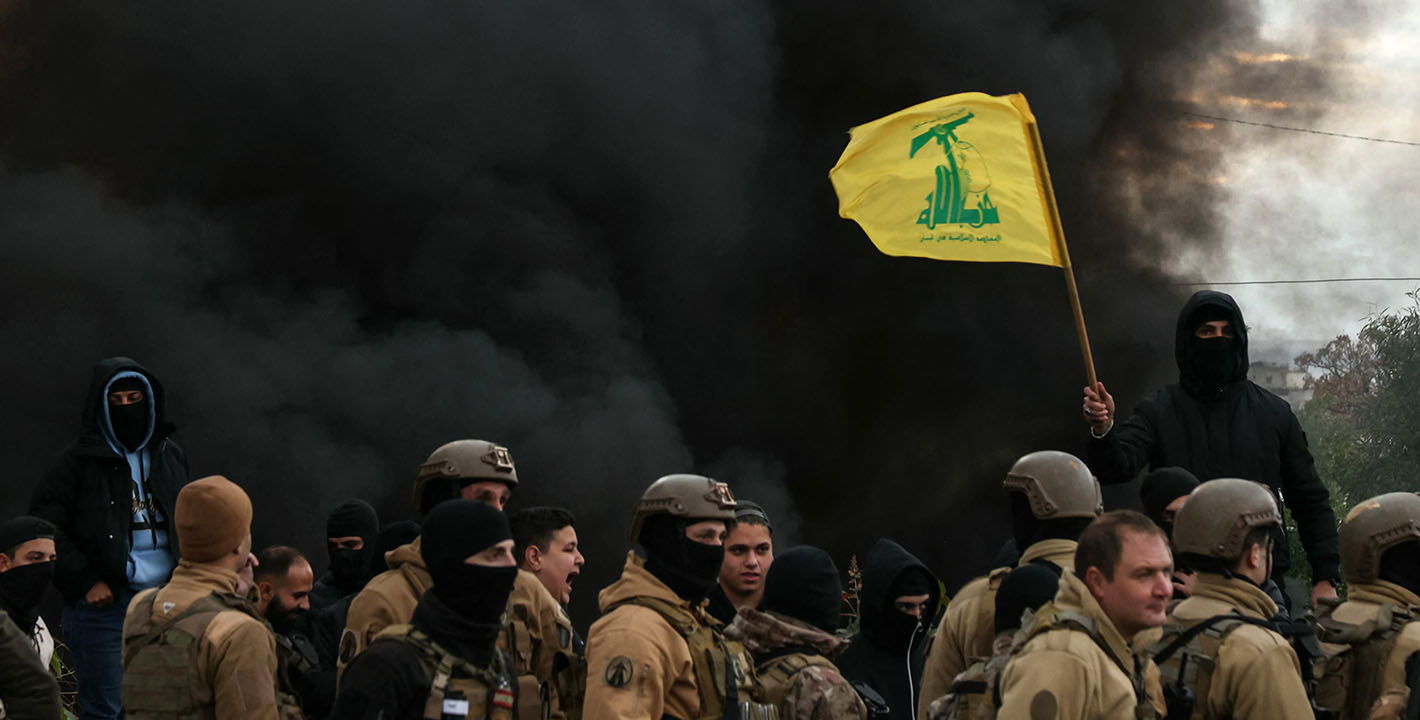
Source: Getty
The party’s domestic and regional roles have changed, so Lebanon should devise a disarmament strategy that encompasses this.
In an interview with Fox News in late April, U.S. Secretary of State Marco Rubio spoke about Hezbollah’s disarmament. He remarked, “[W]hat we’re working toward establishing, is a system that actually works where vetted units within the Lebanese armed forces have the training, the equipment, and the capability to go after elements of Hezbollah and dismantle them so Israel doesn’t have to do it.”
Rubio was mentioning a U.S. idea to train the army to potentially engage in military operations against a component of Lebanese society (because an attack on Hezbollah would surely lead the party to mobilize a substantial portion of the Shiite community). This means facilitating a process that could morph into civil conflict. However, Rubio’s remarks also raised a more fundamental question: What does disarming Hezbollah actually entail today?
When listening to certain people, particularly in Washington, the question of disarmament is deceptively simple. It’s all just a matter of will. With enough will, and U.S. training and intelligence, the Lebanese army could move into Hezbollah-controlled areas and take control of the party’s arms depots, enter homes to confiscate weapons, and interdict weapons supplies from Iran. When the army commander, Rudolph Haykal, mentions the risks of a campaign to disarm Hezbollah, realizing that this would place his institution on a collision course with the Shiite community as a whole, desk jockeys in Washington accuse him of going “rogue,” because he believes the military’s priority is “preventing civil war.”
The reality is more complicated. Does disarmament mean seizing all the party’s weapons—machine guns, rockets, rocket-propelled grenades, anti-tank missiles, and precision-guided missiles and drones? While there are those who would say yes, since the party should be left with no means to harm other Lebanese, no one believes such a scheme is remotely possible. Even Senator Lindsey Graham, who has absorbed Israel’s talking points subcutaneously, defined the priorities in December 2025, when he threatened the party if it “refuse[d] to give up their heavy weapons.” There was no mention of Hezbollah’s other categories of weapons.
In a meeting with Ali Larijani in Beirut in August 2025, Lebanon’s president, Joseph Aoun, also focused on heavy weapons when he suggested to the late Iranian official that Hezbollah surrender its missiles. The proposal was rejected, but it did show that even from the state’s perspective, the concern was not with all the party’s weapons, but only those of strategic importance that could be deployed against other countries, primarily Israel. This makes sense, since the Lebanese army has neither the intention nor the manpower to enter into private residences and confiscate small arms, rocket propelled grenades, and primitive drones, especially as most Lebanese parties have arsenals of light weapons of their own.
So, if there is a consensus that disarmament is primarily about heavy weapons, this leads to a second question: Given that such weapons were part of an Iranian forward defense strategy aimed at deterring Israel from attacking Iran, and given that this strategy has largely failed, do Hezbollah’s heavy weapons remain as vital in the party’s and Iran’s military thinking?
In other words, Hezbollah’s past efforts to take on the characteristics of a regular army by building a missile force and engaging in the strategic bombing of Israel are no longer as meaningful, since Israel can hit back many times harder. Nor does the party play an independent deterrence role anymore, as Iran is now firing its own missiles against Israel as a deterrent. Not surprisingly, during the March-April conflict, Hezbollah’s rocket fire was often coordinated with Iran, serving mainly to ensure that Iranian retaliation was more destructive.
In light of this, Hezbollah’s tasks appear to have changed. From being a major component in Iran’s regional defense network, one designed to act autonomously from Tehran and serve as a shock absorber for Israeli attacks, it appears to have been downsized to a support front, the costs of which are increasingly prohibitive for Lebanon’s Shiite community. At the same time, the party appears ready to revive the identity it had during the 1990s, when it was mainly a resistance force seeking to liberate Israeli-occupied Lebanese territory. Its weapons of choice at the time were small and medium weapons, roadside bombs, and occasionally suicide attacks. Today, Hezbollah has added drones as a key component of its arsenal.
Therefore, if the Lebanese state were to concentrate on taking Hezbollah’s heavy weapons, it is highly likely the party would still retain a panoply of arms allowing it to continue fulfilling its refashioned function in Iran’s strategy. Rubio can train Lebanese soldiers to his heart’s content, but his plan, which involves penetrating all dimensions of Shiite life to uncover even light weapons, would go nowhere. Nor would an army alert to preserving civil peace ever agree to an unimplementable plan that requires it to aggressively target one specific community.
This raises a third question, namely what broader purpose is Hezbollah supposed to serve today for Iran? If its military role has been redefined into that of a support front and a resistance force on the ground, what of Hezbollah’s previous political domination of Lebanon, which its weapons allowed after the Syrian withdrawal in 2005? Between January 2011, when Saad al-Hariri was ousted as prime minister, and November 2024, when Hezbollah was devastated in its war with Israel, the party helped Iran maintain a grip over Lebanon. This led an Iranian parliamentarian, Ali Reza Zakani, to famously declare in September 2014 that Tehran controlled four Arab capitals—Beirut, Damascus, Baghdad, and Sanaa.
Those days are gone, and not just because of Israel’s attacks. While some believe Hezbollah will benefit from Iranian success in its conflict with the United States and Israel, Lebanese realities complicate such an assumption considerably. Hezbollah and its Shiite community are isolated and devastated today, and Lebanon’s political forces will no longer accept the party’s coercion, even if it means resorting to arms. The Sunni community, backed by the regime in Syria, feels strong enough to resist such an outcome. Christians, meanwhile, never fully embraced Hezbollah, and after the Beirut Port explosion of August 2020 and the Tayyouneh incident of October 2021, the community turned decisively against the party. As for the Druze, their leader Walid Joumblatt is being conciliatory with Hezbollah, but that’s to avert Sunni-Shiite tensions in his areas of influence, even as his community remains deeply hostile to the party.
With respect to the Lebanese army, while Haykal has been sensible enough to push back against implementing a military option when it comes to Hezbollah, his institution has also made it clear that it will intervene forcefully to prevent civil conflict. In other words, Hezbollah will probably face the army as well if it turns its weapons on other Lebanese political forces. The army did this with great decisiveness during the Tayyouneh incident. A key step will be for the state to make it clear to Iran that, whatever its accomplishments in the war with the United States and Israel, it will not find it easy to cash in on these in Lebanon.
This transformation in Hezbollah’s status imposes an approach that steers clear of a reckless resort to military force to disarm the party. Instead, the state must reevaluate Hezbollah’s strengths and weaknesses and devise a plan, involving pressure and dialogue, that avoids a head-on collision with the party, which the state will lose—as it has lost all other armed conflicts with sectarian militias. If Hezbollah has become a support front for Iran, then it’s possible for the army to deploy in the south to prevent such coordination, while asserting its legal right to prevent the party from mounting cross-border attacks. If Hezbollah is incapable of dominating the political sphere, this gives the state latitude to fashion new political realities the party cannot oppose. These may include actions such as implementing security plans for parts of the country where Hezbollah operates, closing illegal Hezbollah institutions, and interdicting arms transfers to and by the party. It must also include developing better intelligence capabilities regarding Hezbollah’s activities.
The Lebanese state has the means to expand its authority over its national territory, and over all decisions affecting Lebanon. This is a sovereign right and duty, and unless the state asserts itself, Lebanon’s future as a unified entity could well be imperiled. However, the president and government must also resist any measures by the United States and Israel to railroad the armed forces into a misguided military conflict with Hezbollah and the Shiite community. The purpose of the party’s disarmament, in the end, is to better integrate Shiites into the state, not alienate them by declaring war on their leading communal representative.
Hezbollah’s role is undergoing change by virtue of the shifting circumstances it is facing at home. Exactly what comes out of this is difficult to predict, particularly as the regional context is also undergoing major transformations, with the emergence of a coalition of Sunni states opposed to Israel. Officials in Lebanon have to be well-versed in the regional dimension of the Lebanese problem before taking rash decisions. But one thing they should not do is concede to the United States and Israel the latitude to have a final say on matters affecting Lebanon’s stability.
The U.S. and Israeli record in recent years has been one of war and destruction, sustained by hubris. Lebanon doesn’t need more of that.

Editor, Diwan, Senior Editor, Malcolm H. Kerr Carnegie Middle East Center
Michael Young is the editor of Diwan and a senior editor at the Malcolm H. Kerr Carnegie Middle East Center.
Recent Work
Michael Young
Michael Young
Carnegie does not take institutional positions on public policy issues; the views represented herein are those of the author(s) and do not necessarily reflect the views of Carnegie, its staff, or its trustees.
Reconciliation councils are emerging throughout the country to mediate in intracommunal disputes, many from the war years.
Natacha Danon
In an interview, Rozina Ali discusses her new book on the rise and manifestations of Islamophobia in the United States.
Michael Young
As the U.S.-led Coalition withdraws, the Kurds’ reliance on Baghdad, and on themselves, will only increase.
Wladimir van Wilgenburg

In an interview, Ian Lustick and Eli Clifton discuss their new book on why a prominent ally has so much influence in America.
Michael Young

As the U.S. stumbles in its war with Iran, we are likely to see an acceleration of its disengagement from the region.
Michael Young