

Commentary
Azeema Cheema, Mohanad Hage Ali
{
  "authors": [
    "Mohanad Hage Ali"
  ],
  "type": "commentary",
  "blog": "Diwan",
  "centerAffiliationAll": "dc",
  "centers": [
    "Carnegie Endowment for International Peace",
    "Malcolm H. Kerr Carnegie Middle East Center"
  ],
  "collections": [
    "Three Question Time"
  ],
  "englishNewsletterAll": "menaTransitions",
  "nonEnglishNewsletterAll": "",
  "primaryCenter": "Malcolm H. Kerr Carnegie Middle East Center",
  "programAffiliation": "MEP",
  "programs": [
    "Middle East"
  ],
  "projects": [],
  "regions": [
    "Yemen",
    "Middle East",
    "Gulf"
  ],
  "topics": [
    "Political Reform"
  ]
}
Source: Getty
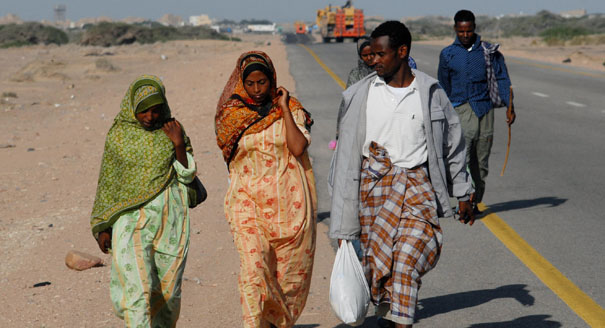
Khalif Abdirahman discusses the ties between Yemen and Somalia, at a time of crisis in the two countries.
Khalif Abdirahman is a Somali researcher with five years of experience in the Horn of Africa. He has participated in numerous studies on issues related to the region, at Tufts University, Humanitarian Outcomes, Transparency International, the Overseas Development Institute, and the Rift Valley Institute. He also has more than ten years of experience in community work and issues relating to the Somali diaspora and their involvement in political and other issues at home.
Currently Abdirahman is working in London with the Rift Valley Institute and the London School Economics. Diwan met with him in early August, at a conference in Beirut organized by Carnegie, to get his perspective on a little-discussed topic, namely the ties between Yemen and Somalia, particularly at a time of crisis in both countries.

Deputy Director for Research, Malcolm H. Kerr Carnegie Middle East Center
Mohanad Hage Ali is the deputy director for research at the Malcolm H. Kerr Carnegie Middle East Center.
Recent Work

Azeema Cheema, Mohanad Hage Ali
Mohanad Hage Ali
Carnegie does not take institutional positions on public policy issues; the views represented herein are those of the author(s) and do not necessarily reflect the views of Carnegie, its staff, or its trustees.

As the U.S. stumbles in its war with Iran, we are likely to see an acceleration of its disengagement from the region.

Michael Young

Huawei pushed hard to enter the Egyptian data centers market, until the Americans made a better offer.

Angie Omar

Middle Eastern states should welcome an accelerated U.S. disengagement from their region.
Michael Young

The accord represents a pivotal moment in the region to avert a security vacuum in the Gulf.
Azeema Cheema, Mohanad Hage Ali

In an interview, Jason Burke discusses his sweeping account of the “revolutionists” who so shaped the 1970s and early 1980s.
Michael Young