

Commentary
There is a disturbing structural parallel between the old global energy economy and the new green transition.
Angie Omar
{
  "authors": [
    "Sherif Mohyeldeen"
  ],
  "type": "commentary",
  "blog": "Diwan",
  "centerAffiliationAll": "dc",
  "centers": [
    "Carnegie Endowment for International Peace",
    "Malcolm H. Kerr Carnegie Middle East Center"
  ],
  "collections": [],
  "englishNewsletterAll": "menaTransitions",
  "nonEnglishNewsletterAll": "",
  "primaryCenter": "Malcolm H. Kerr Carnegie Middle East Center",
  "programAffiliation": "MEP",
  "programs": [
    "Middle East"
  ],
  "projects": [],
  "regions": [
    "Egypt",
    "North Africa"
  ],
  "topics": []
}
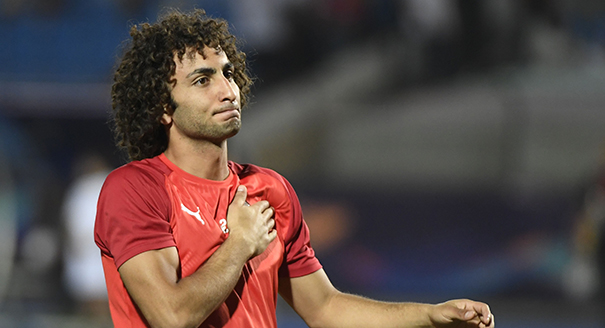
Source: Getty
Sexual harassment charges against football player ‘Amr Warda caused a revealing rift among Egyptians.
The early exit of the Egyptian national team from the African Cup of Nations tournament in Egypt was considered a double loss by many people in the country. It was a sporting loss, given Egypt’s elimination by South Africa on July 6. But it was also a loss in terms of morals, because of the furor surrounding accusations that Egyptian footballer ‘Amr Warda had sexually harassed several women.
While the events together doubtless provoked malaise in Egypt, they did have encouraging consequences with regard to how the country dealt with the sexual harassment charges. The treatment of females has been at the heart of the debate over morals in Egypt since before the uprising in 2011, and this hasn’t changed since. Yet what has changed is how the subject is being discussed in public and the increasing understanding that women have been mistreated and denied their rights in what is a largely patriarchal society.
For years nationalism and moral pride had been connected in the public sphere. Yet the accusations against Warda divided them. Nationalists asked that Warda be forgiven for his actions. This followed his initial denials of harassment and accusations directed at one of the women denouncing him, followed by confusion when another woman, a Mexican model, leaked a video the player had allegedly sent her in which he filmed himself engaging in a lewd act.
This set off a social media storm, with one side highly critical of Warda and the other affirming that there was a need to redefine sexual harassment. In late June the Egyptian Football Federation (EFF) decided to take a stand and dismiss Warda from the national team. However, when a number of his teammates, including the star Egyptian and Liverpool player Mohammed Salah, expressed solidarity with Warda, the EFF backtracked and reinstated him, so that ultimately he was banned from only two games.
Yet that wasn’t the end of the story. Many Egyptians continued to criticize the player and his teammates. They denounced the team as a team of sexual harassers and turned this designation into a Twitter hashtag that went viral. The most surprising thing is that the beloved Salah found himself facing withering criticism for having sided with Warda. At a time when it is common to lionize sports stars and ignore their personal faults, many Egyptians decided, quite remarkably, to break with this habit.
More suprising still, there were Egyptians who cheered the national team’s defeat and its early exit from the African Cup. In trying to understand the factors behind the celebrations over the Egyptian team’s loss, it is important to point to an apparent political dimension to what happened. The calls for Warda to be forgiven were advanced mainly by those perceived as being close to the regime, for whom the success of the national team was regarded as a substitute for the achievements of the regime itself.
This transformation of the Egyptian team into a regime asset provoked an angry reaction from Warda’s critics, who viewed the appeals for leniency toward the player as calls for impunity. This was too close to the regime’s usual methods—where it forgives those agreeing with it, while punishing the rest—to be palatable to those who believed that Warda did not deserve to get off lightly.
Indeed, during Egypt’s matches supporters shouted the name of the retired player Mohammed Aboutrika during the 22nd minute of games—22 having been his team number. Aboutrika has been living in exile in Qatar for the past three years, accused by the regime of being a member of the Muslim Brotherhood. He is still admired by supporters for having helped Egypt win the African Cup in 2006 and 2008. Yet no one ever asked for forgiveness in his case. Aboutrika was one of those who opposed Warda’s return to the national team.
The Egyptian regime had regarded the African Cup as a celebration of itself. It turned out to be everything but that. The denunciations of the national team, like the satisfaction with the team’s defeat, suggested that for many Egyptians an ethically defensible position was more important than a victory that would have satisfied Egypt’s nationalist impulses while playing into the regime’s hands.
Sherif Mohyeldeen
Sherif Mohyeldeen is a nonresident fellow at the Carnegie Middle East Center in Beirut.
Carnegie does not take institutional positions on public policy issues; the views represented herein are those of the author(s) and do not necessarily reflect the views of Carnegie, its staff, or its trustees.
There is a disturbing structural parallel between the old global energy economy and the new green transition.

Angie Omar

This will be the region’s most representative tournament, amid broad changes in its footballing landscape.

Issam Kayssi
Cairo’s efforts send a message to the United States and the region that it still has a place at the diplomatic table.
Angie Omar
The recent African Cup of Nations tournament in Morocco touched on issues that largely transcended the sport.

Issam Kayssi, Yasmine Zarhloule
Mustaqbal Misr has expanded its portfolio with remarkable speed, but a lack of transparency remains.

Yezid Sayigh