

Commentary
Michael Young
{
  "authors": [
    "Michael Young"
  ],
  "type": "commentary",
  "blog": "Diwan",
  "centerAffiliationAll": "dc",
  "centers": [
    "Carnegie Endowment for International Peace",
    "Malcolm H. Kerr Carnegie Middle East Center"
  ],
  "collections": [],
  "englishNewsletterAll": "menaTransitions",
  "nonEnglishNewsletterAll": "",
  "primaryCenter": "Malcolm H. Kerr Carnegie Middle East Center",
  "programAffiliation": "MEP",
  "programs": [
    "Middle East"
  ],
  "projects": [
    "Tunisia Monitor"
  ],
  "regions": [
    "Maghreb",
    "North Africa",
    "Tunisia"
  ],
  "topics": [
    "Political Reform"
  ]
}
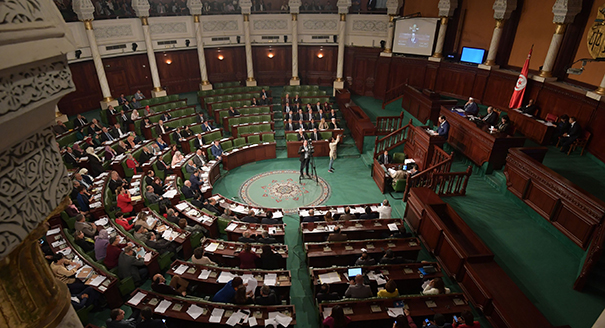
Source: Getty
Tunisia’s upcoming parliamentary elections may lead to a more fractured legislature.
Sarah Yerkes is a fellow in Carnegie’s Middle East Program, where her research focuses on Tunisia’s political, economic, and security developments as well as state-society relations in the Middle East and North Africa. Yerkes is a former member of the State Department’s policy planning staff, where she focused on North Africa. She recently traveled to Tunisia to act as a monitor in the first round of the presidential election. Diwan interviewed her in late September to get her perspective on what happened, and to set up the legislative elections scheduled for October 6.
Michael Young: You were in Tunisia to observe the recent presidential election. What was your main takeaway from the first round of that election, as we await the second round?
Sarah Yerkes: This election was all about rejection of the current political class, which is something we are seeing play out globally, not just in Tunisia. Despite several candidates with significant political and executive experience, such as ‘Abdel-Karim Zbidi, Abdel-Fattah Mourou, Youssef Chahed, and Moncef Marzouqi, the two who advanced to the runoff represent a rejection of the status quo—albeit in very different ways. Qaïs Sa‘id, who came in first with 18 percent of the votes, is a law and order candidate, who many, particularly young Tunisians, believe can push back against the incessant corruption that has plagued the country since the Bin Ali era. Nabil Qaroui, who came in second with 16 percent, is a philanthropist and television magnate, currently in jail on corruption charges, who has promised to bring economic development to the country and is seen as a hero by many in the poorer regions of Tunisia.
The rejectionist attitude was also clear from voter turnout. Despite a successful effort by the elections authorities to increase voter registration, turnout was quite low with only 39 percent of eligible voters showing up. While we have not seen official numbers on youth turnout, in the regions where I observed the election, namely Gafsa and Kasserine, youth turnout was extremely low with many young people either intentionally boycotting the elections or feeling that as they had no good and clear choice among the 26 candidates, it was preferable to stay home.
MY: Legislative elections are to take place on October 6. What is the main thing you will be watching for?
SY: The main thing I will be watching is how well independents fare. Consistent with the rejection of the political status quo, there has been a shift away from traditional political parties toward independent candidates who are not affiliated with any political party. During the 2018 municipal elections, independent candidates performed better than either of the two main political parties, Ennahda and Nida’ Tounes. And this time, I expect we will see a similar strong showing of independents, particularly given that Qaïs Sa‘id himself is an independent. If that is true, it will be very interesting to watch how the next government is formed, with potentially quite a few free agents available for the government-formation process. The prime minister, who plays a very important role in serving as head of government and overseeing the cabinet and most domestic affairs, is chosen by the party or coalition that receives the largest number of votes. Tunisia could find itself in a situation where no party wins more than a small percentage of the overall vote, leading to a very fractured legislature.
MY: How would you gauge Ennahda’s strength? Their candidate was eliminated in the first round of the presidential election.
SY: Ennahda is quite strong, particularly in the interior of Tunisia. I expect the party to do very well during the legislative elections, as they are by far the best-organized political party in the country with the biggest reach throughout the Tunisia. While Mourou did not advance to the presidential runoff, I do not think we should read too much into his defeat. He came in third, with 13 percent of the vote, only three percentage points behind Qaroui, so he still performed very well. Additionally, Ennahda put forth Mourou’s candidacy at the last minute and it was clear in discussions with Tunisians that the party was not overly enthusiastic about his candidature. Finally, the Ennahda vote was split—most clearly between Mourou and Hamadi Jebali, another candidate, who served as Ennahda’s secretary general for more than 30 years.
MY: What did you find was the main concern of Tunisians when you were there? And has this been seriously addressed by the candidates for presidential and legislative elections?
SY: The main concern of most Tunisians is the lack of adequate economic development. During the presidential debates a few of the candidates mentioned the economy, and Qaroui’s campaign has made clear that this would be his priority if elected. However, taking steps to enact economic reform and bring real positive change to the lives of Tunisians is not really within the purview of the executive, as the president serves as head of state, covering national security and foreign affairs. It will be up to the next prime minister and legislature to find a way forward to alleviate the economic burden on Tunisians.

Editor, Diwan, Senior Editor, Malcolm H. Kerr Carnegie Middle East Center
Michael Young is the editor of Diwan and a senior editor at the Malcolm H. Kerr Carnegie Middle East Center.
Recent Work
Michael Young
Michael Young
Carnegie does not take institutional positions on public policy issues; the views represented herein are those of the author(s) and do not necessarily reflect the views of Carnegie, its staff, or its trustees.
This will be the region’s most representative tournament, amid broad changes in its footballing landscape.

Issam Kayssi
The recent African Cup of Nations tournament in Morocco touched on issues that largely transcended the sport.

Issam Kayssi, Yasmine Zarhloule
Mustaqbal Misr has expanded its portfolio with remarkable speed, but a lack of transparency remains.

Yezid Sayigh
The burden of environmental degradation is felt not only through physical labor but also emotional and social loss.
Yasmine Zarhloule, Ella Williams
The country’s youthful protest movement is seeking economic improvement, social justice, and just a little hope.
Yasmine Zarhloule