

Commentary
Michael Young
{
  "authors": [
    "Michael Young"
  ],
  "type": "commentary",
  "blog": "Diwan",
  "centerAffiliationAll": "dc",
  "centers": [
    "Carnegie Endowment for International Peace",
    "Malcolm H. Kerr Carnegie Middle East Center"
  ],
  "collections": [
    "Coronavirus"
  ],
  "englishNewsletterAll": "menaTransitions",
  "nonEnglishNewsletterAll": "",
  "primaryCenter": "Malcolm H. Kerr Carnegie Middle East Center",
  "programAffiliation": "MEP",
  "programs": [
    "Middle East"
  ],
  "projects": [
    "X-Border Local Research Network"
  ],
  "regions": [
    "Gulf",
    "Yemen",
    "Middle East"
  ],
  "topics": [
    "Political Reform"
  ]
}
Source: Getty
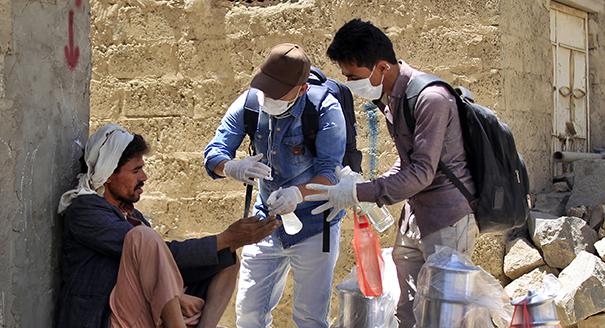
In an interview, Ahmed Nagi discusses the dangers of the coronavirus in a country already facing a terrible conflict.
Ahmed Nagi is a nonresident scholar at the Carnegie Middle East Center, where his research focuses on Yemen. He has been closely following the development of the new coronavirus pandemic in the country, and recently published an article on the topic at the website of the Carnegie Endowment for International Peace. It is to discuss the issue further that Diwan interviewed Nagi in mid-April to get his perspective on what may happen in an impoverished Yemen that has been caught in a devastating war since 2015, and that suffers from a healthcare system in deep crisis.
Michael Young: How have the parties to the Yemen conflict reacted to the spread of the novel coronavirus?
Ahmed Nagi: Despite the fact that they announced that they would take precautions, the warring parties have displayed indifference toward civilians even with regard to their health measures. For instance, in areas controlled by the internationally recognized government, Aden airport and Seiyoun airport in Hadhramawt remained open until March 17, though most of the travelers there either came from or passed through Egypt, which was one of the areas most affected during the early days of the pandemic. The government then announced the closure of ports, following measures taken by Saudi Arabia.
In the northern areas, the Houthis began establishing centers to quarantine people arriving from government-controlled areas. However, these centers are anything but quarantine centers. They contain hundreds of people placed together in small buildings with almost no social distancing rules in place. At the beginning of April, the Houthis closed all internal borders, claiming that the government was not applying the proper preventive measures in the areas under its control. Moreover, the local authorities are trying to ban gatherings, including wedding celebrations, qat markets, group prayers, Friday sermons, and other religious gatherings, despite a lack of commitment by inhabitants.
It is remarkable how measures to contain the coronavirus reveal conflicting plans for fighting the pandemic. We have seen measures independently implemented by the local authorities in governorates controlled by the government. For instance, in Hadhramawt, where the only coronavirus case in the country has been reported, the local authorities announced a partial lockdown even before the case was made public. After that, the southern governorates of Mahra and Shabwa announced the closure of roads with Hadhramawt.
The fact that only one case so far has been made public does not mean that Hadhramawt is the only area affected by the pandemic. What it means is that the authorities in the governorate are, in relative terms, the most transparent. Other areas in Yemen have concealed the spread of the virus to show that they are more adept at implementing containment measures. Moreover, the lack of testing and medical capacities make it difficult to confirm cases of coronavirus, especially when other diseases are present in Yemen, such as cholera, dengue fever, and H1N1, with symptoms similar to the coronavirus. According to interviews with some doctors, the mortality rate has been higher than average in recent weeks, and most of the deaths have been recorded as being caused by the diseases I mentioned.
In terms of the conflict, while Yemenis were expecting the warring parties to halt their hostilities in order to face the coronavirus, the fighting has continued, even escalating in some areas despite announced ceasefires. That is the case of the current confrontations between the Houthis and the government in Marib, Baida and Jawf Governorates, as well as the military tensions between the United Arab Emirates-backed Southern Transitional Council (STC) and Saudi-backed government forces in Abyan and Socotra. It seems that some parties are trying to take advantage of the situation to advance their agendas. What we learned from the cholera outbreak is that the parties to the conflict pay no attention to the concerns of civilians. They only pursue their own military interests.
MY: Is Yemen’s public health infrastructure capable of addressing the spread of the coronavirus?
AN: Before the war Yemen’s health sector was already suffering from a lack of capacity, especially in rural areas where people have no access to basic healthcare. Today, after more than five years of conflict, the public health system is nearly ruined. Even the private healthcare sector has been affected by the situation. Most private hospitals suffer from a lack of health personnel and medical equipment, as well as limited capacity. In addition, most Yemenis live below the poverty line and therefore cannot afford private healthcare services.
In the last two months the World Health Organization (WHO) has equipped a few centers in Aden, San‘a, and Hadhramawt to receive coronavirus cases if they are confirmed. But confirmation requires testing, which is not available in many areas of the country. Beside being unable to receive a large number of cases, the WHO-equipped centers conduct no regular tests for people suspected of having the disease so that we can have a sense of the number of cases. The situation is made worse by a sense of shame among Yemenis. Even if some people have coronavirus symptoms, they do not report them, thinking it could trigger panic.
Consequently, Yemenis are facing the pandemic with a devastated health system, little international assistance, and a lack of awareness in society. All this will mean the pandemic could have serious implications for the war-torn country.
MY: Is there any sense of how widespread the coronavirus epidemic is in Yemen? And what would you say are its main sources?
AN: The Yemeni government has reported only one case so far, but this might not be accurate given the large number of newcomers from affected areas who have entered the country without testing. Furthermore, the number is expected to rise dramatically given the inability of people to follow social distancing measures because of the very difficult economic conditions in the country.
I was talking to one of the locals, and he said, “It is impossible to stay at home, as that will make me unable to feed my family. Even if I catch the coronavirus, there is only a 5 percent possibility of death, while staying at home without work means a 100 percent possibility of death.” When people have only two options—the coronavirus or starvation—of course they will choose the least harmful one.
Another source of the disease that has been hard to control is the flow of migrants into Yemen’s coastal areas. According to Yemen’s Health Ministry, a large number of migrants continue to enter Yemen despite the closure of the country’s borders. The ministry warns that this could spread the coronavirus into many areas.
MY: You recently wrote an article on internal borders in the Yemen conflict. Has the coronavirus affected such borders, and if so how?
AN: The coronavirus has pushed the warring parties to tighten their control over internal borders, leaving each region closed off and isolated. The Houthis, for instance, have threatened to punish anyone who smuggles people into areas under their authority. Participants in the conflict have used the pandemic as an excuse for tighter security control. Yet unlike the time before the virus, many people today are not opposing such restrictions. They view them as justified. But since there is no national action plan to contain the pandemic, it is anticipated that the internal borders may be imposed for a period far outlasting the pandemic itself.
MY: Has aid been provided to Yemen for the coronavirus outbreak? If so, what kind of aid and how have the warring parties used this aid?
AN: Assistance has been provided by certain international nongovernmental organizations in the past two months. In addition, the World Bank announced it would allocate just under $27 million for fighting the pandemic. Nevertheless, this is not enough to curb the disease and address its consequences, especially at a time when most donors are fighting the coronavirus at home. This could be the difference between the cholera outbreak, which afflicted Yemen after April 2017, and the coronavirus, despite the fact that the mortality rate of the latter is higher.
Most of the warring parties have asked for more aid from international nongovernmental organizations. Yet this aid has been used politically in certain parts of the country. For example, the STC has withheld essential coronavirus-related equipment that WHO sent to Yemen in Aden. It has done so to ensure that government medical staff would not have access to it.
MY: Do you anticipate any long-term impact of the disease on Yemen’s international borders, and on border relations?
AN: The land crossings with Saudi Arabia and Oman were largely closed last month, with only a limited number of trucks carrying agricultural products allowed to pass. The closure is expected to last after the pandemic ends, as the Saudis and Omanis fear that the possibility of transmission may remain given the poor state of Yemen’s healthcare system. This would be added to measures on the Saudi side to continue to use the military to prevent smuggling and human trafficking from Yemen. More than 1.5 million Yemenis live in the kingdom and their movement would be significantly affected.


Editor, Diwan, Senior Editor, Malcolm H. Kerr Carnegie Middle East Center
Michael Young is the editor of Diwan and a senior editor at the Malcolm H. Kerr Carnegie Middle East Center.
Recent Work
Michael Young
Michael Young
Carnegie does not take institutional positions on public policy issues; the views represented herein are those of the author(s) and do not necessarily reflect the views of Carnegie, its staff, or its trustees.

As the U.S. stumbles in its war with Iran, we are likely to see an acceleration of its disengagement from the region.
Michael Young

Middle Eastern states should welcome an accelerated U.S. disengagement from their region.
Michael Young

The accord represents a pivotal moment in the region to avert a security vacuum in the Gulf.


Azeema Cheema, Mohanad Hage Ali

In an interview, Jason Burke discusses his sweeping account of the “revolutionists” who so shaped the 1970s and early 1980s.
Michael Young
In an interview, Marc Lynch discusses his new book decrying the post-1990 U.S.-dominated order in the Middle East.
Michael Young