

Paper
Yezid Sayigh
{
  "authors": [
    "Yezid Sayigh"
  ],
  "type": "commentary",
  "blog": "Diwan",
  "centerAffiliationAll": "dc",
  "centers": [
    "Carnegie Endowment for International Peace",
    "Malcolm H. Kerr Carnegie Middle East Center"
  ],
  "collections": [
    "Civil-Military Relations in Arab States"
  ],
  "englishNewsletterAll": "menaTransitions",
  "nonEnglishNewsletterAll": "",
  "primaryCenter": "Malcolm H. Kerr Carnegie Middle East Center",
  "programAffiliation": "MEP",
  "programs": [
    "Middle East"
  ],
  "projects": [],
  "regions": [
    "Middle East",
    "North Africa",
    "Egypt"
  ],
  "topics": [
    "Economy"
  ]
}
Source: Getty
Armed forces throughout the Middle East prove that military affairs are too important to be left to the officers alone.
Collectively, the states of the Arab world are experiencing some of the highest levels of armed conflict, humanitarian crisis, and military spending in the world.
Since 2015, more than half of all Arab states have waged war, have experienced military interventions in politics or economies, or risk relapsing into armed conflict. Nearly 40 percent of all refugees worldwide are in Arab countries. Relations between Arab states are increasingly taking the form of projecting military power. At home, the militarization of political life fuels authoritarianism and abuses of citizens’ rights. It has also created a dependence on military employment to advance social welfare, thereby increasing the risks of defense sector corruption.
Despite massive investment in military buildups, many Arab states struggle to provide their societies with peace and security. National armed forces have broken down in several countries, posing additional challenges of reconstruction and reintegration. Numerous nonstate and state-sponsored armed actors have also emerged, threatening social cohesion, generating predatory economic behavior, and weakening state control further. Military intervention in politics is increasing across the Arab world—as is direct foreign military intervention in Arab countries.
Last but not least, the coronavirus pandemic poses a new threat to the future stability of existing civil-military relationships. Economic and financial challenges that have been deepening in all Arab states over the past 20 years will intensify in the coming years. Governments will face difficult choices on social spending and capital investment in their economies versus maintaining high levels of military spending.
One source of such challenges is that, in most Arab states, decisions to invest in military buildups or go to war are taken by single leaders or a handful of decisionmakers, without public debate or accountability. These leaders are often civilians themselves. However, the lack of verifiable information and professional understanding of defense issues among government agencies, parliaments, and civilian experts outside government is unparalleled, compared to almost anywhere else in the world. This undermines the efficacy and efficiency of defense policymaking, and also deprives national armed forces of the key resources and expertise that they need in all operational and systemic domains.
Civilian expertise in a wide range of competences is vital for the effectiveness of modern armed forces. These range from conventional issues such as strategic planning and long-term budgeting, to the emerging technological, organizational, and doctrinal challenges of automated, robotic warfare and cybersecurity. Data-based decisionmaking and integrated information-sharing systems are a key to addressing these issues, and no defense sector worldwide achieves these skills without the role of many, diverse civilian actors.
In all countries that have advanced militaries—whether in the West, Russia, or China—defense sectors employ thousands of civilian professionals in the previously mentioned spheres, as well as interacting with capable civilians outside government. The absence of such engagement in Arab states means that for many of them, their armed forces have repeatedly underperformed in battle and failed to provide cost-effective national defense.
Arab defense sectors have rarely utilized the massive volumes of foreign military assistance they receive effectively. This is partly a result of the lack of meaningful accountability for performance. But it is also because most defense sectors do not use key civilian competences that would help them learn lessons and absorb assistance, and because they oppose public debate of defense policy.
Reinforcing the civilian role in Arab defense affairs is a promising means to building healthy, balanced civil-military relations. Eventually, this will help build the open security architecture that will contribute to a more prosperous, safer future for Arab societies. In Arab countries where civilians have seen their role increase, initial signs point to improved accountability and defense performance.
Three vectors of civilian involvement constitute the key to civil-military balance in Arab countries. First, civilians can become more involved through a public dialogue on defense. This allows military restructuring and reform plans to be anchored and ratified in public debate. Not only does this provide opportunities for innovation and creativity, it also helps societies avoid reproducing the same problems. For example, in Lebanon, where the armed forces have some engagement with civilian defense experts, novel solutions are arising through civil-military interaction.
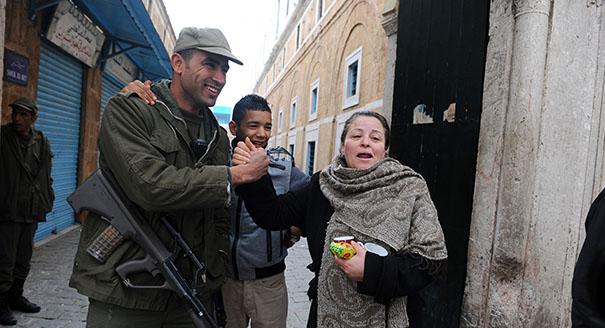
Second, civilian involvement builds civil-military partnership. Mutually beneficial civil-military relations require civilian expertise and institutional involvement in defense affairs—among civil society and research organizations, parliaments, civil services, and defense ministries. Tunisian leaders are finding this to be the case, and civilian and military leaders are working together to create solutions to complex security challenges.
Third, civilian involvement improves defense policy planning. Political opportunity and will are critical, but it helps if they can build on existing policy planning and reform strategies. In the United Arab Emirates, for example, a new defense college educates civilian and military leaders alongside each other to develop a common language of strategic planning and national security decisionmaking. This cadre of strategic thinkers builds on the country’s political will to sharpen defense policy planning.
Efforts to promote civilian involvement in Arab defense affairs, among them Carnegie’s Program on Civil-Military Relations in Arab States, help to create an environment that reduces levels of armed conflict, humanitarian crisis, and military spending, in that way contributing to a more stable and prosperous future.

Senior Fellow, Malcolm H. Kerr Carnegie Middle East Center
Yezid Sayigh is a senior fellow at the Malcolm H. Kerr Carnegie Middle East Center in Beirut, where he leads the program on Civil-Military Relations in Arab States (CMRAS). His work focuses on the comparative political and economic roles of Arab armed forces, the impact of war on states and societies, the politics of postconflict reconstruction and security sector transformation in Arab transitions, and authoritarian resurgence.
Recent Work
Yezid Sayigh
Yezid Sayigh
Carnegie does not take institutional positions on public policy issues; the views represented herein are those of the author(s) and do not necessarily reflect the views of Carnegie, its staff, or its trustees.

The accord represents a pivotal moment in the region to avert a security vacuum in the Gulf.


Azeema Cheema, Mohanad Hage Ali

In an interview, Jason Burke discusses his sweeping account of the “revolutionists” who so shaped the 1970s and early 1980s.

Michael Young
There is a disturbing structural parallel between the old global energy economy and the new green transition.

Angie Omar
This will be the region’s most representative tournament, amid broad changes in its footballing landscape.
Issam Kayssi
Cairo’s efforts send a message to the United States and the region that it still has a place at the diplomatic table.
Angie Omar