

Commentary
Nathan J. Brown
{
  "authors": [
    "Nathan J. Brown"
  ],
  "type": "commentary",
  "blog": "Diwan",
  "centerAffiliationAll": "dc",
  "centers": [
    "Carnegie Endowment for International Peace",
    "Malcolm H. Kerr Carnegie Middle East Center"
  ],
  "collections": [],
  "englishNewsletterAll": "menaTransitions",
  "nonEnglishNewsletterAll": "",
  "primaryCenter": "Malcolm H. Kerr Carnegie Middle East Center",
  "programAffiliation": "MEP",
  "programs": [
    "Middle East"
  ],
  "projects": [
    "Breaking the Israel-Palestine Status Quo: A Rights-Based Approach"
  ],
  "regions": [
    "Middle East",
    "Palestine",
    "Levant"
  ],
  "topics": [
    "Political Reform"
  ]
}
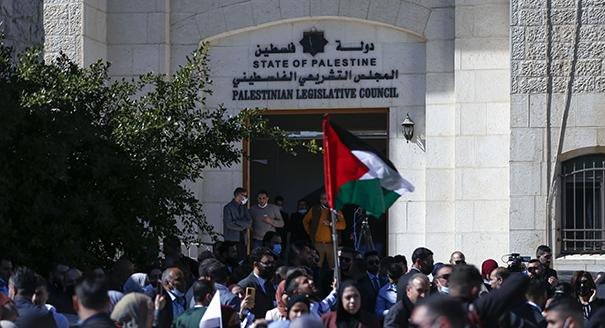
Source: Getty
Elections may breathe some life into Palestinian governance, despite the fact there are those who oppose them.
Palestinian elections seem to have no friends. However, in a recent article my colleague Zaha Hassan and I pleaded for dialing the cynicism back ever so gently.
At least until recently, Palestinians doubted that elections would occur. The legal and political obstacles imposed by Palestinian divisions and the Israeli occupation will mean that even a determined effort by leaders will make a sound electoral process difficult. Indeed, such determination had been lacking until lately. Those with different concerns—from those worried that elections will exacerbate divisions, those opposed to Hamas’s inclusion, or those who believe attention should be focused on reform elsewhere—have all expressed profound doubts about the wisdom of the balloting as planned.
While such analysts can only criticize, powerful political actors who are able to act on their doubts could step in to end the electoral cycle with either a bang or a whimper. Palestinian leaders, worried that the elections are going awry or slipping from their grasp, could abort them; Israeli officials could disrupt them in countless ways; U.S. and European diplomats could deprive elections of the international protection they would need to be effective.
But what if elections to the Palestinian Legislative Council (PLC), the parliament of the Palestinian Authority, go forward as planned? What effect would they have on Palestinian governance? Overall, they might breathe a small bit of life into a stagnant body politic and help forge a tool that Palestinians could use to manage their differences. There are three reasons for such a conclusion.
First, the results will probably be different than the last two elections. Most political forces will participate, unlike in 1996. And unlike both the 1996 and 2006 elections, a pure proportional representation system will likely result in no bloc obtaining a clear majority. It is impossible to say what the outcome would be—itself a healthy sign of sorts, since an election in which the results are certain in advance is almost by definition undemocratic. Polling might be a bit less reliable because the obstacles to voting will vary considerably by location. And it is not yet even clear what choices voters will be offered.
Electoral slates are still being formed—Fatah dissidents may put together one or two alternatives to the official Fatah slate. The rifts within Fatah may push the leadership to find a way to call off the vote. Violence among Fatah rivals occurred in 2006, and could recur now. But if there is an Islamist bloc, a Fatah list, a dissident Fatah list (or two), a leftist list, and perhaps a few others, then the result is likely to be a legislative body in which several parties have voices but none has veto power. The 1996 parliament had an independent streak (many candidates hailing from Fatah had been elected on their own), but was not organized into clear blocs and had trouble cobbling together coherent majorities for anything.
That raises a second aspect of any electoral outcome: the deputies elected will be placed in an institution that now has a clear history, a constitutional foundation, and a set of procedures. The 1996 parliament was built from scratch and began with a squabble over the oath of office. The new parliament will have a clearer path, though hardly an easy one. The Palestinian Basic Law, a set of internal bylaws authored by the first PLC and its support offices, and reflecting the institution’s traditions, worked imperfectly at best in the past and in some ways remains untested. Given a parliament divided into rival blocs, gridlock might be the result. But even a creaky and cantankerous parliament will break the logjam in which unaccountable and ageing careerists monopolize decisionmaking in closed circles. At present, Palestine cannot make a decision of any sort. A divided parliament, an elderly president, and a cabinet caught between the two would therefore actually be a step forward.
And that leads to the third improvement: there will be a clear structure for various elements in Palestinian society to hammer out consensual approaches—and for a majority to receive authorization to act if consensus proves impossible. The political differences between Hamas and Fatah (and now among Fatah factions) are on clear display and have contributed to the political decay at the top of Palestinian society. The division between Gaza and the West Bank is not merely geographical, but now has become embedded in social ties, legal frameworks, and political outlooks.
It should be added that there is one gap in Palestinian society—a generational gap—that receives little international attention, but is audible in virtually any small group discussion to which one is privy among Palestinians. The history lived by the older generation—of national struggle, “revolution,” of building the Palestine Liberation Organization and other institutions, of securing international support—appears to many younger Palestinians to have come to a full stop.
However, there is a reason why arguments among generations are not heard outside of Palestinian living rooms. The younger generation is devoid of clear movements, strategies, and leaders. The young are active, to be sure, but not in the old channels of the nationalist movement. Earlier waves of Palestinian activism produced the individuals and organizations that now stand so unsteadily at the head of the Palestinian national movement. But even those dubbed the “young guard” a couple of decades ago are now eligible for pensions. An election that moves some new, younger faces and ideas from social media into parliament could connect Palestinian political institutions to society in far more vital ways than the desiccated channels now existing. This could move politics from endless discussion to real decisionmaking.
Palestinians skeptical of elections point to the constrained ways these will occur (if they occur at all), the need for reform and energy elsewhere, the divisions that the elections are provoking, and the way they are already being manipulated by leaders who seem to adopt, and drop, electoral processes for tactical reasons. It is not a matter of the perfect being the enemy of the good—there are no good options. The choice for Palestinians is between a bad situation with some signs of movement and entrenched stagnation mixed with slow deterioration. Palestinians have lived with the latter for over a decade, which is why the former may seem attractive.

Nonresident Senior Fellow, Middle East Program
Nathan J. Brown, a professor of political science and international affairs at George Washington University, is a distinguished scholar and author of nine books on Arab politics and governance, as well as editor of five books.
Recent Work
Nathan J. Brown
Nathan J. Brown
Carnegie does not take institutional positions on public policy issues; the views represented herein are those of the author(s) and do not necessarily reflect the views of Carnegie, its staff, or its trustees.
The party’s objectives involve tying together the Lebanese and Iranian fronts, while surviving militarily and politically at home.
Mohamad Fawaz
While armed forces commander Rudolph Haykal’s caution is understandable, he is in a position to act, and must.

Michael Young
The simple conclusion is that the scheme will bring neither peace nor prosperity, but will institutionalize devastation.
Nathan J. Brown
The Jamaa al-Islamiyya is the local Lebanese dimension of a broader struggle involving rival regional powers.

Issam Kayssi
In an interview, Kheder Khaddour explains that Damascus is trying to stabilize its borders, but avoiding war isn’t guaranteed.
Michael Young