

Commentary
Aram Nerguizian
{
  "authors": [
    "Aram Nerguizian"
  ],
  "type": "commentary",
  "blog": "Diwan",
  "centerAffiliationAll": "dc",
  "centers": [
    "Carnegie Endowment for International Peace",
    "Malcolm H. Kerr Carnegie Middle East Center"
  ],
  "collections": [
    "Reaction Shot",
    "Civil-Military Relations in Arab States",
    "Decoding Lebanon"
  ],
  "englishNewsletterAll": "menaTransitions",
  "nonEnglishNewsletterAll": "",
  "primaryCenter": "Malcolm H. Kerr Carnegie Middle East Center",
  "programAffiliation": "MEP",
  "programs": [
    "Middle East"
  ],
  "projects": [],
  "regions": [
    "Levant",
    "Lebanon",
    "Middle East"
  ],
  "topics": [
    "Political Reform"
  ]
}
Source: Getty
Spot analysis from Carnegie scholars on events relating to the Middle East and North Africa.
What Happened?
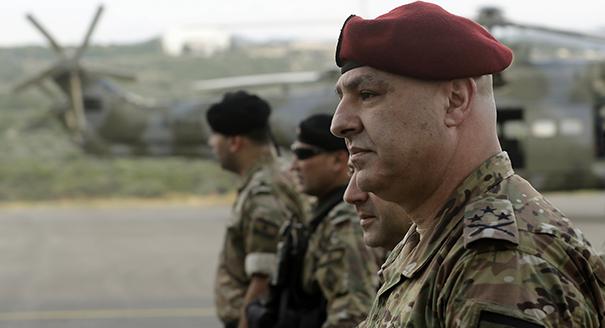
Amid growing protests in Lebanon at the deteriorating economic situation and the massive devaluation of the Lebanese pound, on March 8 the commander of the Lebanese armed forces, General Joseph Aoun, made a speech to officers at army headquarters. He addressed the country’s political leadership on the crisis, amid deadlock in forming a new government. Aoun asked the politicians, “Where are we going? What are you waiting for? What do you plan to do? We have warned more than once of the danger of the situation.”
Aoun also spoke of how the crisis had negatively affected the military, with salaries of servicemen and servicewomen losing 80 percent of their value since late 2019. “The people are hungry, the people are poor … and the members of the military are also suffering and are hungry,” he said. Aoun rejected criticism of the armed forces for accepting foreign aid, adding “Were it not for such assistance, the situation would have been far worse.” This appeared to be an implicit response to those who had condemned the military for accepting aid from the United States, among other countries.
Why Is It important?
The commander’s speech was the first open criticism voiced by a senior military official against the political class since Lebanon’s collapse began in late 2019. It was also a signal that the military had crossed the Rubicon. The commander spoke at 10:00 AM. At noon, President Michel Aoun called on the army to clear the streets. By 5:00 PM no action had been taken. Therefore, Lebanon appears to have entered the unknown in terms of civil-military relations.
With regard to military spending, as things stand now with the effects of inflation, the armed forces’ internal estimates project that the current account can support military salaries and contract wages until the end of June, no further. After that either the government must agree to supplemental funding or the armed forces will have to suspend paying personnel in increasing numbers. Alternatively, the military could pull budgetary resources from other areas tied to readiness and mobility. While senior military cadres do not assess that the operational collapse of the armed forces is imminent, the same cannot be said for their mobility and effectiveness.
What Aoun was doing was sounding the alarm and bluntly asking the political class whether it wanted Lebanon to have a functional military or not. His message was clear: Do something credible or do not count on us to be the security actor you take for granted. In other words, as popular resentment rises the politicians may not be able to rely on the military to protect them, let alone to oppose protestors.
What Are the Implications for the Future?
Aoun implicitly told the politicians and the population three things: First, that the military does not want to involve itself in politics, but there are now orders that it will not follow. Second, because the military and the population are suffering together, protestors should take advantage of the situation and organize. And third, as long as protests remain peaceful, the military will side with the protestors.
With respect to the military in institutional terms, Aoun’s speech pointed to worrying trends. Foreign assistance remains vital to help the armed forces to continue functioning. While countries such as the United States and the United Kingdom must abide by restrictions on the use of aid to support the salaries of foreign militaries, they can prompt other funders, such as the United Arab Emirates, to support Lebanon’s military in ways that maintain the morale of soldiers.
Such assistance would help to contain two trends that may threaten the armed forces’ continued professionalism: a relatively higher number of requests for early retirement, which means that experienced officers are exiting; and requests by more junior officers for unpaid leave or furloughs of about three months to do work on the side and supplement their military salaries.
There are also several risk factors. Fearing what might be a more autonomous military, there are factions that may want to use violence to send a warning to the armed forces. Hezbollah, Amal, and Gibran Bassil, the head of the Free Patriotic Movement, have the most to lose from a military that is increasingly distancing itself from the ruling class. For example, they and others may want to test the military’s resolve on the streets. This points to a parallel issue. If the military were to atrophy, this would not harm Hezbollah. On the contrary, the party would be the only one left standing, an outcome few outside Lebanon, particularly in Washington, want to see materialize.
There is also a real danger of a resurgence of extremist groups tied to the Islamic State along the border with Syria and in increasingly desperate and destitute urban centers. Aoun’s message was that the military’s readiness needed to be assured and could not be accomplished thanks to external partners alone. What was required was an internal consensus and funding to secure the armed forces’ role as a defender of internal stability and territorial integrity.
Former Senior Advisor, Program on Civil-Military Relations in Arab States, Malcolm H. Kerr Carnegie Middle East Center
Aram Nerguizian was senior advisor of the Program on Civil-Military Relations in Arab States at the Malcolm H. Kerr Carnegie Middle East Center, where his work focuses on the Lebanese security sector, long-term force transformation in the Levant, and efforts to develop national security institutions in post-conflict and divided societies.
Recent Work
Aram Nerguizian
Aram Nerguizian
Carnegie does not take institutional positions on public policy issues; the views represented herein are those of the author(s) and do not necessarily reflect the views of Carnegie, its staff, or its trustees.
Reconciliation councils are emerging throughout the country to mediate in intracommunal disputes, many from the war years.
Natacha Danon
As the U.S.-led Coalition withdraws, the Kurds’ reliance on Baghdad, and on themselves, will only increase.
Wladimir van Wilgenburg

As the U.S. stumbles in its war with Iran, we are likely to see an acceleration of its disengagement from the region.

Michael Young
The Zaidi government’s objective to collect weapons is constrained by regional conflict, but it can take certain measures at home.
Ali Al-Mawlawi

The accord represents a pivotal moment in the region to avert a security vacuum in the Gulf.


Azeema Cheema, Mohanad Hage Ali