

Commentary
The Zaidi government’s objective to collect weapons is constrained by regional conflict, but it can take certain measures at home.
Ali Al-Mawlawi
{
  "authors": [
    "Marc Pierini",
    "Francesco Siccardi"
  ],
  "type": "commentary",
  "blog": "Diwan",
  "centerAffiliationAll": "dc",
  "centers": [
    "Carnegie Endowment for International Peace",
    "Carnegie Europe",
    "Malcolm H. Kerr Carnegie Middle East Center"
  ],
  "collections": [],
  "englishNewsletterAll": "menaTransitions",
  "nonEnglishNewsletterAll": "",
  "primaryCenter": "Malcolm H. Kerr Carnegie Middle East Center",
  "programAffiliation": "MEP",
  "programs": [
    "Middle East"
  ],
  "projects": [],
  "regions": [
    "Levant",
    "Middle East",
    "Türkiye",
    "Syria"
  ],
  "topics": [
    "Political Reform"
  ]
}
Source: Getty
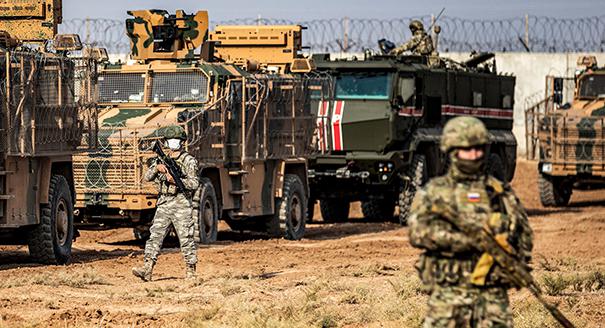
Turkey has unfinished business when it comes to fighting Kurdish forces south of its border.
Turkey has conducted four military operations along its border with Syria between 2016 and 2020. On May 26, President Recep Tayyip Erdoğan’s announcement that Turkey would conduct a new operation in northern Syria was endorsed by the Turkish National Security Council to “clear [its] southern borders from the threat of terrorism.” Turkish artillery fire in the region has been registered since early June, while Russia has intensified military patrols in the parts of northern Syria it controls. Why would Turkey launch such a new operation now?
Ankara controls large swathes of territory in northern Syria, but its previous attempts at establishing a continuous 30-kilometer-deep safety zone along the entirety of the Turkish-Syrian border have so far failed. Turkish troops and their affiliates still do not control a stretch of around 70 kilometers east and west of the city of Kobani, as well as a larger portion of territory around the city of Qamishli, all the way to the Tigris River in the east. In these areas, Turkey has been repeatedly blocked by Russian forces, while a “joint patrol” mechanism was put in place between Ankara and Moscow.
It seems that Turkey now feels confident it can renew its attempt at taking full control of some of these areas, to the point that Erdoğan has announced an operation publicly. The Turkish president has indicated that Turkey would initially target the cities of Manbij and Tal Rifaat, to the west of Kobani.
There are four main apparent reasons for such an operation. First, taking full control of another safety zone along the Turkish-Syrian border would be the logical continuation of the previous Turkish operations in northern Syria. It would also fit in with a permanent theme of Ankara’s policy—to fight the Kurdistan Workers Party (PKK), which it considers to be a terrorist organization, and its Syrian affiliate, the People’s Defense Units (YPG). There is nothing new here, except for breaking the status quo reached with Russian forces on the ground when operation Peace Spring came to a halt in October 2019.
Second, Ankara may be calculating that Russia, otherwise busy with the protracted invasion of Ukraine, may not have the time and resources to prevent a new Turkish incursion, nor the political legitimacy to object to it given its own operations in Donbas. It should be noted however that, according to the Syrian Observatory for Human Rights, Russia has reinforced its base at Qamishli airport with aircraft, helicopters, and antiaircraft missiles. U.S. forces are also present on the southern fringe of that zone, according to the same source.
Third, seen from a Western standpoint, there is inevitably a domestic political dimension to such an operation, similar to the objection voiced by Turkey to NATO’s enlargement to include Finland and Sweden. With Erdoğan facing dramatically unfavorable preelection polls and a dire economic situation, including sky-rocketing inflation and declining levels of foreign investment, his temptation to rally voters around the flag and silence criticism from the opposition coalition on a subject of national interest is obvious. In addition, the more the operation is criticized by foreign powers, the more useful it may be seen by the Turkish leadership, which is always eager to present itself as a power independent from Russia and the West.
Fourth, if the operation proves to be successful and sustainable, it would reinforce Ankara’s plan to “voluntarily repatriate” Syrian refugees from Turkey, thereby scoring another point on the domestic political scene, amid rising displeasure with the refugee presence.
The issue for Turkey’s leadership is assessing the risks involved. Any new Turkish military operation in northern Syria would be opposed by the United States. U.S. Secretary of State Antony J. Blinken declared so on June 1, adding that Washington “supports the maintenance of the current ceasefire lines.” The European Union will probably adopt the same position.
The United States maintain a small contingent of 900 troops in northeastern Syria, mainly to prevent a resurgence of the Islamic State. Washington’s cooperation with the YPG in this region has been one of the thorniest issues in bilateral relations between Turkey and the United States. A new Turkish operation would probably clash with U.S. interests on the ground, further aggravating the diplomatic spat between Turkey and its Western allies over the sale of U.S. warplanes, relations with Russia, and NATO enlargement.
In addition, Turkey’s hope to attract international humanitarian assistance for the resettlement of Syrian refugees in areas it controls in northern Syria is unlikely to garner much support—for obvious reasons. The successive operations in northern Syria fall under no international mandate. There are also indications of massive demographic change as a majority of Syrian refugees currently in Turkey are Sunni Arabs, so by relocating them to northern Syria Turkey would achieve the strategic objective of diluting the Kurdish populations living there. Ankara hopes this will guarantee its long-term security. Moreover, other Syrian areas already under Turkey’s control show signs of a lasting presence. Local administrative and security structures are appointed by Turkey, public services such as health and post offices are run by Turkey, and the de facto currency is the Turkish lira.
On June 2, Russia also voiced its opposition to such an operation in no uncertain terms: “We hope that Ankara will refrain from actions that could lead to a dangerous deterioration of the already difficult situation in Syria.” Moscow also shared its understanding “about threats to [Turkey’s] national security emanating from the border regions.”
An official statement from the Turkish presidency indicated that the planned operation in northern Syria was discussed by Erdoğan and Russian President Vladimir Putin on May 30, while a parallel statement from the Kremlin remained mute on the subject. In Syria, Russia backs the Assad regime and supports the country’s full sovereignty and territorial integrity. Despite the confidence expressed by official circles in Ankara, it is hard to conceive why, at a time when it is confronting the entire Western bloc following its invasion of Ukraine, Russia would allow a NATO member to move so resolutely against its Syria policy. For Moscow, any failure to protect its interests in the region would be widely perceived as a sign of weakness.
The relationship between Erdoğan and Putin is complex and in recent years very serious incidents have occurred between their militaries on Syrian territory and in its airspace. Unless one assumes that a hidden understanding is already in place, this time the risks for Ankara are bound to be higher than usual.

Senior Fellow, Carnegie Europe
Marc Pierini is a senior fellow at Carnegie Europe, where his research focuses on developments in the Middle East and Turkey from a European perspective.
Deputy Director, Carnegie Europe
Francesco Siccardi is deputy director at Carnegie Europe.
Carnegie does not take institutional positions on public policy issues; the views represented herein are those of the author(s) and do not necessarily reflect the views of Carnegie, its staff, or its trustees.
The Zaidi government’s objective to collect weapons is constrained by regional conflict, but it can take certain measures at home.
Ali Al-Mawlawi

Huawei pushed hard to enter the Egyptian data centers market, until the Americans made a better offer.

Angie Omar

The accord represents a pivotal moment in the region to avert a security vacuum in the Gulf.


Azeema Cheema, Mohanad Hage Ali

In an interview, Jason Burke discusses his sweeping account of the “revolutionists” who so shaped the 1970s and early 1980s.

Michael Young
In an interview, Sohaib Jawhar analyzes the profound changes in the ties between the neighboring countries.
Michael Young