

Paper
Ahmed Nagi
{
  "authors": [
    "Ahmed Nagi"
  ],
  "type": "commentary",
  "blog": "Diwan",
  "centerAffiliationAll": "dc",
  "centers": [
    "Carnegie Endowment for International Peace",
    "Malcolm H. Kerr Carnegie Middle East Center"
  ],
  "collections": [],
  "englishNewsletterAll": "menaTransitions",
  "nonEnglishNewsletterAll": "",
  "primaryCenter": "Malcolm H. Kerr Carnegie Middle East Center",
  "programAffiliation": "MEP",
  "programs": [
    "Middle East"
  ],
  "projects": [],
  "regions": [
    "Gulf",
    "Yemen",
    "Middle East"
  ],
  "topics": [
    "Political Reform"
  ]
}
Source: Getty
The ceasefire has been extended in Yemen, but all the signs are that the war may be set to continue.
The ongoing truce in Yemen has momentarily reduced the intensity of the conflict in the country. However, the increasing violations of the truce and the failure to reach a permanent ceasefire means that the present situation may be just a prelude to a brutal new round of military confrontation.
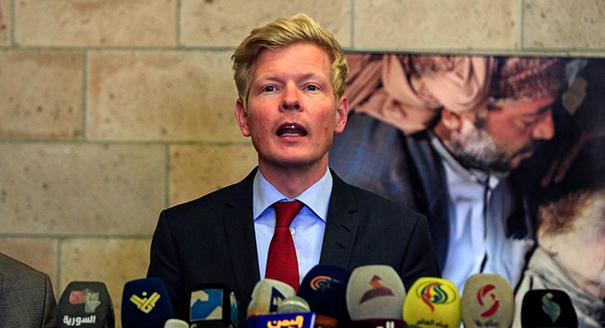
On August 2, the United Nations special envoy for Yemen, Hans Grundberg, announced that the warring parties in Yemen had agreed to extend the truce for an additional two months. This was the second extension since the truce agreement entered into force in early April, between Ansar Allah, better known as the Houthis, and the Saudi-led Arab coalition, which backs the internationally recognized Yemeni government. The terms of the truce include allowing the entry of fuel ships into the Hodeida port and allowing two commercial flights a week to and from Sanaa airport. The agreement also states that the special envoy will “invite the parties to a meeting to agree on opening roads in Taiz and other governorates to facilitate the movement of civilian men, women and children ...”
The truce decreased the number of military clashes between the sides, especially cross-border attacks, whose frequency had risen significantly earlier this year. It also enabled some Yemenis to benefit from the direct flights to Jordan or Egypt through Sanaa Airport. At the same time, the flow of fuel to Houthi-controlled areas reduced the fuel crisis in those areas, which was at its height in the period preceding the agreement. Most importantly, the truce created a space for political talks.
However, the agreement has seemed to falter over the opening of roads in Taiz and other governorates, which is one of its key points. The Office of the Special Envoy was able to sponsor direct talks between the two sides in Amman, Jordan, but reaching an understanding over the issue has remained elusive. This has led to considerable disappointment among Yemenis, who view the opening of roads as a sign of the seriousness of the conflicting parties to alleviate the suffering of the Yemeni population and reach a broader political understanding.
Other signs are also contributing to increasing doubts that that truce will last. According to the Yemen Truce Monitor, managed by the Armed Conflict Location and Event Data Project, there were around 1,860 truce violations until July 29, leading to the death of 316 people. However, there were no violations by the Arab coalition against the Houthis or by the Houthis against Saudi Arabia or the United Arab Emirates. Instead, all of the violations have involved Yemenis fighting among themselves. Revealingly, the party most responsible for violating the truce is the Houthis, who were responsible for some 1,680 violations, or 95 percent of the total, causing the death of 300 people.
These figures explain why many civilians regard the truce primarily as a unilateral truce by the Yemeni government, with the Houthis only halting attacks against coalition countries. Meanwhile, Houthi military operations have continued in several internal areas, especially Taiz and Ma’rib. The truce does not include the deployment of monitoring teams to supervise whether the parties are respecting its conditions. Rather, implementation has been left to the goodwill of the parties.
On another track, talks between Saudi Arabia and the Houthis have continued in Muscat, Oman. These have not achieved any significant progress thus far, but the talks may yet lead to a Saudi-Houthi agreement. However, all this would mean is that the pattern of the Yemeni war may be in the process of changing. The Yemeni government is excluded from the Muscat talks, so that even if the Saudis and Houthis reach an understanding, the war in Yemen may well continue between the contending local parties once the Saudis and their allies have disengaged.
Today, there are three key issues affecting the ongoing truce and negotiations. First, the Houthis believe they are the only legitimate representative of Yemen and that no one has the right to represent the country except them. They view the internationally recognized government and their other opponents as part of the Saudi-led coalition, or “mercenaries” as they label them in their media outlets. This conviction has gained strength because the Houthis feel they are winning the seven-year conflict, especially after they managed to mount attacks against strategic targets inside Saudi Arabia and the UAE.
Second, the Yemeni government appears to be the weakest link in the current political and military landscape. Since its formation at the beginning of April after the removal of president Abd Rabbu Mansour Hadi, the Presidential Leadership Council (PLC) has been unable to overcome many of the obstacles and challenges it faces. Its absorption of all the anti-Houthi groups did not move beyond a formal framework, and the council remains impotent and divided. There have been delays in unifying the military components falling under the PLC, which may help lead to the collapse of the truce, bringing the situation back to square one.
Third, the Saudi-led coalition views its role as that of a mediator, not as a warring party. Riyadh’s and Abu Dhabi’s new strategy is to portray the war as a local Yemeni issue, without mentioning the role they have been played since March 2015. This approach became dominant after the two created local proxies to defend their interests. Not surprisingly, the focus of the Saudis in their talks with the Houthis is on stopping cross-border attacks, not on addressing internal Yemeni issues.
The truce is not an end in itself. It is just a pause that can lead either to a permanent ceasefire or a new chapter of devastating war if it is not exploited. We are seeing the emergence of a disturbing situation, one in which peace opportunities are diminishing while the participants in the conflict are recklessly ignoring the welfare of civilians. This makes Yemen a manifestation of the failure both of war and peace.

Senior Analyst at the International Crisis Group
Ahmed Nagi is a senior Analyst at the International Crisis Group.
Recent Work
Ahmed Nagi
Carnegie does not take institutional positions on public policy issues; the views represented herein are those of the author(s) and do not necessarily reflect the views of Carnegie, its staff, or its trustees.

As the U.S. stumbles in its war with Iran, we are likely to see an acceleration of its disengagement from the region.

Michael Young

Middle Eastern states should welcome an accelerated U.S. disengagement from their region.
Michael Young

The accord represents a pivotal moment in the region to avert a security vacuum in the Gulf.


Azeema Cheema, Mohanad Hage Ali

In an interview, Jason Burke discusses his sweeping account of the “revolutionists” who so shaped the 1970s and early 1980s.
Michael Young
In an interview, Marc Lynch discusses his new book decrying the post-1990 U.S.-dominated order in the Middle East.
Michael Young