

Commentary
Harith Hasan, Alfadhel Ahmad
{
  "authors": [
    "Harith Hasan"
  ],
  "type": "commentary",
  "blog": "Diwan",
  "centerAffiliationAll": "dc",
  "centers": [
    "Carnegie Endowment for International Peace",
    "Malcolm H. Kerr Carnegie Middle East Center"
  ],
  "collections": [],
  "englishNewsletterAll": "menaTransitions",
  "nonEnglishNewsletterAll": "",
  "primaryCenter": "Malcolm H. Kerr Carnegie Middle East Center",
  "programAffiliation": "MEP",
  "programs": [
    "Middle East"
  ],
  "projects": [],
  "regions": [
    "Levant",
    "Iraq",
    "Middle East"
  ],
  "topics": [
    "Political Reform"
  ]
}
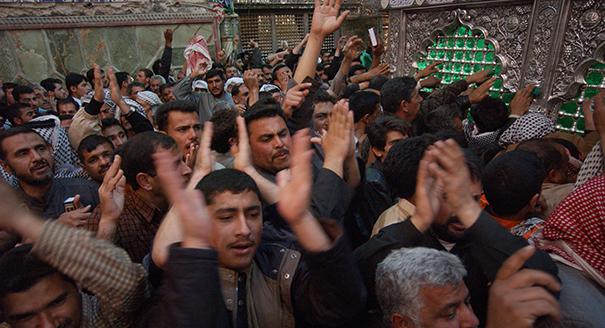
Source: Getty
Is the community a purveyor of revolutionary change, a defender of the status quo, or a combination of both?
We are in the Muslim month of Muharram, a time of mourning for Shia Muslims, when they commemorate the martyrdom of Imam Hussein. Over the centuries, rituals during Muharram have been crucial in maintaining and energizing the Shia collectivity and helping to perpetuate its narratives, myths, and worldviews.
During Muharram, various religious, ideological, and political strains within Shiism compete to shape the commemoration and charge its rituals with meanings and tales that convey their systems of belief. These strains offer different interpretations of the martyrdom and frame it in the context of current affairs and reality. This year in Iraq, the commemoration has occurred at a time when Shiism is becoming something akin to a state doctrine, if not yet a “ruling ideology.”
Recently, the Iraqi council of ministers announced that Eid al-Ghadir was a national holiday. The feast celebrates the day when the Prophet Mohammed declared that his cousin Ali, the father of Imam Hussein, would be his heir. To the Shia, Ali is the first imam, and since the fall of Saddam Hussein’s regime in 2003, Shia Islamist groups have demanded that Eid al-Ghadir be turned into a national holiday. In early July, Prime Minister Mohammed al-Sudani delivered a speech before a large gathering of politicians, parliamentarians, and state officials to commemorate Al-Ghadir. The gathering was organized by the Coordination Framework, the Shia coalition that rules Iraq. Behind Sudani was a billboard that read, “Our framework [the Coordination Framework] is our strength, Al-Ghadir is our course of action.”
This is the latest manifestation of a situation that has accelerated in recent years, where the public sphere has become increasingly dominated by Shia symbolism and imagery. This trend may reflect the demographic reality of Iraq in which the Shia represent a majority, but it is also inherently political. Shia affirmation is characterized by a struggle for power and emerging authoritarian hierarchies, which are manifested in the effort to symbolically dominate public space and redemarcate the boundaries of what is acceptable there.
This process of the “Shiization” of public space underlines three realities about power in Iraq today. First, while Shia political, religious, and armed groups formally subscribe to power-sharing arrangements with Sunni and Kurdish factions, they have secured comfortable control over the actual levers of power in the country. That is why they feel more inclined to demonstrate their ascendancy and are less compelled to consider the sensitivities of other communities.
This has been shown, for example, by the spread of Shia imagery in Baghdad. This includes murals and statues of Abou Mahdi al-Muhandis, who was the chief of staff of the Popular Mobilization Forces, a coalition of militias in which Shia religious groups play a dominant role, and Qassem Suleimani, who led the Quds Force of Iran’s Islamic Revolutionary Guard Corps. Both men were killed in a U.S drone strike in January 2020. It has also been evident in the Office of Shia Endowments’ extended control over mosques and buildings that were contested with the Office of Sunni Endowments.
Second, while such behavior shows increasing Shia confidence vis-à-vis other religious and ethnic communities, it also reflects a degree of anxiety among ruling Shia Islamist groups. They saw their dominance challenged in an unprecedented way from within the Shia community in the so-called Tishreeni protests of 2019–2020. Therefore, by seeking to assert themselves and spread their symbols, the ruling Shia parties want to create both a perception of their enduring power and a sense of familiarity publicly that helps to mitigate their anxiety. Media platforms and figures linked to these Shia groups have developed an authoritarian discourse that instills fear in Shia constituencies over the loss of Shia power and the threat of chaos. A prominent Shia cleric echoed these fears by telling his audience that if the choice today was one between corruption and chaos, corruption was the lesser evil.
Third, Shia affirmation also derives from the rift within the Shia Islamist camp between the Coordination Framework and the Sadrist movement led by Muqtada al-Sadr—one that widened after the 2021 election. The rift has been expressed in rhetorical competition between the two sides to show which is more devoted to Shiism and its main principles.
The recent Sadrist protests and storming of the Swedish Embassy in Baghdad after an Iraqi asylum-seeker in Sweden burned the Quran were instigated by Sadr as a show of his uncompromising adherence to Islam. On this and other occasions, Sadrist media platforms voiced criticism of the Coordination Framework’s willingness to compromise for the sake of retaining power, a message Sadr has reiterated as he leans increasingly to religious populism after his “withdrawal from politics” last year. His claim that he was prevented by “corrupt” rivals from implementing reforms is often framed in religious, sometimes apocalyptic, terms.
To counter Sadr’s bluster, the Daawa Party, a leading faction in the Coordination Framework, has called for new legislation criminalizing criticism or abuse of prominent Shia clerics. The call came after attacks by Sadr’s followers on Daawa offices due to claims that party members had made abusive statements about Mohammed Sadeq al-Sadr, Moqtada’s late father and founder of the Sadrist movement. The competition between the Sadrists and their rivals is a contest in which each side has tried to appear more conservative, Islamist, and Shia-centric than the other. But this often hides the actual reasons for hostility, which are linked to personal resentments and factional rivalries for power and resources.
In this context, the rituals during Muharram are both a manifestation of the transformation of Shiism into an ideology of the status quo, even as it was a platform to challenge the status quo. This is exemplified in the roles played by the so-called Husseini Quraa, reciters of poems and tales of Hussein’s martyrdom, whose business has significantly flourished since 2003. While some of the well-known reciters have performed in gatherings organized by key Shia politicians such as Ammar al-Hakim, a prominent leader of the Coordination Framework, others have used these platforms to criticize the ruling elite and its corruption.
Having emerged ascendant after years of violent conflict and the struggle for power, Shiism in Iraq is being subjected to internal contestation, like most collective identities in times of instability, uncertainty, and disruption. It is torn between two contradictory impulses—its self-designation as a revolutionary force driven by the example of Hussein, and its newer role as a status quo doctrine, employed by Iraq’s ruling Shia oligarchy to resist change.

Associate researcher at the Arab Center for Research and Policy Studies.
Harith Hasan is an associate researcher at the Arab Center for Research and Policy Studies.
Recent Work
Harith Hasan, Alfadhel Ahmad
Harith Hasan
Carnegie does not take institutional positions on public policy issues; the views represented herein are those of the author(s) and do not necessarily reflect the views of Carnegie, its staff, or its trustees.
Reconciliation councils are emerging throughout the country to mediate in intracommunal disputes, many from the war years.
Natacha Danon
As the U.S.-led Coalition withdraws, the Kurds’ reliance on Baghdad, and on themselves, will only increase.
Wladimir van Wilgenburg

As the U.S. stumbles in its war with Iran, we are likely to see an acceleration of its disengagement from the region.

Michael Young
The Zaidi government’s objective to collect weapons is constrained by regional conflict, but it can take certain measures at home.
Ali Al-Mawlawi

The accord represents a pivotal moment in the region to avert a security vacuum in the Gulf.


Azeema Cheema, Mohanad Hage Ali