

Commentary
Issam Kayssi
{
  "authors": [
    "Issam Kayssi"
  ],
  "type": "commentary",
  "blog": "Diwan",
  "centerAffiliationAll": "",
  "centers": [
    "Carnegie Endowment for International Peace",
    "Malcolm H. Kerr Carnegie Middle East Center"
  ],
  "englishNewsletterAll": "",
  "nonEnglishNewsletterAll": "",
  "primaryCenter": "Malcolm H. Kerr Carnegie Middle East Center",
  "programAffiliation": "",
  "regions": [
    "Lebanon",
    "Israel",
    "Levant"
  ]
}
Source: Getty
The decision of Lebanon’s parliament may look exceptional, but in reality it is not.
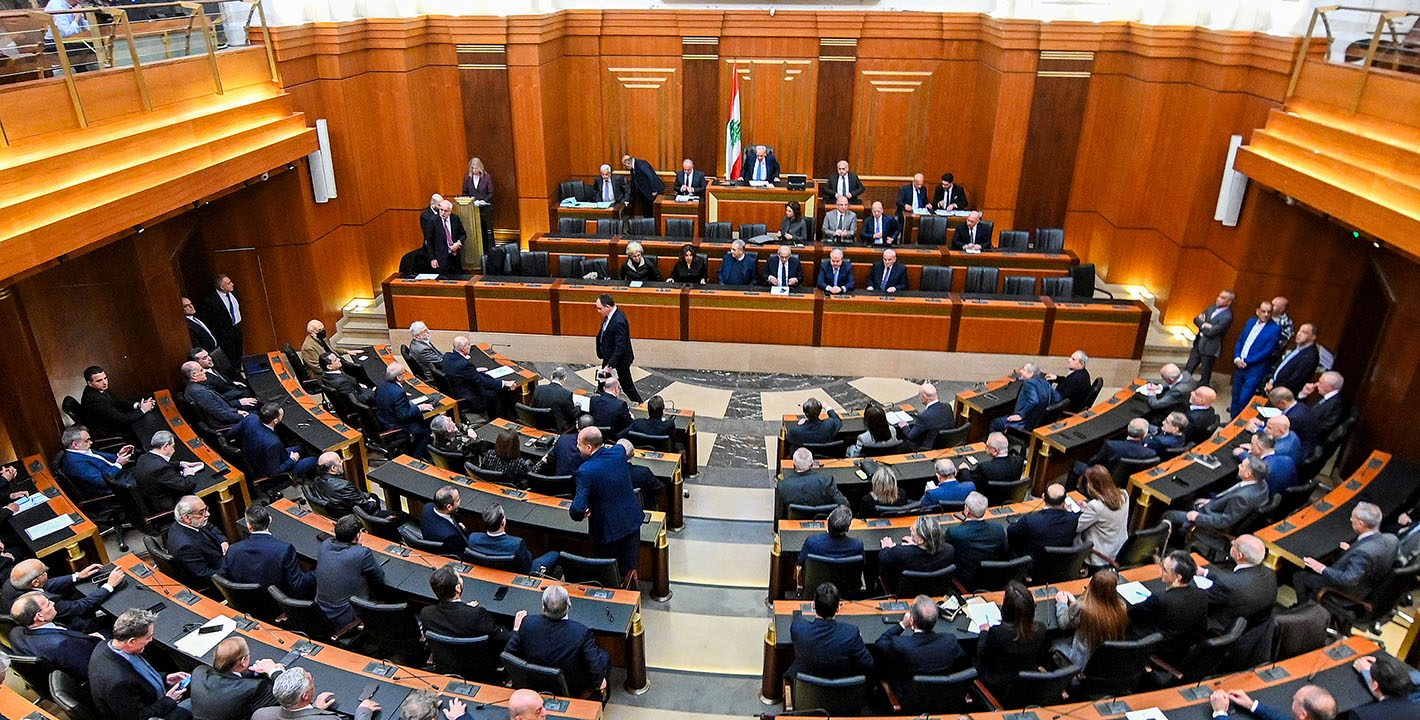
On March 9, as Israel struck Beirut’s southern suburbs and hundreds of thousands of Lebanese sought refuge in makeshift shelters and temporary homes around the country, Lebanon’s parliament convened in the capital city’s downtown district. The purpose of the extraordinary session was to reach agreement on an issue that has become familiar in Lebanese politics. By a vote of 76 to 41, with four abstentions, lawmakers extended their mandate by two years, postponing parliamentary elections scheduled for May 2026.
The vote came as Lebanon, where Israeli strikes had continued intermittently despite the November 2024 cessation of hostilities agreement, found itself pulled into a regional war. More than 600 people have been killed and some 800,000 displaced in recent days as Israeli bombardment has intensified across the country. This followed Hezbollah’s entry into the conflict between the United States and Israel on the one hand, and Iran on the other, on March 2, when it opened fire on Israel to avenge the killing of Iran’s supreme leader in an airstrike. Lebanon is now grappling with mass displacement—following Israeli warnings, entire towns in the south have emptied, as have the southern suburbs of Beirut—in addition to mounting casualties and damage to infrastructure. Under such conditions, organizing a nationwide election in May appeared increasingly impracticable, both politically and logistically.
Yet the call to delay elections for two full years quickly reopened a familiar debate in Lebanese politics. When extraordinary circumstances arise, how flexible should democratic timelines be? What does it mean for parliament to extend its own mandate, once again, for half of a four-year parliamentary term?
The parliamentary session itself unfolded with a mixture of routine and surrealism. Despite speculation that its members might not attend because of the war, Hezbollah’s parliamentary bloc appeared in its entirety. Bloc leader Mohammed Raad made his first public appearance since media reports about his killing had circulated days earlier. Lawmakers debated procedural timelines and constitutional interpretations. Absent from the discussion, however, was a deeper political question, namely the role of Hezbollah itself in pulling Lebanon into a conflict that had now made elections all but impossible. There was not even a moment of silence for the victims of the conflict. Hezbollah lawmakers took their seats, participated in the vote, and left without speeches or statements.
The debate around the postponement, however, was lively. No lawmakers attending the session argued that elections could realistically take place on schedule. The concern that weighed heavily on the discussion was institutional continuity. If parliament’s term were to expire without the holding of elections, and the Nawaf Salam government were to collapse for any reason, Lebanon could find itself in a situation where the Maronite Christian president becomes the only fully empowered authority during a moment of national crisis. The country’s highest political office for Shiites, speaker of parliament, would be left vacant and that for Sunnis, the prime minister, would be filled by Salam in a caretaker capacity.
Thus, the real disagreement was not over whether to delay the vote, but over how long the delay should last. Elections in Lebanon require months of preparation even under normal circumstances. Polling stations must be organized, electoral rolls finalized, and logistical arrangements coordinated across the country’s fifteen electoral districts, as well as for Lebanese voters abroad. Independent parliamentarian Firas Hamdan, who represents a district in the south and supported the parliamentary extension, argued that with large portions of the population having been displaced, organizing elections would require at least nine or ten months of preparation, even in the unlikely event that security conditions stabilized soon.
The major Christian parties—the Lebanese Forces, the Free Patriotic Movement, and the Kataeb Party—accepted the need for a delay, but objected to extending parliament’s mandate for two full years. Instead, they advocated shorter postponements that could themselves be reassessed once the security situation became clearer. Several alternatives were proposed. Lawmakers suggested extensions of two, four, or six months. At one point, Free Patriotic Movement leader Gebran Bassil publicly supported a one-year extension as a possible compromise, an idea that George Adwan of the Lebanese Forces bloc indicated he could accept.
Yet ultimately the vote was not on any of these alternatives. Speaker Nabih Berri, long-time ally of Hezbollah, framed the choice more narrowly by putting forward a two-year extension as the only proposal before the chamber. With no consensus emerging around a shorter delay, the motion passed with the support of a majority of the 128 lawmakers.
After the session, opponents of the decision argued that the length of the extension crossed an important line. Kataeb leader Samy Gemayel stated that a one-year delay would have sufficed. Adwan similarly argued that Lebanon must break with a recurring pattern in which institutional deadlines are stretched. For his part, independent parliamentarian and former president of the Beirut Bar Association Melhem Khalaf described the two-year extension as unconstitutional, warning that allowing the legislature to prolong its mandate beyond what was necessary risked undermining the principle of electoral accountability.
Over and above these legal arguments was a political question: how much of the decision was driven by wartime necessity, and how much by political calculation? There is a widespread realization that the war may reshape Lebanon’s political landscape. Armed conflict inevitably alters public sentiment, particularly toward the actors directly involved in it. For Hezbollah, which entered the confrontation with Israel and now bears much of the perceived political responsibility for its consequences, the coming months will prove politically difficult. In the immediate term, the destruction, displacement, and economic disruption resulting from the war could erode support for the party in some constituencies, or at least introduce uncertainty about how voters might respond once the fighting subsides.
For political actors across the spectrum, this uncertainty matters. Holding elections once the immediate phase of the war has passed but while its consequences remain highly visible could produce volatile electoral dynamics. A longer delay, by contrast, allows more time for political narratives to evolve, potential reconstruction efforts to begin, and public frustrations to be defused. In that sense, the timing of elections is not merely a logistical question but also a political one.
The extension also intersects with another important institutional milestone: Lebanon’s next presidential election. In Lebanon’s political system, the Maronite Christian president is elected by parliament, meaning that the composition of the legislature at that moment is crucial. By extending the current parliament’s term for two years, lawmakers ensure that the next parliamentary elections will produce the legislature that elects the next president.
Such calculations may not always be acknowledged openly. Yet they illustrate how procedural decisions in Lebanon often carry broader implications. The debate over whether to delay elections for a few months or two years was not only about administrative feasibility, but also about how different timelines might change the country’s internal political balance in the years ahead.
Such dynamics also fit into a historical pattern. Lebanese electoral calendars have rarely been as fixed as the constitution suggests. On paper, Lebanon operates under a constitutional framework that establishes clear institutional timelines: parliamentary elections every four years and presidential terms lasting six. In practice, however, these deadlines have often proven negotiable when the country is confronted with violent obstruction or political stalemate.
Indeed, since the 1950s, Lebanon’s political system has repeatedly found itself caught in cycles of transnational conflict or domestic political deadlock that end up postponing constitutional deadlines. Parliamentary mandates are extended, presidential elections delayed, and institutional timelines stretched. The parliament elected in 1972 remained in office throughout the fifteen-year civil war. The legislature elected in 2009 extended its mandate several times, citing security concerns linked to the war in neighboring Syria, ultimately delaying elections until 2018.
After decades of this pattern, it becomes increasingly difficult to see it as a temporary departure from the rules. Rather, the pattern reflects the way the Lebanese system operates. The question, then, is not simply when the next elections will take place, but whether Lebanon’s institutional deadlines, under its current system, can ever fully escape the cycles of crisis that repeatedly suspend them.

Research Analyst, Malcolm H. Kerr Carnegie Middle East Center
Issam Kayssi is a research analyst at the Malcolm H. Kerr Carnegie Middle East Center.
Recent Work
Issam Kayssi
Issam Kayssi
Reconciliation councils are emerging throughout the country to mediate in intracommunal disputes, many from the war years.
Natacha Danon
As the U.S.-led Coalition withdraws, the Kurds’ reliance on Baghdad, and on themselves, will only increase.
Wladimir van Wilgenburg

In an interview, Ian Lustick and Eli Clifton discuss their new book on why a prominent ally has so much influence in America.

Michael Young
The Zaidi government’s objective to collect weapons is constrained by regional conflict, but it can take certain measures at home.
Ali Al-Mawlawi
It is improbable that Israel’s forthcoming elections will alter much in terms of how the country thinks about security.

Nathan J. Brown