

Commentary
Camille Ammoun
{
  "authors": [
    "Camille Ammoun"
  ],
  "type": "commentary",
  "blog": "Diwan",
  "centerAffiliationAll": "",
  "centers": [
    "Carnegie Endowment for International Peace",
    "Malcolm H. Kerr Carnegie Middle East Center"
  ],
  "englishNewsletterAll": "",
  "nonEnglishNewsletterAll": "",
  "primaryCenter": "Malcolm H. Kerr Carnegie Middle East Center",
  "programAffiliation": "",
  "programs": [],
  "projects": [],
  "regions": [
    "Gulf",
    "Saudi Arabia",
    "United Arab Emirates"
  ],
  "topics": [
    "Technology"
  ]
}
Source: Getty
The GCC states’ use of Artificial Intelligence will generate much leverage over the global digital infrastructure and climate talks.
For decades, Gulf Cooperation Council (GCC) countries have announced plans to diversify their economies away from fossil fuel extraction, with artificial intelligence (AI) now increasingly presented as the latest engine of transformation. They have prepared major economic planning documents, embarked on megaprojects in the desert, and promoted new sectors, as evidence that they are looking toward a post-oil future. Yet the Gulf’s political economy remains structurally dependent on access to cheap fossil fuel energy, and this dependence continues to shape the domestic development strategies and international climate diplomacy of the GCC countries.
Saudi Arabia and the UAE have expanded into petrochemicals, moving down the hydrocarbon value chain rather than exiting from it. Bahrain and later Dubai have invested in financial services, which thrive on regional capital flows that remain directly tied to fossil fuel wealth. Real estate development has spread across the Arabian Peninsula, absorbing surplus capital while locking Gulf cities into urban forms that depend heavily on access to cheap energy for cooling, desalination, transport, and maintenance. Tourism has grown rapidly, yet it is among the most water- and energy-intensive sectors imaginable in arid environments. Finally, logistics have emerged as a potential pillar, but one that is exposed to shifting routes and the reorientation of global trade toward the Indo-Pacific.
Aluminum production in the GCC, which has been presented as a success story, is one of the clearest attempts at industrial diversification that illustrates such dynamics. It relies on a single comparative advantage, namely abundant and cheap fossil fuel-generated electricity. Aluminum production is an electricity-intensive process, because turning bauxite into metal requires electrolysis, which uses very large amounts of continuous electrical power. There are five smelters in the GCC that collectively produced around 6.3 million tons of primary aluminum in 2024, roughly 9 percent of global output, highlighting aluminum’s role as a cornerstone of GCC non-oil exports. This industrial concentration in the GCC does not reflect technological innovation or labor productivity gains, but an ability to convert inexpensive hydrocarbons into exportable industrial output.
All of these strategic diversification attempts reduce fiscal risk and smoothen revenue volatility, but do not decouple Gulf economies from fossil fuels. They remain rent-based, energy-hungry, and structurally dependent on hydrocarbon extraction. This same logic is now reappearing in a new, more sophisticated form, driven by the rapid expansion of artificial intelligence.
Meaningful diversification into AI innovation, defined as algorithmic breakthroughs and frontier research, remains out of reach for GCC countries. Such innovation depends on dense research ecosystems, academic freedom, open knowledge circulation, and long-term institutional trust. These conditions cannot be purchased overnight, nor can they be engineered solely through capital injections or sovereign funds.
But as AI deployment accelerates, the material foundations of the digital economy are becoming harder to ignore and global demand for data storage and computing capacity is increasing. For GCC countries, this gap creates new opportunities. AI depends on data centers, server farms, cooling systems, and uninterrupted power supply. And the GCC does have access to cheap and reliable energy, as well as political systems capable of mobilizing land, capital, and infrastructure, including the efficient deployment of cooling systems at scale. This positions GCC countries not as creators of AI systems, but as hosts of the digital economy’s already technologically mature physical backbone.
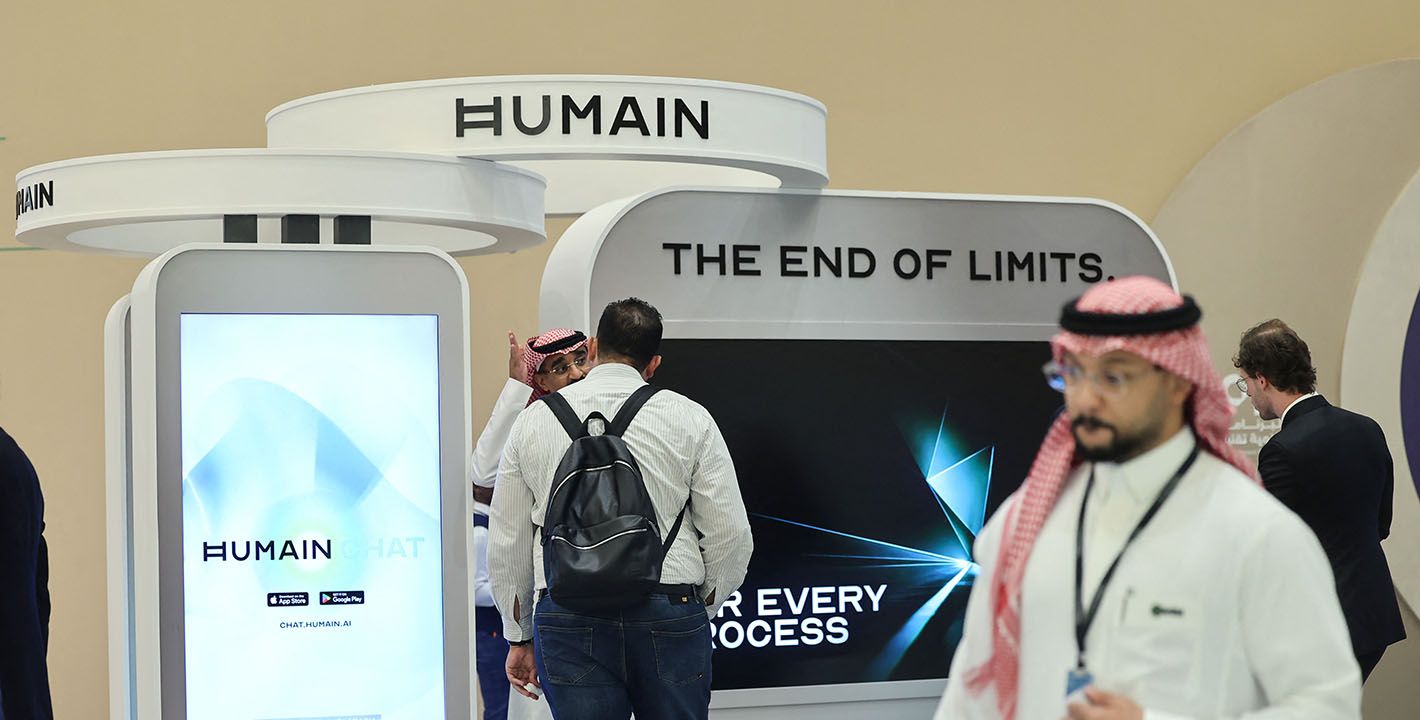
Cloud storage is thus emerging as the Gulf’s new aluminum, with fossil fuels exported not only as industrial outputs, but increasingly in the more abstract form of digital services. In practice, this strategy is already materializing through a wave of largescale data center deals across the region. In the United Arab Emirates, Microsoft and Abu Dhabi’s G24 have announced a 200-megawatt capacity expansion of the UAE’s data center arm Khazna, part of a wider $15 billion investment commitment. In Saudi Arabia, Advanced Micro Devices and Cisco Systems have partnered with local AI company Humain to launch a joint venture starting with a 100-megawatt facility. These projects have been enabled by parallel developments, including U.S. approval of several billion dollars’ worth of Nvidia AI chip exports under bilateral agreements designed to support the establishment of data centers in the GCC. Finally, in September 2026, Riyadh will host the fourth Global AI Summit, bringing together government leaders, policymakers, tech CEOs, experts, innovators, and researchers from across the data and AI sectors.
The scale of this build-out reflects the way cloud computing is becoming the Gulf’s new aluminum—another pathway through which cheap fossil-fuel energy is converted into exportable, carbon-embedded storage capacity, under the banner of diversification. The cloud, often imagined as immaterial and placeless, is in fact deeply territorial. It sits somewhere, consumes vast amounts of electricity, and generates heat that must be cooled. Carbon is no longer visible at the point of consumption, it is concealed behind the abstraction of data storage and computational power, with emissions geographically displaced and politically diluted. This can be described as the export of fossil fuel clouds by oil-rich Gulf countries.
As the next UN Climate Conference, COP31, returns to the region in Antalya, Türkiye, in November this year, the rapid expansion of cloud infrastructure in the Gulf raises a strategic concern for climate action. By hosting a growing share of the world’s energy-intensive digital infrastructure, much of it powered by fossil fuels, GCC states risk consolidating a new form of leverage in climate negotiations, combining their traditional role as hydrocarbon producers with growing control over critical computing infrastructure. This conversion could significantly strengthen their bargaining power on the global diplomatic scene, and especially as climate blockers, by reframing fossil dependence not only as a question of energy security, but increasingly as one of strategic digital necessity. This would give these states more tools to further delay energy transition, while extracting maximum value from their fossil reserves.
Former Nonresident Scholar , Malcolm H. Kerr Carnegie Middle East Center
Camille Ammoun was a nonresident scholar at the Malcolm H. Kerr Carnegie Middle East Center. His research focuses on climate change, political economy, and urban development.
Recent Work
Camille Ammoun
Camille Ammoun
Carnegie does not take institutional positions on public policy issues; the views represented herein are those of the author(s) and do not necessarily reflect the views of Carnegie, its staff, or its trustees.

Huawei pushed hard to enter the Egyptian data centers market, until the Americans made a better offer.

Angie Omar

Middle Eastern states should welcome an accelerated U.S. disengagement from their region.

Michael Young

The accord represents a pivotal moment in the region to avert a security vacuum in the Gulf.


Azeema Cheema, Mohanad Hage Ali
This will be the region’s most representative tournament, amid broad changes in its footballing landscape.
Issam Kayssi
In an interview, Marc Lynch discusses his new book decrying the post-1990 U.S.-dominated order in the Middle East.
Michael Young