

In The Media
Minxin Pei
{
  "authors": [
    "Minxin Pei"
  ],
  "type": "legacyinthemedia",
  "centerAffiliationAll": "dc",
  "centers": [
    "Carnegie Endowment for International Peace"
  ],
  "collections": [],
  "englishNewsletterAll": "asia",
  "nonEnglishNewsletterAll": "",
  "primaryCenter": "Carnegie Endowment for International Peace",
  "programAffiliation": "AP",
  "programs": [
    "Asia"
  ],
  "projects": [],
  "regions": [
    "China"
  ],
  "topics": [
    "Political Reform",
    "Democracy",
    "Trade"
  ]
}
REQUIRED IMAGE
Source: Carnegie
China's ruling party cannot have it all
Originally published in the Financial
Times, January 14, 2004
The Chinese Communist party has faced two quandaries since it launched economic
liberalisation in 1979. The first is to build a legal framework that can protect
property rights, instil market confidence in the party's commitment to reform
and yet retain the party's monopoly on power. The second is to tackle the pluralising
consequences of rapid development without abandoning one-party rule.
Experiences elsewhere show that few one-party regimes have managed these two tasks well. The rule of law, the foundation of a market economy, is basically incompatible with one-party rule, the essence of which is the arbitrariness of power. Because authoritarian rulers operate with no institutional checks and balances, they have few incentives to honour their commitments, however solemnly avowed.
However, undaunted by the risks that adopting institutional reforms to enhance market confidence and accommodate a more pluralist society may undermine its rule, the Communist party has developed a strategy of opening up peripheral parts of the political system (such as village elections) and passing commercial laws, while allowing no challenge to its power.
The constitutional revisions recently approved by the standing committee of the National People's Congress (China's legislature) typify this strategy. These revisions, debated in secrecy and approved unanimously, are certain to be formally adopted at the full session of the Congress in March. Few examples better illustrate both the promise and limitations of top-down political reform under one-party rule.
To be sure, the overall thrust of the change is positive, particularly in providing stronger protection for private property. A revised Article 5 will read: "Citizens' legal private property is not to be violated . . . the state protects citizens' private property rights and inheritance rights according to law." And a new clause, "The state respects and protects human rights," is also added. For a government that not too long ago persecuted private property owners and denounced "human rights" as an alien western concept, these are monumental improvements.
Coming barely a year after Hu Jintao, China's new leader, made a highly publicised speech on the supremacy of the Chinese constitution, these changes raise the tantalising prospect of a renewed political opening.
We must, however, see the revisions for what they are: ideological justifications of the party's economic reform policies. Such ideological rhetoric may be necessary, but is not sufficient, for protecting property and human rights. Institutional and policy reforms that embody such values are required.
This means the Chinese government needs further to liberalise the economy and make the judicial process more independent and effective. Such institutional changes are indispensable in making the provision about protection for private property meaningful because, as formulated, protection is granted only to "legal private property". Today, government restrictions outlaw numerous legitimate economic activities. Laws governing market transactions need to be drafted or updated. The party's control of the judiciary also casts doubt on courts' ability to determine fairly which private property is legal and which not.
In the case of human rights, the real test of Beijing's new-found commitment will be whether, in practice, it permits people to exercise such rights as freedom of speech and of religion.
Most important will be the party's willingness to accept constitutional curbs on its power. These may include a new and independent constitutional review process, expansion of direct local elections and dilution of party control of the judiciary.
Few should have illusions that such radical steps will follow. Previous constitutional revisions have failed to keep their promises. For example, in 1999 the concept of "ruling the country according to law" was written into the constitution - but no reforms have been implemented since to strengthen the judiciary.
To dispel any misunderstanding about the party's motivations, Wu Bangguo, head of the national legislature, declared when the proposed revisions passed the standing committee that constitutional revision must serve the needs of "enhancing and improving the leadership of the Communist party".
Obviously, the party still believes it can have its cake and eat it too.
Former Adjunct Senior Associate, Asia Program
Pei is Tom and Margot Pritzker ‘72 Professor of Government and the director of the Keck Center for International and Strategic Studies at Claremont McKenna College.
Recent Work
Minxin Pei
Minxin Pei
Carnegie does not take institutional positions on public policy issues; the views represented herein are those of the author(s) and do not necessarily reflect the views of Carnegie, its staff, or its trustees.

Huawei pushed hard to enter the Egyptian data centers market, until the Americans made a better offer.

Angie Omar

Morocco and Algeria, each in its own way, are having to navigate the global economic fallout of the U.S.-Israeli military campaign against Iran.

Yasmine Zarhloule

China has aligned its cooperation model with Saudi Arabia’s own priorities, most notably since the kingdom unveiled its Vision 2030. Although China announced the Belt and Road Initiative in 2013, the big push in relations happened only after the ascendance of King Salman to the throne in 2015 and Riyadh’s push for Beijing to meet Saudi needs.

Hesham Alghannam
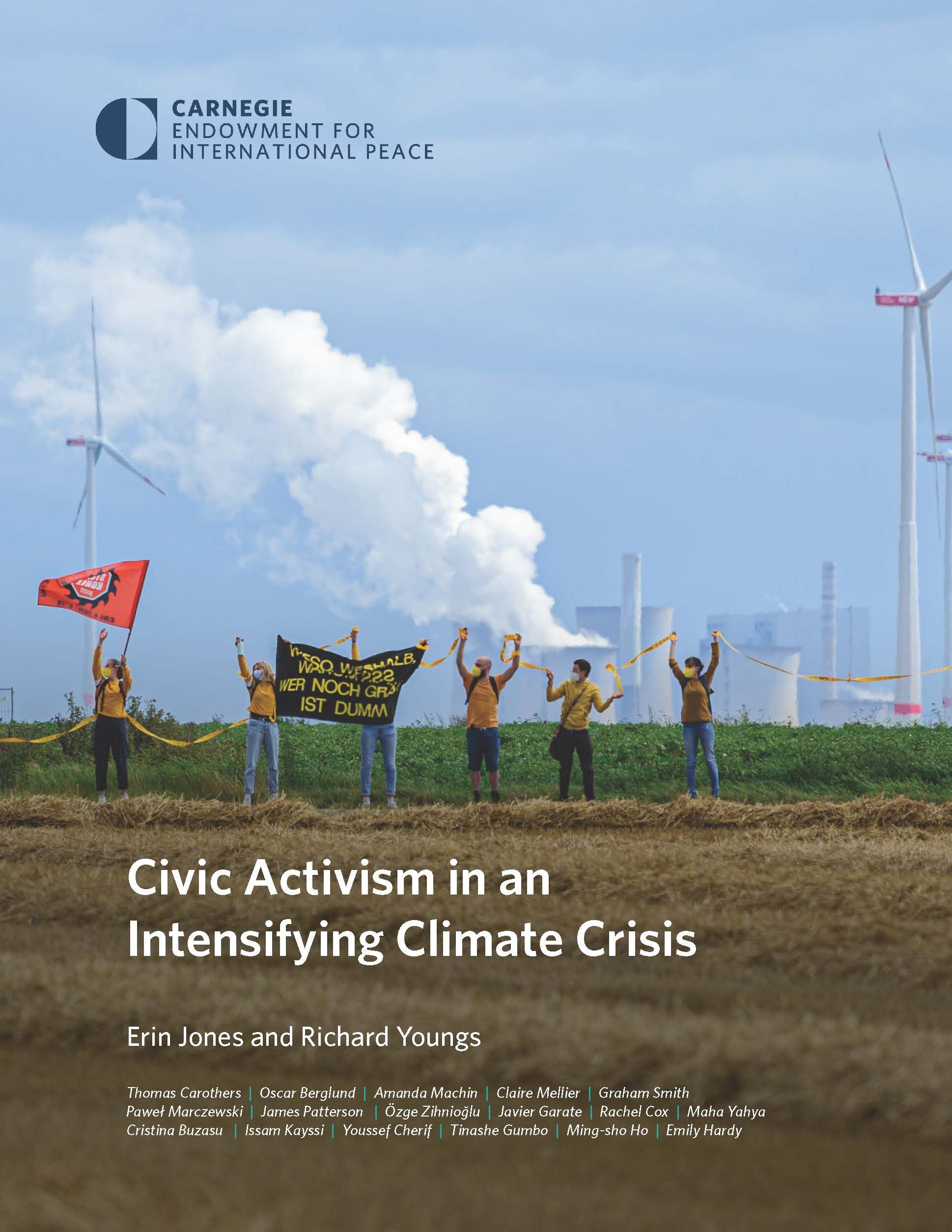
To address the deepening climate crisis, climate activism is employing a wider variety of tactics and aiming at a broader set of goals. In response, the movement faces stronger repression and civic backlash against climate action.


Erin Jones, Richard Youngs

A humanitarian crisis in Lebanon deepens, and Syrian refugees face a perilous choice: remain in a war-torn environment or return to Syria where they risk encountering significant dangers and discrimination. There are significant challenges and risks to their search for safety in Syria.
Haid Haid