

Q&A
Mark Medish
{
  "authors": [
    "Mark Medish"
  ],
  "type": "legacyinthemedia",
  "centerAffiliationAll": "dc",
  "centers": [
    "Carnegie Endowment for International Peace"
  ],
  "collections": [],
  "englishNewsletterAll": "ctw",
  "nonEnglishNewsletterAll": "",
  "primaryCenter": "Carnegie Endowment for International Peace",
  "programAffiliation": "russia",
  "programs": [
    "Russia and Eurasia"
  ],
  "projects": [],
  "regions": [
    "Caucasus",
    "Russia"
  ],
  "topics": [
    "Political Reform",
    "Democracy"
  ]
}
Source: Getty
Peter the Great once decreed that Russian monarchs should appoint their own successors. Peter forgot to do it himself, but the tradition eventually took root and survived the fall of both czardom and the Soviet Union. The upcoming succession of Russian President Vladimir Putin is no exception.
Source: Foreign Policy

When Russian voters go to the presidential polls on March 2, they will affirm a foregone conclusion. Running virtually unopposed and vehemently supported by the state-controlled mass media, Putin’s protégé Dmitry Medvedev will become the third president of the Russian Federation.
Medvedev’s impending victory makes the job of the domesticated Russian media easier. Like on-file obituaries, the post-election stories have already been written (subject to some minor final details, the electoral equivalent of the precise cause of death). The Putin succession was not bereft of drama, however. To the contrary, a colorful and contested presidential election process actually took place, though it wasn’t on the campaign trail or at the ballot box. The real Russian election occurred in a black box—namely, inside the soul of Vladimir Putin. To use an American analogy, one could say that the “superdelegates” in Putin’s head cast their ballots, and when all the debates were finished, the winner was Medvedev.
What the nomination process lacked in transparency, it made up for in suspense. Throughout most of 2007, Putin led his compatriots and Russia watchers on a wild-goose chase for his successor. The answer was hiding in plain sight: Medvedev was in fact the first name put into circulation as a potential president. Indeed, most cognoscenti were convinced he was the man a year ago, when he led Russia’s delegation to Davos for the annual meeting of the World Economic Forum. But doubts soon arose about the boyish technocrat from St. Petersburg. Was he too young, too callow, too Western, too non-KGB?
Over time, Medvedev’s candidacy seemed to fade in favor of other names such as Sergei Ivanov, Putin’s erstwhile KGB comrade, and later, Viktor Zubkov, the new prime minister. But they turned out to be mere also-rans. Of course, there were limits to the contest. Unauthorized candidates such as former world chess champion Garry Kasparov and Putin’s own former long-serving premier Mikhail Kasyanov were intimidated and sidelined. In the end, Medvedev came back from the dead to overcome the most formidable candidate of all: Vladimir Putin himself. A few days after anointing Medvedev last December, Putin revealed that he would stay on as prime minister himself, a job he held once before. Perhaps for the first time in history, a reigning king chose to become regent.
Putin deserves credit for honoring his constitutional term limit. With 70 percent approval ratings, he could easily have gone around it by popular acclamation. Thus, by opting to relinquish the top job, Putin is about to have his own version of a George Washington moment. Putin also deserves significant credit for picking a non-KGB agent to head the Russian state. It shows some imagination and must go against his professional instincts.
The Medvedev-Putin formula has produced a dual response from Russia-watchers in the West. Many investment analysts have dubbed it a “dream team” and hailed a “seamless transition.” In their view, President Medvedev will present a fresh face of economic pragmatism while Prime Minister Putin will ensure continuity and mitigate risk. For Russia’s foreign investors, this is “change we can believe in.”
Political experts, by contrast, have generally denounced the electoral charade and bemoaned the decline of Russian democracy. Indeed, Putin in his second term has tested the limits of democratic retrenchment. Even as living standards have improved, Russians have seen media freedoms curtailed, civil society gradually strangulated, and state organs recapturing the commanding heights of the economy. Russian society has become unmistakably less open and less free. To be sure, things are not as repressive as in Soviet times. Russians still enjoy many freedoms including the right to travel, and there is no ideological orthodoxy. But the country’s political direction is extremely worrisome. Loss of empire has not eliminated the Russian state’s centuries-old penchant for control of society.
For Russia watchers, there are two important and related practical questions about the succession plan. First, is this dream team a sign of strength or weakness? And second, is it a stable arrangement?
As obvious evidence of Putin’s political strength, there is no question he was the sole decider in selecting Medvedev to succeed him. The deeper question, however, is whether Putin was really free to exit the equation. The fact that he plans to assume the premiership, a lesser job, suggests that he needed to stay in power. But why? Perhaps warring Kremlin barons insisted that he do so to protect their interests. If that is true, the grand plan looks more like improvisation and compromise than the will of an omnipotent czar. There must be days when Putin envies his old European counterparts such as Gerhard Schröder, Jacques Chirac, and Tony Blair, who at least were free to go.
But even assuming Putin’s plan reflects his supremacy, one can question the dream team’s durability. The most obvious question is the constitutional division of powers. Putin has been at pains to remind people that the prime minister is “the highest executive power in the country.” Putin protests too much. The president has the discretion to dismiss a prime minister—as Putin did twice. It is the president who is commander in chief and sits in the mighty Kremlin. Thus, Putin is gambling that his supreme authority is portable outside the fortress walls. Furious efforts are reportedly under way to divide the spoils and lock key personnel into a matrix of appointments that will ensure the warring factions are satisfied and Putin controls the levers of power. But this scramble only highlights the underlying weakness of the Russian political system: Institutions are weak, patronage is king, and legitimacy runs thin.
As he guides his young successor, Putin must be reflecting on the fickle nature of history. He knows he was something of an accidental president. Far from being part of a KGB conspiracy, he was selected as premier by Boris Yeltsin as an afterthought in the summer of 1999. A few months later the unheralded Putin became president of Russia, and the rest is history.
There are early signs that, like Putin before him, Medvedev may prove to be his own man. It is striking how Medvedev has emphasized freedom in recent speeches: “Freedom is better than non-freedom. These words are the quintessence of human experience.” Only time will tell what the future Russian president has in mind, but the pull of Russian history remains strong. During the reign of Peter the Great, a German cartographer who visited Muscovy wrote of the Russians in his atlas: “The Common People live in great subjection to the Lords.” Today, Russia’s territory is again about the size it was under Czar Peter, and the mapmaker’s editorial comment still seems depressingly apt.
Mark Medish is vice president for studies at the Carnegie Endowment for International Peace. He served as a senior director for Russian, Ukrainian, and Eurasian affairs on the U.S. National Security Council from 2000 to 2001.
Former Visiting Scholar
Medish served in the Clinton administration as special assistant to the President and senior director for Russian, Ukrainian, and Eurasian Affairs on the National Security Council from 2000 to 2001.
Recent Work
Carnegie does not take institutional positions on public policy issues; the views represented herein are those of the author(s) and do not necessarily reflect the views of Carnegie, its staff, or its trustees.
In an interview, Sergei Melkonian discusses Armenia’s and Azerbaijan’s careful balancing act among the United States, Israel, and Iran.

Armenak Tokmajyan

The country’s leadership is increasingly uneasy about multiple challenges from the Levant to the South Caucasus.
Armenak Tokmajyan
In an interview, Daniela Richterova speaks about her book on Czechoslovakia’s Cold War ties to Palestinian groups and others.

Michael Young
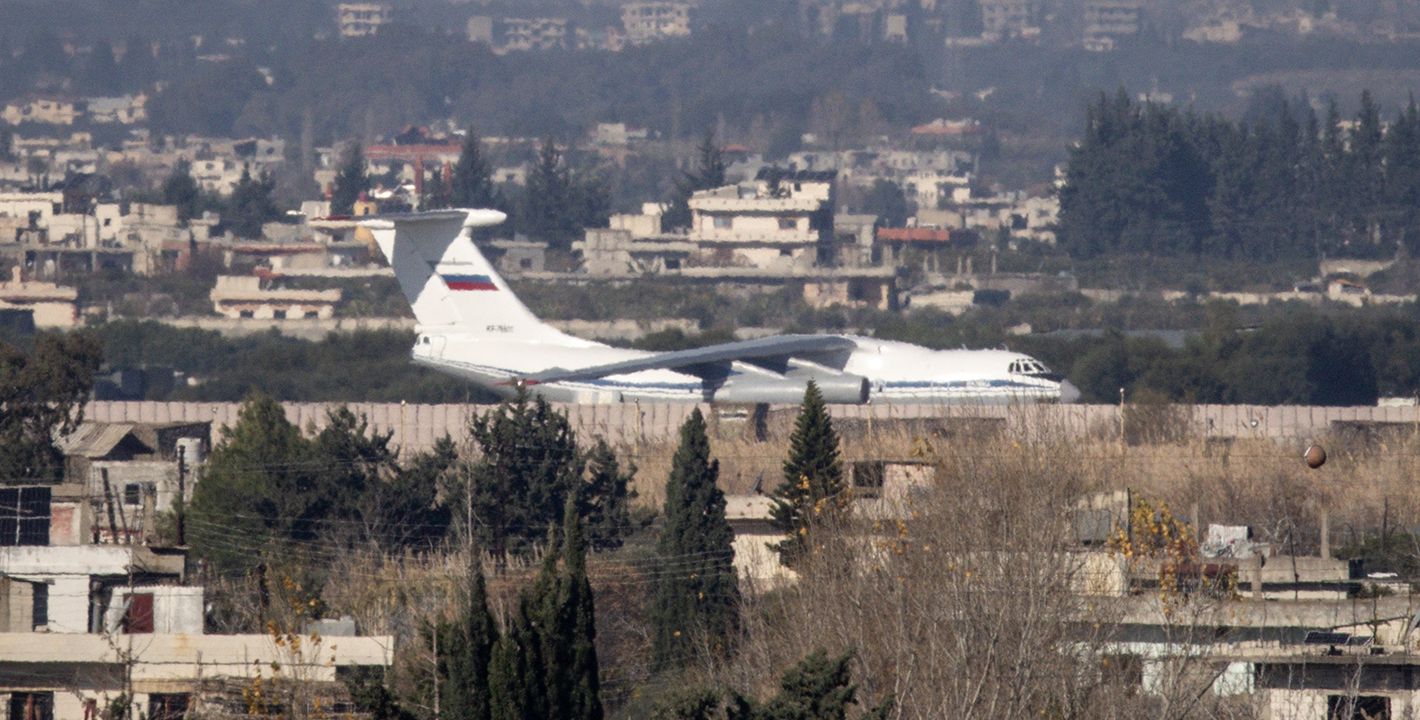
The downfall of the Assad regime represented a setback, but Russia’s primary focus remains Ukraine.
Sergei Melkonian
To address the deepening climate crisis, climate activism is employing a wider variety of tactics and aiming at a broader set of goals. In response, the movement faces stronger repression and civic backlash against climate action.

Erin Jones, Richard Youngs