

Commentary
Michael Pettis
{
  "authors": [
    "Michael Pettis"
  ],
  "type": "legacyinthemedia",
  "centerAffiliationAll": "dc",
  "centers": [
    "Carnegie Endowment for International Peace",
    "Carnegie China"
  ],
  "collections": [],
  "englishNewsletterAll": "asia",
  "nonEnglishNewsletterAll": "",
  "primaryCenter": "Carnegie China",
  "programAffiliation": "AP",
  "programs": [
    "Asia"
  ],
  "projects": [],
  "regions": [
    "North America",
    "United States",
    "East Asia",
    "Western Europe"
  ],
  "topics": [
    "Economy",
    "Trade",
    "Foreign Policy"
  ]
}
Source: Getty
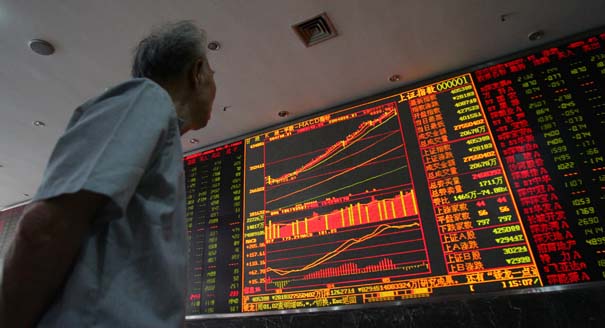
The overvalued U.S. dollar has been unable to adjust sufficiently against Asian currencies, creating a risk that the United States will revert to trade protectionism in its attempt to achieve a better trade balance.
Source: South China Morning Post

During the 1920s and shortly after the onset of the financial crisis beginning in 1929, several countries either abandoned the gold standard or pegged their currencies to gold at levels much below the prewar parity.
These countries all subsequently experienced rapid improvements in their trade balances and suffered much less from the ravages of the global contraction.
But other countries, most obviously the United States, were sharply constrained in their ability to adjust their currencies. Until the accession to the presidency in 1933 of Franklin Roosevelt, a gold sceptic, and given the enormous gold reserves accumulated by the US over the course of the decade, there was little appetite in Washington for what seemed like unorthodox monetary policies.
Consequently the US and other countries that were unwilling or unable to engage in competitive devaluations suffered much of the brunt of the adjustment from countries that were less constrained. The former were the countries, according to the authors, that were the most likely to resort to the "second-best" adjustment mechanisms of tariff barriers.
"Without the flexibility to depreciate their currencies, many gold-standard nations turned to trade restrictions in hopes that these would boost their domestic industries and curb unemployment. Thus, the 1930s' rush to protectionism was not so much a triumph of special-interest politics as it was a result of second-best macroeconomic policies," the authors write.
That shouldn't surprise us. In a world of contracting global demand, policymakers will be concerned not just with measures to boost domestic demand but also with measures that allow them to acquire a greater share of foreign net demand. The easiest way to do this is by currency realignment, but countries that are unable to realign their currencies will nonetheless be under pressure to find alternative ways of doing so.
What does this have to do with the present crisis in global demand? A great deal, perhaps. Most analysts agree that the US dollar is overvalued, and that part of the adjustment needed to bring the country's trade into a more sustainable balance will involve a depreciation of the dollar against the currency of its trading partners.
Unfortunately it has proven very difficult, if not impossible, for the dollar to adjust sufficiently against Asian currencies, where most analysts believe the biggest adjustments need to take place. Both the US and Europe are facing the kinds of constraints faced by countries that, according to Eichengreen and Irwin, were unable to engage in the competitive devaluations of the 1920s and 1930s.
Since the best policy option, currency devaluation, is not available, perhaps they too will be forced into the second-best option: tariffs and other forms of trade protection.
Nearly everyone agrees that a world that retreats into direct and indirect forms of trade protection is a world that is worse off and likely to recover more slowly from the global crisis. But in the 1930s, it was also widely understood that the collapse in international trade was a disaster that would only worsen the crisis.
And yet countries, seeking to protect their own trade positions, collectively engaged in behaviour that left them worse off.
Once again, it seems that we are going to make the same mistakes.

Nonresident Senior Fellow, Carnegie China
Michael Pettis is a nonresident senior fellow at the Carnegie Endowment for International Peace. An expert on China’s economy, Pettis is professor of finance at Peking University’s Guanghua School of Management, where he specializes in Chinese financial markets.
Recent Work
Michael Pettis
Michael Pettis
Carnegie does not take institutional positions on public policy issues; the views represented herein are those of the author(s) and do not necessarily reflect the views of Carnegie, its staff, or its trustees.

By failing to address Palestinian representation, the current process is bound to lead to just another temporary arrangement.

Nathan J. Brown

The armed forces champion a form of capitalism that is generating revenue, but its reliance on rent faces diminishing returns, leaving the country with massive sunk costs and deferred returns, deepening dependency on external borrowing.

Yezid Sayigh

Morocco and Algeria, each in its own way, are having to navigate the global economic fallout of the U.S.-Israeli military campaign against Iran.

Yasmine Zarhloule
Any move by the United States to make good on Trump’s suggestion that Washington persuade Damascus to confront Hezbollah militarily would have catastrophic consequences.

Kheder Khaddour
As talks begin between Washington and Tehran, Beirut has an opening to advance a regional plan for the party’s disarmament.

Michael Young