

Commentary
In an interview, Ian Lustick and Eli Clifton discuss their new book on why a prominent ally has so much influence in America.
Michael Young
{
  "authors": [
    "Michele Dunne",
    "Konstantin Eggert"
  ],
  "type": "legacyinthemedia",
  "centerAffiliationAll": "dc",
  "centers": [
    "Carnegie Endowment for International Peace",
    "Carnegie Russia Eurasia Center"
  ],
  "collections": [],
  "englishNewsletterAll": "menaTransitions",
  "nonEnglishNewsletterAll": "",
  "primaryCenter": "Carnegie Endowment for International Peace",
  "programAffiliation": "MEP",
  "programs": [
    "Middle East"
  ],
  "projects": [
    "Eurasia in Transition"
  ],
  "regions": [
    "Middle East",
    "Israel",
    "Palestine"
  ],
  "topics": [
    "Security",
    "Foreign Policy"
  ]
}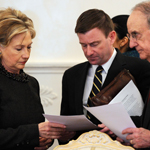
Source: Getty
The United Nations, the United States, the European Union, and Russia have called for a freeze on all Israeli settlement activity, increasing the international pressure on Israel in the hopes of reinvigorating indirect peace talks.
Source: BBC World Service

The quartet continues to play an important role in that it “prevents the Israelis, Palestinians, Syrians, etc. from trying to play one international power off the other,” notes Michele Dunne. It allows the international powers "to meet, agree, and formalize their approach."
For Russia, membership in the quartet requires walking a delicate balance between maintaining their credentials as friends of the Palestinians while avoiding undermining their strong relationship with Israel. Konstantin Eggert suggests that there shouldn't be high hopes for the quartet meeting. "I think that this quartet meeting is going to produce exactly what other meetings have produced before, and that's pretty much nothing," he said.

Former Nonresident Scholar, Middle East Program
Michele Dunne was a nonresident scholar in Carnegie’s Middle East Program, where her research focuses on political and economic change in Arab countries, particularly Egypt, as well as U.S. policy in the Middle East.
Konstantin Eggert
Carnegie does not take institutional positions on public policy issues; the views represented herein are those of the author(s) and do not necessarily reflect the views of Carnegie, its staff, or its trustees.

In an interview, Ian Lustick and Eli Clifton discuss their new book on why a prominent ally has so much influence in America.

Michael Young

As the U.S. stumbles in its war with Iran, we are likely to see an acceleration of its disengagement from the region.
Michael Young
It is improbable that Israel’s forthcoming elections will alter much in terms of how the country thinks about security.

Nathan J. Brown

Huawei pushed hard to enter the Egyptian data centers market, until the Americans made a better offer.

Angie Omar

The accord represents a pivotal moment in the region to avert a security vacuum in the Gulf.


Azeema Cheema, Mohanad Hage Ali