

Paper
Paul Salem
{
  "authors": [
    "Paul Salem"
  ],
  "type": "legacyinthemedia",
  "centerAffiliationAll": "",
  "centers": [
    "Carnegie Endowment for International Peace",
    "Malcolm H. Kerr Carnegie Middle East Center"
  ],
  "collections": [],
  "englishNewsletterAll": "",
  "nonEnglishNewsletterAll": "",
  "primaryCenter": "Malcolm H. Kerr Carnegie Middle East Center",
  "programAffiliation": "",
  "programs": [],
  "projects": [],
  "regions": [
    "Egypt",
    "Gulf",
    "Levant",
    "Maghreb"
  ],
  "topics": [
    "Political Reform",
    "Security"
  ]
}
Source: Getty
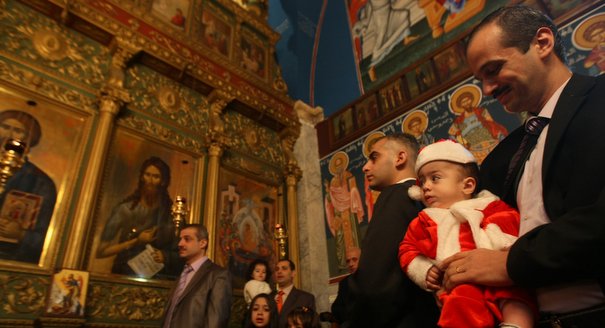
As the Christian population in Middle Eastern countries dwindles, it will take concerted regional action and international attention to enable Christian-Muslim coexistence in the region.
Source: L'espresso

The new decade began in the Middle East with a car bomb that went off minutes after midnight outside an Egyptian church and left more than twenty people dead. This bombing came just a few weeks after dozens were killed when radical Islamic gunmen took over a church in Iraq. The rise of al-Qaeda and the spread of radical Islamic movements have made a difficult situation worse for the Middle East’s Christian minorities.
Comprising 20 percent of the region’s population at the beginning of the twentieth century, the remaining 10-12 million make up only 5 percent of the population today. While Christians played prominent roles in the cultural, nationalist, leftist, and anti-colonial movements of earlier decades, they are increasingly sidelined from the Islamist politics of recent years. Since 2011, they have also borne some of the brunt of the confrontation between radical Islam and the (Christian) West.
In Iraq, almost half a million Christians have fled the country since the American-led invasion of 2003. After the US-led allied forces destroyed the Iraqi state, the community was left with no safe haven or means of protection. They were caught in Arab-Kurdish and Sunni-Shii confrontations, as well as direct attacks from al-Qaeda, and now number less than 3 percent of the population. In Egypt, the Christian Coptic community, which makes up about 10 percent of the population, suffers from state discrimination and hostility from radical Islamist movements.
In Sudan, the northern government was at war with its partially Christian south for decades—a war that is ending in secession. Christians in the Palestinian territories have dropped from 15 percent of the Arab population in 1950 to around 1 percent today, pushed out by the conditions of Israeli occupation and the rise of militant Islam. In Syria, the country’s 10 percent Christian population has been generally protected under the Assad regime, although its numbers are also gradually dwindling.
Lebanon used to be the only Arab country with a Christian majority, and as such had a Christian-dominated government from 1920 until 1990. The demographic majority became a minority in the 1950s, and a long civil war from 1975 to 1990 led many Christians to move abroad and ended with the Christian president being stripped of many of his powers.
Maintaining the historic Christian presence in the Middle East will not be easy, as the risks are numerous. The dramatic exodus from Iraq shows that state-provided stability and security, imperfect as it is, is still far preferable to chaos and state-failure. But governments must be much more proactive in providing inclusion and security for all minorities. Egypt, for instance, can and should do much more to include and protect the Coptic community.
Regional and international coordination is also necessary. The Sudanese government, for example, should be warned by Arab and international governments to guard against retribution on southerners who might be left behind in northern Sudan after secession. In Iraq, some have suggested setting up temporary safe havens or other exceptional measures to stem the flow.
Muslims and Christians have a lot at stake in preserving moderation and tolerant societies in the Middle East. They have lived and worked side by side for centuries to the mutual benefit of both. But it will take more governmental responsibility, and concerted regional and international attention to make sure that the twenty-first century is not the last century of Christian-Muslim coexistence in the birthplace of both religions.
Senior Fellow at the Middle East Institute
Paul Salem is a senior fellow at the Middle East Institute.
Recent Work
Paul Salem
Paul Salem
Reconciliation councils are emerging throughout the country to mediate in intracommunal disputes, many from the war years.
Natacha Danon
The civil war in Syria may have ended, but the country continues to serve as a source for the trafficking of illegal substances into and via Jordanian territory.

Armenak Tokmajyan, Laith Qerbaa
As the U.S.-led Coalition withdraws, the Kurds’ reliance on Baghdad, and on themselves, will only increase.
Wladimir van Wilgenburg
The Zaidi government’s objective to collect weapons is constrained by regional conflict, but it can take certain measures at home.
Ali Al-Mawlawi

Middle Eastern states should welcome an accelerated U.S. disengagement from their region.

Michael Young