{
  "authors": [
    "Nathan J. Brown"
  ],
  "type": "legacyinthemedia",
  "centerAffiliationAll": "dc",
  "centers": [
    "Carnegie Endowment for International Peace",
    "Malcolm H. Kerr Carnegie Middle East Center"
  ],
  "collections": [
    "Arab Awakening"
  ],
  "englishNewsletterAll": "menaTransitions",
  "nonEnglishNewsletterAll": "",
  "primaryCenter": "Carnegie Endowment for International Peace",
  "programAffiliation": "MEP",
  "programs": [
    "Middle East"
  ],
  "projects": [],
  "regions": [
    "North Africa",
    "Egypt"
  ],
  "topics": [
    "Political Reform"
  ]
}
Source: Getty
In The Media
The Egyptian Constitution's Rulebook for Change
Even if President Mubarak were to step down, provisions in the Egyptian constitution could undermine the ultimate goal of a regime change and a transition toward full democracy.
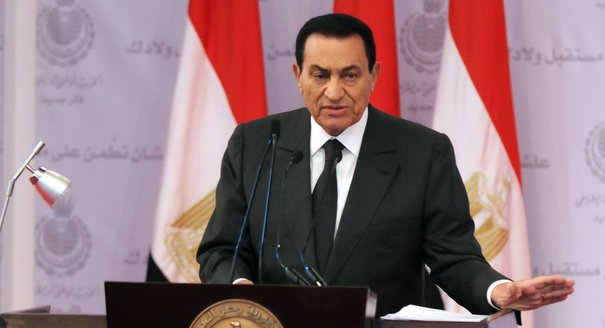
The Egyptian Constitution's Rulebook for ChangeWhen the White House calls for President Husni Mubarak to resign now, we are not simply calling for a new president to take his place. Mubarak stepping down immediately means something very different than some might think it does. Rather than simply replacing the man on top, we are close to calling for something like regime change. That may be a good thing, and indeed, many of the demonstrators are clearly aiming for precisely that. But it is not clear that those who simply call for Mubarak to leave have thought through the details of what happens next.
In order to think this through, let's go to the rulebook, which is the Egyptian constitution. Does that really matter? Well, it may or may not. But Mubarak on Tuesday and Vice President Omar Sulayman today talked about the constitution explicitly -- and Sulayman in particular sounded more like a constitutional law professor than an intelligence man. And no wonder. The text gives Egypt's current leaders the tools that they want, so they would try to follow it. If Mubarak stays on until September -- even as a figurehead (and listening to Sulayman today it sounded as if that is what the Egyptian president has become) -- the regime can carefully manage the process. If Mubarak leaves early -- as the U.S. and the opposition demands --things become messier
According to the constitution, if the President steps down, he is not succeeded by the Vice President. That's right -- if Mubarak resigns and gets on an airplane tonight, Omar Sulayman, who seems to be in effect acting president at the moment, would not take his place. Instead, the post would be filled by Fathi Surur, the speaker of the People's Assembly. Surur is a former law professor and a reliable regime stalwart. He is not from the military or the security apparatus and is widely regarded as a figure whose job has been to manage the parliament for the regime. And he has done so effectively. His presidency would delight nobody. (Some elements of the opposition have suggested that Surur should be pressed to turn down the post, in which case the job falls to the chief justice of the Constitutional Court. His profile is much lower than Surur but his career would inspire no more confidence.)
As acting President, either the speaker or the chief justice would appear to be simply a weak, transition figure. And in fact, that is precisely what he would be. If he takes over as acting President, he cannot run for election for the post -- and new elections have to be held within 60 days. Since there is not enough time to amend the constitution, that means the existing provisions would have to be used. And those provisions were designed with one purpose in mind: to allow the existing leadership to designate the president. There is virtually no way the opposition could field a viable candidate under such conditions.
So if Mubarak resigned, there would be three choices:
Follow the constitution and wind up with the regime handpicking a successor after 60 days for a full presidential term. That hardly resolves anything. The procedures are written in such a way that Sulayman could be nominated, but it would break the promise both Mubarak and Sulayman made for constitutional reform. This procedure would not even put lipstick on the regime's current face.
Follow the constitution with the promise that the new president (presumably Sulayman) pick up the constitutional reform process. That puts the crisis on hold for 60 days and offers the opposition promises for reform that might be redeemed later -- and might not be. This would put lipstick on, but not much else, particularly given the toxic lack of trust in the regime's promises.
Suspend the constitution and negotiate a transition between the current regime leaders and the opposition. And then we are in regime change territory, operating outside the existing rules. If the process were successful, it would not produce merely a reconfigured regime but would be moving toward a different kind of political system. The opposition has made clear that it wants such an outcome, but it has not sketched out any vision in detail. The negotiations over transition would be difficult and confusing, demanding that the opposition transform its negative platform (Mubarak must leave) into a positive one.
If Mubarak resigned today, the third option is the only one that offers anything like real political change. It may be the best outcome and it is what the opposition is effectively demanding. It may very well deserve our support, but we should know that when we call for Mubarak to step down, then legally at least this is where we are effectively pushing.
UPDATE: A group of leading intellectuals (including my good friend and colleague Amr Hamzawy), former officials, and activists and activists) have hit upon an ingenious constitutional solution. Published in the Egyptian daily al-Shuruq and translated by my home away from home, the Carnegie Endowment, the proposal suggests that Mubarak deputize Sulayman to serve as president. This is constitutionally possible—if the president is unable to serve (in this case presumably because of political ill health) he can hand power over temporarily (in this case until the fall when his term is over) to the vice president.By stopping short of a final resignation, the need for immediate elections is removed and there is enough time to amend the constitution.
As I say, this is an ingenious constitutional solution. But would it work politically? It is a promising effort but also one that rests on hopes that may not be warranted. It works only if Mubarak cooperates and those currently running the country make their peace with a real transition. In other words, it would be a way for the regime to sue for a gentle and orderly peace; it has the added benefit of preserving legal forms (always helpful in a country trying to build the rule of law). But there is no sign that the regime is looking for a gentle transition or even a real compromise with the opposition.
Nathan J. Brown, a professor of political science and international affairs at George Washington University, is a distinguished scholar and author of nine books on Arab politics and governance, as well as editor of five books.
Carnegie does not take institutional positions on public policy issues; the views represented herein are those of the author(s) and do not necessarily reflect the views of Carnegie, its staff, or its trustees.
More Work from Malcolm H. Kerr Carnegie Middle East Center
The armed forces champion a form of capitalism that is generating revenue, but its reliance on rent faces diminishing returns, leaving the country with massive sunk costs and deferred returns, deepening dependency on external borrowing.
Understanding how farmers in the Oued Sahel-Soummam Valley grapple with climate change is essential for addressing the paradoxes through which adaptation, operating at both individual and institutional levels, deepens the region’svulnerability and erodes the social fabric and agrarian identity that once defined life.
The UN Support Mission in the country should reassess its approach so that consensus between the warring parties becomes the eventual goal, rather than a procedural matter that dogs the negotiating process at every turn.