

Paper
Paul Salem
{
  "authors": [
    "Paul Salem"
  ],
  "type": "legacyinthemedia",
  "centerAffiliationAll": "",
  "centers": [
    "Carnegie Endowment for International Peace",
    "Malcolm H. Kerr Carnegie Middle East Center"
  ],
  "collections": [
    "Arab Awakening"
  ],
  "englishNewsletterAll": "",
  "nonEnglishNewsletterAll": "",
  "primaryCenter": "Malcolm H. Kerr Carnegie Middle East Center",
  "programAffiliation": "",
  "programs": [],
  "projects": [],
  "regions": [
    "Gulf",
    "Levant",
    "Lebanon",
    "Syria",
    "Middle East",
    "Iran"
  ],
  "topics": [
    "Political Reform",
    "Security"
  ]
}
Source: Getty
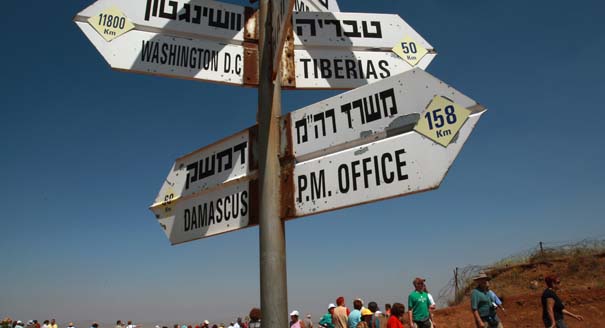
Upheaval in Syria and the imminent U.S. withdrawal from Iraq mark a potentially massive power shift in the Middle East which could bring new opportunities for peace, and risks of war, for Israel, Syria, and Lebanon.
Source: National

Iran has been riding an arc of regional ascendancy since America's post-September 11 wars toppled its two main enemies: the Taliban in Afghanistan and the Saddam regime in Iraq. Over the past eight years, Iran has built a strong web of influence in Iraq, with Shiites as well as Sunni and Kurdish groups, both in government and in the opposition. Given the US withdrawal, Iran could deepen and consolidate that influence.
But with the Syrian regime facing potential collapse, Iran could lose its longest-standing Arab ally. The situation in Syria has only gone from bad to worse. Internally, the regime has survived eight months of the uprising - more than the regimes of Egypt's Mubarak or Tunisia's Ben Ali did. But it is at war with wide sections of its population, the Syrian economy is in deep crisis, and Damascus has lost its friends in the Arab world and Turkey.
Losing Syria would be Iran's biggest strategic blow since the Iran-Iraq war of the 1980s. In a recent interview with the Wall Street Journal, the head of the opposition's Syrian National Council, Burhan Ghalioun, said that a new government in Syria would cut strategic ties to Iran and stop arms transfers to Hizbollah. So, if the Assad regime falls, Iran will not only lose Syria, it will also lose strategic access to Hizbollah; access to Hamas and the Palestinians; and access to the Israeli border. And that might mark the end of Iran's arc of ascendancy, and usher in a period of reduced Iranian influence in the Middle East.
Tehran will likely react to that power shift by trying to build more influence in Iraq. However, Iranian influence over tomorrow's Baghdad is not a foregone conclusion. Iraqi and Arab nationalism run deep in Iraq, and Iran might find it as hard to dominate Iraq as the Americans did.
Iraq and Iran fought a long war in the 1980s, and Iran's popularity even among Iraqi Shiites is quite low. Iraqi and Iranian Shiites also vie for religious leadership between the historical primacy of Najaf, and the recent leadership role centred in Qom. Furthermore, the government of Baghdad might want to maintain strong strategic relations with the United States, even after the troop withdrawal, to build its own capacities and avoid becoming a client state of Iran.
The fall of the Assad regime might also create new dynamics in the Arab-Israeli conflict. Without Syria's cover, Hizbollah, which receives training, weapons and financial support from Iran, and needs the overland bridge via Syria, would be strategically more vulnerable. If Israel felt that it could wage another war against Hizbollah without the latter being able to fully rearm, as Hizbollah did after 2006, this might create conditions for another Israel-Hizbollah war. This war would devastate Lebanon yet again, but would create new power balances in the Levant.
Alternatively, a new regime in Damascus might create an opportunity for a breakthrough in the Arab-Israeli peace process. Any new Syrian regime would want to regain the Golan Heights from Israel. In fact, the Syrian National Council has already indicated its interest in a negotiated return of the Golan.
Under new leadership, Syria would also want to find a way to weaken Hizbollah. This might create an opportunity for a revival of Syrian-Israeli peace talks that were frozen in 2008. If Syria and Israel move toward peace, Lebanon would have to follow suit. And Hizbollah would be faced with the choice of defying Syria, or finding a way to accept the new realities: this would include gradually disarming or integrating its weapons within a national defence framework, in exchange for a return of the Shebaa Farms, Ghajar and other parts of occupied Lebanese territory.
Movement on Syrian-Israeli peace talks in a post-Assad Syria could create new dynamics and new possibilities for a final breakthrough in the Israeli-Palestinian peace talks. The region might finally reach a general Arab-Israeli peace agreement incorporating the Arab peace offer of 2002.
In all cases, the Levant will witness a power shift in the months ahead. This will create new conditions of opportunity as well as risk. We would do well to build on the opportunities and avoid the dangers of further confrontation and conflict.
Senior Fellow at the Middle East Institute
Paul Salem is a senior fellow at the Middle East Institute.
Recent Work
Paul Salem
Paul Salem
Carnegie does not take institutional positions on public policy issues; the views represented herein are those of the author(s) and do not necessarily reflect the views of Carnegie, its staff, or its trustees.

Middle Eastern states should welcome an accelerated U.S. disengagement from their region.

Michael Young

In an interview, former ambassador Charles Freeman assesses the Trump administration’s war against Iran.
Michael Young

The accord represents a pivotal moment in the region to avert a security vacuum in the Gulf.


Azeema Cheema, Mohanad Hage Ali

In an interview, Jason Burke discusses his sweeping account of the “revolutionists” who so shaped the 1970s and early 1980s.
Michael Young
Lying at the heart of Lebanon’s dysfunction is an inability to secure accountability and institutional legitimacy.
Maha Yahya