• Research
  • Diwan
  • About
  • Experts
Carnegie Middle East logoCarnegie lettermark logo
LebanonIran
{
  "authors": [
    "Uri Dadush",
    "Kati Suominen"
  ],
  "type": "legacyinthemedia",
  "centerAffiliationAll": "",
  "centers": [
    "Carnegie Endowment for International Peace"
  ],
  "collections": [],
  "englishNewsletterAll": "",
  "nonEnglishNewsletterAll": "",
  "primaryCenter": "Carnegie Endowment for International Peace",
  "programAffiliation": "",
  "programs": [],
  "projects": [],
  "regions": [
    "United States",
    "China",
    "North America"
  ],
  "topics": [
    "Economy",
    "Trade"
  ]
}
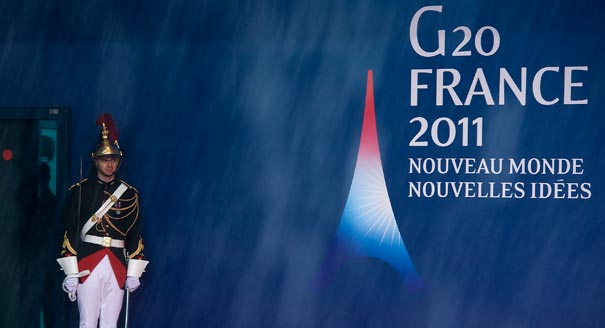
Source: Getty

In The Media

Is There Life for the G20 Beyond the Global Financial Crisis?

In 2008, the G20 proved to be an effective forum for coordinating action to stem the global financial crisis. But now that the storm has passed, it remains to be seen if the G20 is capable of assuming leadership on key economic governance issues.

Link Copied
By Uri Dadush and Kati Suominen
Published on Jan 31, 2012

Source: Journal of Globalization and Development

The G20 summit of heads of state, a creature born of the financial crisis, has appointed itself as the preeminent forum for global economic policymaking. Notwithstanding its original design to curb food price volatility, reform the global monetary system, and improve the working of the G20 itself, the group’s latest summit in Cannes, France in November 2011 was hijacked by the prolonged Eurozone financial crisis. An enormous source of turbulence in the world economy, Europe’s problems are the world’s problems and should be on the G20 agenda. But the Euro crisis also diverted the G20’s focus from its long-term imperative: ensuring sustained global economic growth. Instead, the outcome of the summit was inconclusive, vague, and thus modest: the group agreed in principle to increase the resources of the International Monetary Fund to respond to Europe’s woes; China modestly strengthened its pledge to move towards exchange flexibility to assuage critics of its currency manipulation; and the leaders yet again expressed their commitment to the Doha trade round.

The French summit epitomizes the difficulties in making sweeping yet specific decisions in a large, diverse group of nations with divergent interests. Comprising ten emerging markets, nine advanced economies, and the EU, the G20 reflects the reality of a world economy where developing and advanced countries are starting to have roughly equal economic weight. By including the largest emerging markets, it has the potential to fill a large gap in global economic governance that its predecessors – the G4 launched by US Treasury Secretary George Schultz in 1973, and the subsequent permutations, G5, G7 club of rich countries, and the G8, which also included Russia – were not built to bridge. The G7 helped the liberal democracies prevail in the Cold War and worked to enhance global macroeconomic stability, while the G8 sought to engage Russia after the collapse of the Soviet bloc. But with the onslaught of economic globalization and the rise of emerging economies, both groups are outdated as venues for global policy coordination. The G20, on the other hand, looks and feels like a 21st century forum.

About the Authors

Uri Dadush

Former Senior Associate, International Economics Program

Dadush was a senior associate at the Carnegie Endowment for International Peace. He focuses on trends in the global economy and is currently tracking developments in the eurozone crisis.

Kati Suominen

German Marshall Fund

Authors

Uri Dadush
Former Senior Associate, International Economics Program
Uri Dadush
Kati Suominen
German Marshall Fund
EconomyTradeUnited StatesChinaNorth America

Carnegie does not take institutional positions on public policy issues; the views represented herein are those of the author(s) and do not necessarily reflect the views of Carnegie, its staff, or its trustees.

More Work from Malcolm H. Kerr Carnegie Middle East Center

  • Commentary
    Diwan
    In the Trump Gaza Plan, Diplomatic Failure is Success

    By failing to address Palestinian representation, the current process is bound to lead to just another temporary arrangement.

      Nathan J. Brown

  • Paper
    Egypt’s Military Landlord Economy and its Limitations

    The armed forces champion a form of capitalism that is generating revenue, but its reliance on rent faces diminishing returns, leaving the country with massive sunk costs and deferred returns, deepening dependency on external borrowing.

      Yezid Sayigh

  • Article
    From Hormuz to the Maghreb: The Geopolitical Reach of a Gulf Crisis

    Morocco and Algeria, each in its own way, are having to navigate the global economic fallout of the U.S.-Israeli military campaign against Iran.

      Yasmine Zarhloule
  • Commentary
    Diwan
    New Syria, Old Lebanon: Absence of the State

    Any move by the United States to make good on Trump’s suggestion that Washington persuade Damascus to confront Hezbollah militarily would have catastrophic consequences. 
      Kheder Khaddour
  • Commentary
    Diwan
    Lebanon Should Try to Place Hezbollah on the U.S.-Iran Table

    As talks begin between Washington and Tehran, Beirut has an opening to advance a regional plan for the party’s disarmament.

      Michael Young

Get more news and analysis from
Malcolm H. Kerr Carnegie Middle East Center
Carnegie Middle East logo, white
  • Research
  • Diwan
  • About
  • Experts
  • Projects
  • Events
  • Contact
  • Careers
  • Privacy
  • For Media
Get more news and analysis from
Malcolm H. Kerr Carnegie Middle East Center
© 2026 Carnegie Endowment for International Peace. All rights reserved.
