

Commentary
Judy Dempsey
{
  "authors": [
    "Judy Dempsey"
  ],
  "type": "legacyinthemedia",
  "centerAffiliationAll": "",
  "centers": [
    "Carnegie Endowment for International Peace",
    "Carnegie Europe"
  ],
  "collections": [
    "Transatlantic Cooperation"
  ],
  "englishNewsletterAll": "",
  "nonEnglishNewsletterAll": "",
  "primaryCenter": "Carnegie Europe",
  "programAffiliation": "",
  "programs": [],
  "projects": [],
  "regions": [
    "Russia",
    "Europe",
    "North America"
  ],
  "topics": []
}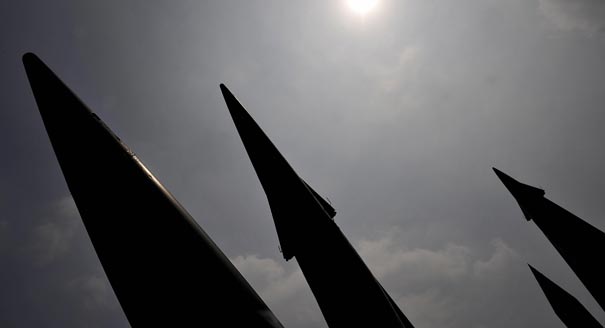
Source: Getty
In an interview with Judy Dempsey, former U.S. senator Sam Nunn discusses the Euro-Atlantic Security Initiative.
Source: Munich Calling

The former Democrat senator from the state of Georgia who during his service was chairman of the Senate Armed Services Committee, is one of the founding members of the Nuclear Threat Initiative (NTI).
Set up in 2001, its goal is to strengthen global security by reducing the risk of use and preventing the spread of nuclear, biological, and chemical weapons and to work to build the trust, transparency, and security which NTI members believe are preconditions to the ultimate fulfillment of the Non-Proliferation Treaty’s goals and ambitions.
NTI dove tails with Mr. Nunn’s co-chairmanship of the Euro-Atlantic Security Initiative, established two years ago.
The project brought together former policy makers, diplomats, generals and business leaders from Russia, North America and Europe to look at options to address the region’s faltering security system and to chart a roadmap of practical action that would lead to a more secure future.Along with the other two co-chairmen, Wolfgang Ischinger, chairman of the MSC and veteran German diplomat, and Igor Ivanov, former Russian foreign minister, Mr. Nunn has been shepherding the EASI’s cohorts of experts towards making recommendations on how to put closure to post Cold War conflicts.
The issues EASI focused on were military security, human security and economic security. They included ballistic missile defense, frozen conflicts, energy and Turkey and strategic nuclear missiles.
Though all the topics are so different and complex, the persistence of the problems each share similar weaknesses: lack of dialogue and trust -- as Mr. Nunn explains in this interview with Judy Dempsey for MSC.
INTERVIEW WITH SAM NUNN, JANUARY 30, 2012
DEMPSEY: You – a group of retired high officials from the U.S., Russia and Europe - have put forward far-reaching proposals for cooperation on topics as varied as missile defense, the exploration of the Arctic or solving frozen conflicts in the Caucasus. Do you believe any of this will ever be implemented?
NUNN: We are aiming to build a European Atlantic Security Community where you can discuss differences of opinion, knowing in advance that you are going to solve them by diplomatic and legal means without the threat of military force. But we have had distrust built up over a long period of time. We believe the best way to avoid road blocks is to work together on a number of concrete initiatives.
DEMPSEY: Let’s look at one of them – your proposals on dealing with the frozen conflicts in places like Transnistria, Nagorno-Karabakh, South Ossetia and Abkhazia. How can you persuade the Russians that the West is not seeking influence and territory, but human security?
NUNN: We don’t have a magic bullet. But Russia and Poland have recently given us a good lesson on what you can do if leaders set aside historical mistrust and develop a cooperative attitude. It’s a matter of mood and attitude. Those two countries have made enormous amounts of progress in the last couple of years. So what we suggest is to begin a dialogue on these frozen conflicts, depending on the parties involved and whether they would accept some outside support. We could have a group of former heads of state, like a group of elders, working on various possible conflicts.
DEMPSEY: So far, Russia is prolonging these frozen conflicts.
NUNN: Russia has a lot of fears and apprehensions based on its history. The Russians have been invaded a number of times, and that makes them see threats in a different perspective. That is why we are focusing on a politically-mandated dialogue between military leaders in NATO and Russia as well as between Russia and other neighboring countries.
DEMPSEY: What would that achieve?
NUNN: Discussing one’s fears and apprehensions about other nations at the military level will not solve them immediately. But military-to-military discussions, if they take place over a period of time, can really help both sides understand each other’s position. They serve to give warnings so that countries don’t fear a sudden attack. In these discussions, military leaders could also be charged with the responsibility of determining where force postures and positioning of military forces could be changed to ease the other side’s apprehensions. So I think that that kind of dialogue over a period of time would pay off in terms of greatly increased confidence and dissipation of mistrust.
DEMPSEY: Is there sufficient political leadership to push through this kind of dialogue?
NUNN: Governments have to want to solve the problems, that’s true. And problems are always hard to solve in the middle of elections. But you know, there are always elections somewhere.
DEMPSEY: Should Turkey be brought in to play a bigger role?
NUNN: Turkey is enormously important. Turkey is a great example of a Muslim government that is part of the international community and participates on the basis of the rule of law. There will always be problems, for instance over the Kurds. But by and large, Turkey is of great importance to Europe, to NATO and indeed to Russia, that Turkey be included in as many important forums as possible.
DEMPSEY: Do the Europeans grasp the scale of these issues?
NUNN: We are a group of 25 people that represent the European nations, Russia and the U.S. and we have had very encouraging discussions over the last two years. Our countries have the potential of tackling some of the biggest problems in the world. We can lead on them, or else we are going to get so far behind on them that they become increasingly unlikely to be resolved.
In this list I include nuclear arms cooperation, biological challenges in terms of health and possible weaponization, trade, economy, energy, environment, cyber security. All of those things are hard to handle individually, and all of them demand leadership. Either the Euro-Atlantic Security community will be formed and really be meaningful, or all these issues will loom larger and larger.
This article was originally published in the Munich Security Conference's Munich Calling.

Nonresident Senior Fellow, Carnegie Europe
Judy Dempsey is a nonresident senior fellow at Carnegie Europe
Recent Work
Judy Dempsey
Judy Dempsey
Carnegie does not take institutional positions on public policy issues; the views represented herein are those of the author(s) and do not necessarily reflect the views of Carnegie, its staff, or its trustees.
The country’s leadership is increasingly uneasy about multiple challenges from the Levant to the South Caucasus.

Armenak Tokmajyan
In an interview, Daniela Richterova speaks about her book on Czechoslovakia’s Cold War ties to Palestinian groups and others.

Michael Young
But growing hostility to Israeli actions is too late to save the West from the lasting damage of Gaza.
Michael Young
The downfall of the Assad regime represented a setback, but Russia’s primary focus remains Ukraine.
Sergei Melkonian
Why did Bashar al-Assad’s armed forces fail to act, unlike those in Egypt, Libya, Algeria, and Sudan?

Yezid Sayigh