

Commentary
Yukon Huang, Isaac B. Kardon, Matt Sheehan
{
  "authors": [
    "Yukon Huang"
  ],
  "type": "legacyinthemedia",
  "centerAffiliationAll": "dc",
  "centers": [
    "Carnegie Endowment for International Peace",
    "Carnegie Europe"
  ],
  "collections": [],
  "englishNewsletterAll": "asia",
  "nonEnglishNewsletterAll": "",
  "primaryCenter": "Carnegie Endowment for International Peace",
  "programAffiliation": "AP",
  "programs": [
    "Asia"
  ],
  "projects": [],
  "regions": [
    "East Asia",
    "China",
    "Asia"
  ],
  "topics": [
    "Economy"
  ]
}
Source: Getty
If Beijing wants to deal with the issues that have spawned rising social unrest, it needs to reshape China’s economic institutions and control over basic resources in ways that moderate, rather than exacerbate, disparities.
Source: Financial Times

Yet the leadership recognises that the country faces daunting economic, social and environmental challenges including vulnerabilities created by past excessive credit expansion. Wen Jiabao, China’s premier, warned on Monday that growth is set to slow this year. It is aiming for a 7.5 per cent rise in gross domestic product, the first time since 2004 that the annual target has dropped below 8 per cent.
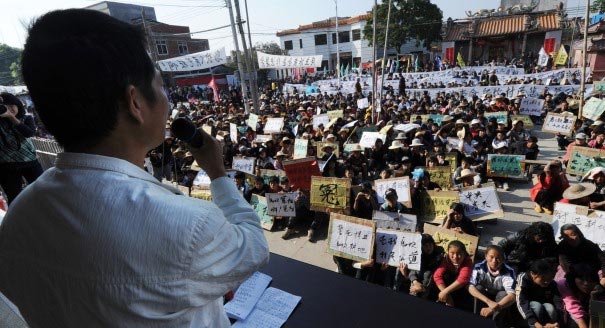
But these are likely to be seen as technicalities among those gathered in Beijing. Far more worrisome for the political elite is the question of how to deal with rising social unrest. This was underscored by the global attention given to the Wukan village land-related protests that pushed provincial leaders to support more open local elections. Other disturbances such as last year’s strikes by truck drivers in Shanghai and recent unrest by migrant workers at Foxconn reflect the tensions stemming from decades of widening social inequality that seems out of place for a regime that originated from egalitarian ideals.For all of China’s economic successes – which lifted some 600m out of poverty – income disparities nevertheless have ratcheted up with the gini coefficient now at 0.47 compared with around 0.25 in the mid-1980s. This has fostered a sense that the system is uncaring, and that opportunities are now being determined by one’s status rather than initiatives.
There is a strong link between the growth in social unrest and the reality that the reform process launched by Deng Xiaoping three decades ago has stalled. Rising social tensions come broadly from two forces, namely limitations of China’s national budget and banking systems in addressing distributional needs and distortions arising from controls over use of land and labour.
A key weakness of the process of economic liberalisation is its failure to provide the fiscal means for the authorities to limit inequalities that came with rapid growth. China’s banking system – which is unique in handling a large share of the financing of public services that would normally go through the budget – accentuates these problems.
The unusually limited role that the national budget plays in supporting expenditures makes it difficult to respond to rising expectations, particularly for an economy where the state controls the bulk of resources. The budget as a proportion of the size of the economy is only two-thirds that of other middle income countries, and half that of European Union. As a consequence, welfare spending has been inadequate, amounting to around half the level (as a share of GDP) of comparable countries.
Rather than strengthening its fiscal system, Beijing relies on its banks to fund much of the growing demand for infrastructure. This has led to episodes of expanded lending to local governments, which (due to concerns regarding repayment) has skewed credit in favour of better off localities and towards the larger state enterprises, rather than private small-scale operators.
Thus the ability to make redistributive transfers (handled elsewhere either by decentralised budgets or through the quasi-fiscal expenditures of banks) has not been available.
No segment of society feels these social pressures more than the 250m migrant workers who do not have access to the same services and employment choices as established residents. As a younger generation without the pre-reform poverty experience matures, their semi-indentured status no longer matches their aspirations in a modernising China. Even with real wage increases of 10-15 per cent annually, increasing numbers of migrants have either returned to their native provinces or increased their demands for more rights.
Migration pressures are also linked to the frequent disputes over land. This reflects the failure to clarify use rights and establish more transparent and equitable transfer systems since all land is formally owned by the state. Local authorities are starved of much needed revenues in the absence of structured property taxes that could serve as the fulcrum for their revenue base. Thus they have been forced to sell off land use rights to balance their budgets. By under paying owners and charging premiums to developers, local bureaucrats are able to capture countless multiples of what they originally paid. The process offers considerable opportunities for corruption and thus weakens trust at community levels. This accounts for some of the more contentious acts of social protest as in Wukan.
If the incoming senior leadership wants to deal with the issues that have spawned rising social unrest, it needs to rethink some of the unintended consequences of its current growth-driven model. Paramount is to reshape China’s economic institutions and control over basic resources in ways that moderate, rather than exacerbate, disparities.
This article was originally published in the Financial Times.

Senior Fellow, Asia Program
Huang is a senior fellow in the Carnegie Asia Program where his research focuses on China’s economy and its regional and global impact.
Recent Work

Yukon Huang, Isaac B. Kardon, Matt Sheehan
Yukon Huang, Genevieve Slosberg

Huawei pushed hard to enter the Egyptian data centers market, until the Americans made a better offer.

Angie Omar

The armed forces champion a form of capitalism that is generating revenue, but its reliance on rent faces diminishing returns, leaving the country with massive sunk costs and deferred returns, deepening dependency on external borrowing.

Yezid Sayigh

In an interview, Ishac Diwan looks at the merits and flaws in the draft legislation distributing losses from the financial collapse.

Michael Young
Mustaqbal Misr has expanded its portfolio with remarkable speed, but a lack of transparency remains.
Yezid Sayigh

Arab diaspora business communities in Egypt often mirror the same systemic challenges facing Egyptian businesses.

Nur Arafeh, Yezid Sayigh, Qaboul al-Absi, …