This resource was published on 08/19/2013 and is not updated to reflect changing circumstances.
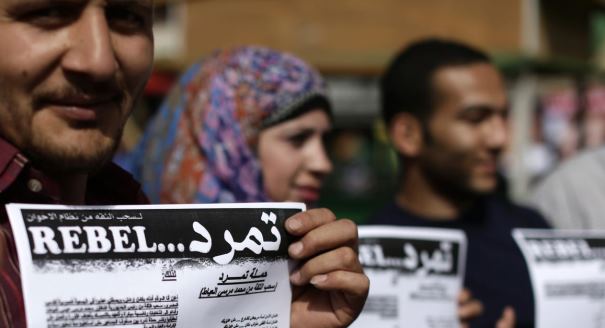
Egypt’s Rebel Movement, Tamarrud, was a key player in the protests that contributed to former president Mohamed Morsi’s removal from office on July 3, 2013. The campaign’s signature drive united the opposition against the president and mobilized a massive number of Egyptians to protest against his government. Founders of the movement emphasized their interest in bringing politics away from the offices and parties of politicians and back into the streets with the Egyptian people.
Leadership
Mahmoud Badr: Founding member
Mohamed Abdel-Aziz: Founding member
Hassan Shaheen: Founding member
Ahmed Abdu: Founding member
Ahmed al-Masry: Founding member
Moheb Doss: Founding member
Background
The Rebel Movement was founded by a group of activists from the Kifaya Movement in April 2013 to mobilize opposition to Morsi’s administration. Frustrated by the failure of opposition groups such as the National Salvation Front to organize and campaign effectively in the streets, the movement’s founders decided to start a signature drive that could capitalize on popular dissatisfaction with Morsi’s government. The petition was meant to signal a vote of no confidence in the president and called for early presidential elections.
The campaign rapidly met with success. It claimed to have attained 2 million signatures in its first ten days, and it soon garnered endorsements from most of Egypt’s major opposition organizations and political parties. By the end of June, the Rebel Movement announced that it had collected 22 million signatures. Though many have questioned the accuracy of this number, which cannot be verified, the movement clearly succeeded in establishing an extensive grassroots network and mobilizing enormous protests against Morsi.
The unstated goal of the movement was to acquire enough momentum to trigger a military intervention to depose the president. Some have criticized the Rebel Movement for its close relationship with the military, and it has been reported that the organization’s leaders were meeting with military and security officials in the weeks prior to Morsi’s removal. When protests planned for June 30 drew a significant number of Egyptians into the streets, the military stepped in and removed Morsi, citing popular demand.
After Morsi’s Fall
The Rebel Movement’s popular success ensured it a prominent role on the Egyptian political scene after Morsi was deposed. Despite expressing reservations about formally joining the political system, the movement’s leaders have continued to organize protests in support of the military and the transitional government and against the Muslim Brotherhood and terrorism. The group has also received an offer from Egypt’s interim president, Adli Mansour, to fill two seats in the fifty-member council charged with amending the constitution.
Since Morsi’s removal, the organization has reportedly been divided over the nature of its relationship to the military and whether or not it should transform into a political party. The potential for future disagreements with the transitional government also emerged when some of the group’s leaders publicly criticized Mansour’s appointment of several governors associated with the regime of former Egyptian president Hosni Mubarak. As Egypt’s new political system takes shape, it remains to be seen if the Rebel Movement will overcome divisions within its ranks and how the group will choose to exercise its political influence.