

In The Media
John Judis
{
  "authors": [
    "John Judis"
  ],
  "type": "legacyinthemedia",
  "centerAffiliationAll": "",
  "centers": [
    "Carnegie Endowment for International Peace"
  ],
  "collections": [],
  "englishNewsletterAll": "",
  "nonEnglishNewsletterAll": "",
  "primaryCenter": "Carnegie Endowment for International Peace",
  "programAffiliation": "",
  "programs": [],
  "projects": [],
  "regions": [
    "North America",
    "Middle East",
    "Iraq"
  ],
  "topics": [
    "Democracy"
  ]
}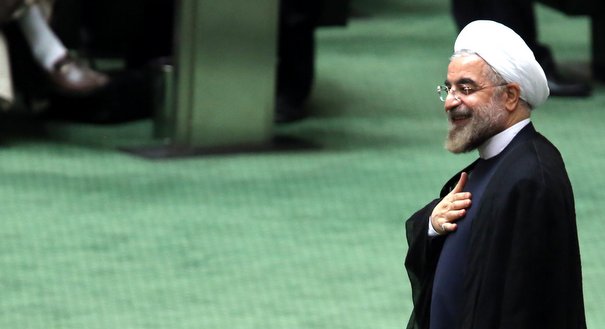
Source: Getty
Attempts at imposing Western political norms have failed abysmally.
Source: New Republic
What do Spain’s King Juan Carlos, Pope Francis, and Iranian President Hassan Rouhani have in common? And what does it tell us about the American invasion of Iraq?
*In 1969, Spain’s aging dictator Francisco Franco bypassed the legal heir to the Spanish throne, whom he suspected of liberalism, and anointed the conservative young Prince Juan Carlos as his heir. Juan Carlos was expected to continue Spain’s authoritarian rule, but when Franco died in 1975, and Juan Carlos ascended to the throne, he astounded Franco’s Falangist backers by setting Spain on a path to democracy, from which it has never veered.
*This March, the Catholic Church’s College of Cardinals chose Cardinal Jorge Mario Bergoglio to succeed the ultraconservative Pope Benedict XVI. The new pope, who took the name Francis, had been accused of cooperating with Argentina’s military junta in 1976 in the kidnapping of two priests. The allegations were not proved, but it was feared that Francis would turn out to be another Papal conservative. So far, however, he has turned out to be the second coming of Pope John XXIII rather than of Benedict. He has sought to revive the church’s commitment to the poor and reform the Vatican officialdom and bureaucracy. In a recent interview, he declared he is a not a “right-winger” and chided his fellow churchmen for obsessing about homosexuality, contraception, and abortion.
*In this June’s presidential elections in Iran, Saeed Jalili, Iran’s nuclear negotiator from 2007 to 2013, was thought to be the favorite of Supreme Leader Ali Khamenei and the favorite to win the election. Iran’s Guardian Council had barred the obvious moderate choice, former President Ali Akbar Hashemi Rafsanjani from running. Rafsanjani had thrown his support to the lesser known Rouhani, a cleric who had served as nuclear negotiator under Iran’s last moderate leader, Mohammad Khatami. To the surprise of Western Iran experts, Rouhani won easily, with more votes than all the conservative candidates combined. Rouhani, with, it seems, Khamenei’s blessing, has made a succession to moves that have indicated his willingness to negotiate an end to any nuclear weapon program Iran had. Rouhani wished Jews a happy new year and is bringing the only Jewish member of Iran's Parliament with him to the United Nations. Rouhani could hand President Barack Obama the biggest diplomatic breakthrough—extending through the Middle East, including Syria—since Ronald Reagan’s summit with Soviet leader Mikhail Gorbachev in October 1987 began the end of the Cold War.
What’s the link here? At the risk of obscurity, I would cite the German philosopher G.W.F. Hegel’s conception of history as Spirit’s journey toward Freedom. Of course, Hegel’s conception of Spirit and Freedom may be a little different from ours, but it still makes some sense to call these different events in Spain, Rome, and Tehran part of Spirit’s journey toward Freedom. And what’s distinctive about each of them is that they were somewhat unexpected—especially by the critics of Franco, Papal conservatism, and Iran’s mullahs—and that they were not imposed but happened—to use a term favored by Edmund Burke—organically. Yes, there were outside pressures in each case, but the pressures could have easily had the opposite effect, as predicted at the time.
There have been successful attempts to impose freedom and democracy through intervention. Germany and Japan after World War II come to mind. But they were defeated powers whose people had accepted defeat and American suzerainty and who had a greater fear at the time of Soviet domination. These countries also had some experience in parliamentary government to draw upon. But other attempts at imposing Western political norms have failed abysmally—mostly recently in Iraq, Afghanistan, and probably, too, Libya. And if the West were to try its hand in Syria, I suspect that would also prove a failure. There is a problem in some countries like Iraq and Syria that were imperial creations in which the reigning power suppressed fierce sectarian conflicts that have since re-emerged and that may doom these countries as cohesive states. But I still wonder sometimes what would have happened in Iraq, which had a real middle class and some semblance of a non-oil economy, if the United States had just let matters unfold there. Sanctions maybe, condemnation certainly, but no invasion. Was there a Juan Carlos in waiting?
Former Visiting Scholar
As a visiting scholar at Carnegie, Judis wrote The Folly of Empire: What George W. Bush Could Learn from Theodore Roosevelt and Woodrow Wilson.
Recent Work
John Judis
John Judis
Carnegie does not take institutional positions on public policy issues; the views represented herein are those of the author(s) and do not necessarily reflect the views of Carnegie, its staff, or its trustees.
As the U.S.-led Coalition withdraws, the Kurds’ reliance on Baghdad, and on themselves, will only increase.
Wladimir van Wilgenburg

As the U.S. stumbles in its war with Iran, we are likely to see an acceleration of its disengagement from the region.

Michael Young
The Zaidi government’s objective to collect weapons is constrained by regional conflict, but it can take certain measures at home.
Ali Al-Mawlawi

The accord represents a pivotal moment in the region to avert a security vacuum in the Gulf.


Azeema Cheema, Mohanad Hage Ali

In an interview, Jason Burke discusses his sweeping account of the “revolutionists” who so shaped the 1970s and early 1980s.
Michael Young