

Commentary
Maria Lipman
{
  "authors": [
    "Maria Lipman"
  ],
  "type": "commentary",
  "centerAffiliationAll": "",
  "centers": [
    "Carnegie Endowment for International Peace",
    "Carnegie Russia Eurasia Center"
  ],
  "collections": [],
  "englishNewsletterAll": "",
  "nonEnglishNewsletterAll": "",
  "primaryCenter": "Carnegie Russia Eurasia Center",
  "programAffiliation": "",
  "programs": [],
  "projects": [],
  "regions": [
    "Russia"
  ],
  "topics": [
    "Political Reform",
    "Democracy",
    "Civil Society"
  ]
}
Source: Getty
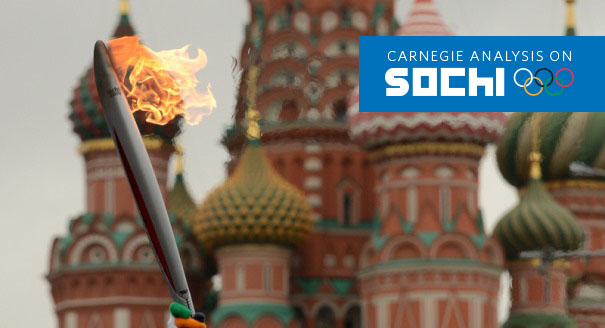
The anti-gay campaign may have helped the Kremlin to pit the conservative majority against the excessively modernized trouble-makers. But the wave of negative publicity this campaign is generating has taken a heavy toll on the image of Russia in general, and the Sochi Olympics in particular.
Twenty seven Nobel Laureates signed a letter demanding that Russia repeal its ban on “propaganda of nontraditional relations among minors.” In Russia, however, it is not uncommon to think that the ban is actually not enough. For instance, the creative director of Russia’s largest mobile phone retailer says he’d burn gays in the furnace alive. In early January he wrote an open letter to President Putin calling for recriminalization of gay sex among men (such a law existed in the Soviet Union and was abolished in post-Communist Russia just over two decades ago). A high-ranking representative of the Russian Orthodox Church says it’s a good idea and suggests that Russia hold a national referendum on the recriminalization of gay sex. A popular TV anchor also said earlier that the infamous ban on “gay propaganda” is too weak a measure against the gay evil. His suggestion: gays “should be prohibited from donating blood or sperm. And their hearts, in the case of a car accident, should be buried, or burned, as unfit for extending anyone’s life.”
In the past year social conservatism and reliance on “traditional values” have become all but an official ideology in Russia. In his annual Address to the Federal Assembly in December President Vladimir Putin spoke about Russia as defending “the values of traditional families, real human life, including religious life” against those nations that “revise their moral values and ethical norms.” Putin’s stance even won him praise from Pat Buchanan who approvingly referred to the Russian president as “one of us.”
In fact Russia’s claim for moral authority, especially as a defender of religious life, sounds false. While the Western secularization may have indeed undermined some of the traditional Christian values, in Bolshevik Russia religion had been abolished, churches were destroyed, and many thousands of priests and bishops executed (of course the clergy were but one out of many social groups that the Communist regime exterminated). Today Putin’s government, however, would rather lash out at the West for immorality and decadence, than condemn the Soviet perpetrators of terror for their heinous crimes.
The current shift toward moral conservatism is apparently driven by political motives. It was a response to the rise of a politically defiant minority that took to the streets in 2011 and 2012 chanting “Russia without Putin.” The Kremlin responded with a general crackdown and a propaganda campaign aimed to discredit its opponents in the eyes of the more conservative and loyal majority.
Russian conservatism shouldn’t be overestimated, however, as applies to sex and family issues. Buchanan would be surprised to know that Russia has the world’s highest rate of abortions. Divorce rate is quite similar to that in the United States (Putin himself divorced just last year). Extra- or premarital sex is hardly shocking to anyone. It is in their perception of gays that the Russian people are radically more conservative than their western counterparts. And that made gays a useful target for the Kremlin.
Ironically it was the ban on “gay-propaganda,” not gay activism that pushed the issue of gay rights to the fore. The gay constituency in Russia had generally kept low profile, and the attitude of the society at large was mostly that of “don’t ask, don’t tell.” Now the infamous law unleashed all kinds of aggressive loyalists and obscurantists and even provoked physical violence against gays. And as the Sochi Olympics drew closer and attracted more attention to Russia, the outrage in the West grew increasingly louder.
The anti-gay campaign may have helped the Kremlin to pit the conservative majority against the excessively modernized trouble-makers. These days those who dare oppose the Kremlin’s conservative laws and policies are readily branded as “unpatriotic” and undermining the Russian “traditional values.” However, the wave of negative publicity this campaign is generating has taken a heavy toll on the image of Russia in general, and the Sochi Olympics in particular. But an even graver damage is done to the national development by the alienation of the younger, independent-minded, energetic, and modernized Russians.
Former Scholar in Residence, Society and Regions Program, Editor in Chief, Pro et Contra, Moscow Center
Lipman was the editor in chief of the Pro et Contra journal, published by the Carnegie Moscow Center. She was also the expert of the Carnegie Moscow Center’s Society and Regions Program.
Recent Work
Maria Lipman
Maria Lipman
Carnegie does not take institutional positions on public policy issues; the views represented herein are those of the author(s) and do not necessarily reflect the views of Carnegie, its staff, or its trustees.
The country’s leadership is increasingly uneasy about multiple challenges from the Levant to the South Caucasus.

Armenak Tokmajyan
The country’s youthful protest movement is seeking economic improvement, social justice, and just a little hope.

Yasmine Zarhloule
In an interview, Daniela Richterova speaks about her book on Czechoslovakia’s Cold War ties to Palestinian groups and others.

Michael Young
In fragmented political contexts, climate activism is a way to contest both ecological harm and the structures of violence and neglect that allow it to persist.


Issam Kayssi, Mohanad Hage Ali
The downfall of the Assad regime represented a setback, but Russia’s primary focus remains Ukraine.
Sergei Melkonian