

Commentary
Thomas de Waal
{
  "authors": [
    "Thomas de Waal"
  ],
  "type": "commentary",
  "centerAffiliationAll": "",
  "centers": [
    "Carnegie Endowment for International Peace",
    "Carnegie Europe",
    "Carnegie Russia Eurasia Center"
  ],
  "collections": [],
  "englishNewsletterAll": "",
  "nonEnglishNewsletterAll": "",
  "primaryCenter": "Carnegie Europe",
  "programAffiliation": "",
  "programs": [],
  "projects": [],
  "regions": [
    "Russia"
  ],
  "topics": [
    "Political Reform"
  ]
}
Source: Getty
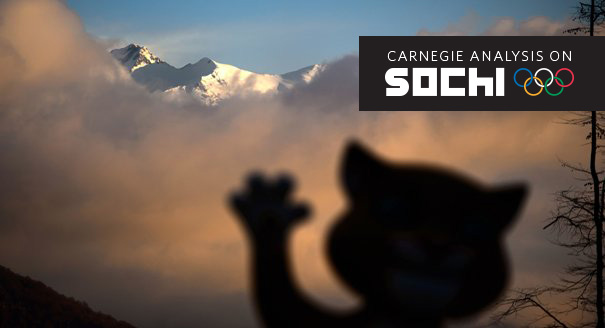
Though Sochi is located in the Caucasus, the planners of the Sochi Olympics failed to give the games any Caucasian flavor. It looks as though the North Caucasians have been factored into the planning of the games only in so far as they present a security headache.
Only the most die-hard Russophobe could fail to have enjoyed last Friday's Opening Ceremony for the Winter Olympics. Its panoramic sweep through Russian history extended the notion of Russianness by including cultural figures such as the Jewish painter Marc Chagall and the émigré novelist Vladimir Nabokov.
Of course the visual history lesson glossed over the dark pages of Russian history—there was no Gulag or Stalingrad. But no Olympic host nation would have done that much differently.
What was missing was a mention of the part of Russia that Sochi is located in and whose mountains the skiers are racing on—the Caucasus. Watching those onion domes and Tolstoyan balls, an outside spectator could have been forgiven for not knowing that Sochi was only incorporated into the Russian empire in the mid-19th century by colonial conquest—that this is "Russia's South," with a very different history to its heartlands.
The ceremony surely was the moment to make a gesture to the indigenous Circassian inhabitants of the region, who were bloodily defeated here in 1864 and whose descendants survive only in remnants around Sochi. But that moment came and went.
The planners of these games, beginning with President Vladimir Putin, are not Russian arch-nationalists. Compared to the substantial segment of Russian opinion, which is racist toward Muslims and calls for the Russian to "stop feeding the Caucasus," Putin is quite moderate and stresses that Russian citizenship is a civic and not an ethnic category.
Putin's attitude to the non-Russian Muslim minorities of the North Caucasus could be described as late Soviet. By that I mean he appears to regard them as peoples who "voluntarily joined" Russia, who benefit from its modernizing civilization and whose historical grievances are not to be taken seriously. Hence the failure to give the Sochi Olympics any Caucasian flavor, even of a folkloric kind. Absent that, it looks as though the North Caucasians have been factored into the planning of the games only in so far as they present a security headache.
The Closing Ceremony will strike this note even more discordantly. It is scheduled for February 23. To most Russians, that is the quintessentially male holiday, "Defender of the Fatherland" day. For Chechens and Ingush it will also be the 70th anniversary of Stalin's mass deportations in 1944, a day which sent tens of thousands of their kin to their deaths. So a date, which could easily have been avoided, will end up emphasizing the divide between Russia and the North Caucasus, rather than national togetherness.

Senior Fellow, Carnegie Europe
Thomas de Waal is a senior fellow at Carnegie Europe, specializing in Eastern Europe and the Caucasus.
Recent Work
Thomas de Waal
Thomas de Waal
Carnegie does not take institutional positions on public policy issues; the views represented herein are those of the author(s) and do not necessarily reflect the views of Carnegie, its staff, or its trustees.
The country’s leadership is increasingly uneasy about multiple challenges from the Levant to the South Caucasus.

Armenak Tokmajyan
In an interview, Daniela Richterova speaks about her book on Czechoslovakia’s Cold War ties to Palestinian groups and others.

Michael Young
The downfall of the Assad regime represented a setback, but Russia’s primary focus remains Ukraine.
Sergei Melkonian
Why did Bashar al-Assad’s armed forces fail to act, unlike those in Egypt, Libya, Algeria, and Sudan?

Yezid Sayigh
Spot analysis from Carnegie scholars on events relating to the Middle East and North Africa.
Armenak Tokmajyan