

In The Media
Lina Khatib
{
  "authors": [
    "Lina Khatib"
  ],
  "type": "other",
  "centerAffiliationAll": "dc",
  "centers": [
    "Carnegie Endowment for International Peace",
    "Malcolm H. Kerr Carnegie Middle East Center"
  ],
  "collections": [],
  "englishNewsletterAll": "menaTransitions",
  "nonEnglishNewsletterAll": "",
  "primaryCenter": "Malcolm H. Kerr Carnegie Middle East Center",
  "programAffiliation": "MEP",
  "programs": [
    "Middle East"
  ],
  "projects": [],
  "regions": [
    "Levant",
    "Syria",
    "Middle East"
  ],
  "topics": [
    "Political Reform",
    "Security"
  ]
}
Source: Getty
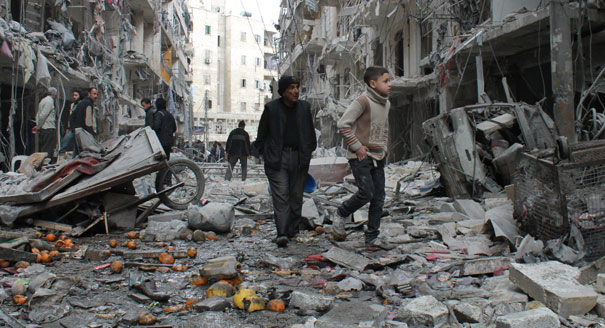
The crisis in Syria—a regional and international conflict—is leading the country toward a failed state scenario where diplomacy or military intervention is no longer possible.
Source: Stockholm University
“It’s unfortunately a very gloomy scenario ahead,” said Carnegie’s Lina Khatib during Stockholm University’s open talk on Syria. “In the very beginning of the crisis, when it wasn’t a conflict yet—an armed conflict—it was an uprising by people against an oppressive regime. There could have been a way for the international community to exert diplomatic pressure on the Bashar al-Assad regime—to force the regime to at least compromise.”
However, the international community, in Khatib’s opinion, “has acted in a very selfish manner regarding the Syrian conflict and not looking far ahead about how actually inaction can backfire and lead to, for example, the jihadist issue that we are...concerned about in Europe and the economic crisis that is, you know, catastrophic, and the whole generation of Syrians that is growing up without education...and what this means for the Middle East as a whole.”
Combined with the international community’s “lack of foresight,” neither diplomacy nor military intervention will actually work, expressed Khatib. “We’ve now reached the point of no return. There’s no point in ousting Assad militarily when we have a country that is approaching a failed state scenario.”
Former Director, Middle East Center
Khatib was director of the Carnegie Middle East Center in Beirut. Previously, she was the co-founding head of the Program on Arab Reform and Democracy at Stanford University’s Center on Democracy, Development, and the Rule of Law.
Recent Work
Lina Khatib
Lina Khatib
Carnegie does not take institutional positions on public policy issues; the views represented herein are those of the author(s) and do not necessarily reflect the views of Carnegie, its staff, or its trustees.
The Zaidi government’s objective to collect weapons is constrained by regional conflict, but it can take certain measures at home.
Ali Al-Mawlawi

Huawei pushed hard to enter the Egyptian data centers market, until the Americans made a better offer.

Angie Omar

The accord represents a pivotal moment in the region to avert a security vacuum in the Gulf.


Azeema Cheema, Mohanad Hage Ali

In an interview, Jason Burke discusses his sweeping account of the “revolutionists” who so shaped the 1970s and early 1980s.

Michael Young
In an interview, Sohaib Jawhar analyzes the profound changes in the ties between the neighboring countries.
Michael Young