

Research
- +6
Yasmine Farouk, Nathan J. Brown, Maysaa Shuja Al-Deen, …
{
  "authors": [
    "Michele Dunne"
  ],
  "type": "legacyinthemedia",
  "centerAffiliationAll": "dc",
  "centers": [
    "Carnegie Endowment for International Peace",
    "Malcolm H. Kerr Carnegie Middle East Center"
  ],
  "collections": [],
  "englishNewsletterAll": "menaTransitions",
  "nonEnglishNewsletterAll": "",
  "primaryCenter": "Carnegie Endowment for International Peace",
  "programAffiliation": "MEP",
  "programs": [
    "Middle East"
  ],
  "projects": [],
  "regions": [
    "Middle East",
    "Israel",
    "Palestine",
    "Levant"
  ],
  "topics": [
    "Security"
  ]
}
Source: Getty
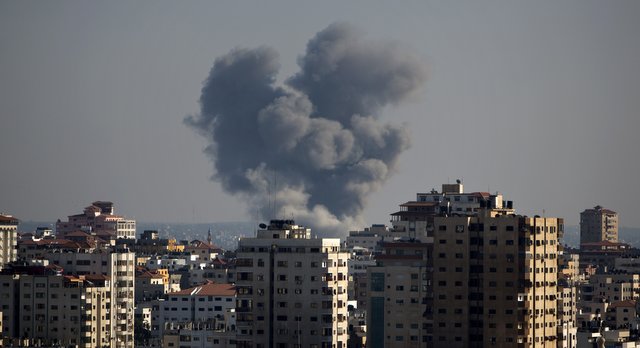
With the whole region in a period of change, a ceasefire between Israel and Hamas has proven more elusive than in previous times of conflict.
Source: CCTV America
“Both the Israelis and Hamas need to show that the sacrifices they made were somehow worth it, that they got something out of it,” said Carnegie’s Michele Dunne on CCTV America, speaking about the ongoing Israeli-Gaza peace talks. The Palestinians are pressing for some significant opening up of Gaza which the Israelis are unwilling to agree to, while the Israelis are pressing for an international task force in order to prevent more weapons from getting into Gaza.
It is unlikely that there will be a long-term deal, Dunne continued. While outside players can play a bridging role once the two parties are ready to reach an agreement, the whole region is in a period of change, making it more difficult to reach a ceasefire than in previous times of conflict.

Former Nonresident Scholar, Middle East Program
Michele Dunne was a nonresident scholar in Carnegie’s Middle East Program, where her research focuses on political and economic change in Arab countries, particularly Egypt, as well as U.S. policy in the Middle East.
Recent Work


Yasmine Farouk, Nathan J. Brown, Maysaa Shuja Al-Deen, …
Robert Springborg, Emile Hokayem, Becca Wasser, …
Carnegie does not take institutional positions on public policy issues; the views represented herein are those of the author(s) and do not necessarily reflect the views of Carnegie, its staff, or its trustees.

The accord represents a pivotal moment in the region to avert a security vacuum in the Gulf.


Azeema Cheema, Mohanad Hage Ali

In an interview, Jason Burke discusses his sweeping account of the “revolutionists” who so shaped the 1970s and early 1980s.

Michael Young

By failing to address Palestinian representation, the current process is bound to lead to just another temporary arrangement.
Nathan J. Brown

Morocco and Algeria, each in its own way, are having to navigate the global economic fallout of the U.S.-Israeli military campaign against Iran.

Yasmine Zarhloule

There is a disturbing structural parallel between the old global energy economy and the new green transition.

Angie Omar