

Commentary
Judy Dempsey
{
  "authors": [
    "Judy Dempsey"
  ],
  "type": "other",
  "centerAffiliationAll": "dc",
  "centers": [
    "Carnegie Endowment for International Peace",
    "Carnegie Europe"
  ],
  "collections": [
    "Europe’s Eastern Neighborhood"
  ],
  "englishNewsletterAll": "ctw",
  "nonEnglishNewsletterAll": "",
  "primaryCenter": "Carnegie Europe",
  "programAffiliation": "EP",
  "programs": [
    "Europe"
  ],
  "projects": [],
  "regions": [
    "Europe",
    "Eastern Europe",
    "Ukraine",
    "Iran"
  ],
  "topics": [
    "Foreign Policy",
    "Security",
    "Technology",
    "Civil Society"
  ]
}
Source: Getty
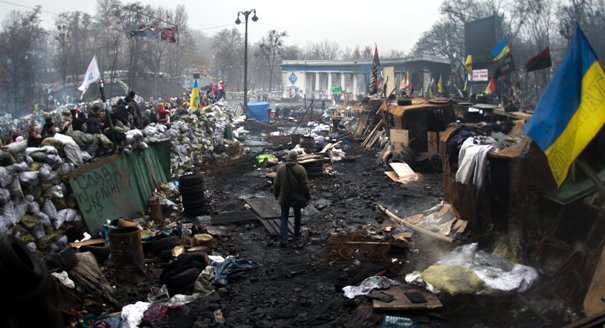
During the Euromaidan protest movement—as in the first years of the Arab Spring—it was the power of social media that galvanized civil society.
When I began reading this important book, I was immediately taken back to the late 1970s and 1980s. This may seem strange given that this book is about the 21st century and how the social media and digital age is having a profound impact on civil society and governments throughout Eastern Europe.
Yet there is a special connection, if not a continuity between the dissidents in Central and Eastern Europe back then and the civil society movements that are today springing up throughout the region. It is the power of the word.
Over 35 years ago, in Poland and the then Czechoslovakia, in Hungary and Romania, brave people toiled away on their typewriters.
Using the flimsiest of paper, each page was separated by worn sheets of scarce carbon paper. The manuscripts were distributed by hand at great personal risk. Samizdat made their way to the West. Underground universities made do with copies of books and articles and carboned copies of essays and speeches.
British academics came to lecture in Julius Tomin’s Prague apartment. That was the way to spread truth and knowledge. It was a way to present the “other” view of the world. It was a way to dent the monopoly of information exercised by the ruling communist regimes.The impact of samizdat varied. But one thing was and is certain. It protected a special alternative space.
With the digital age, this space has expanded to an extraordinary degree. The authors are right to devote a chapter to the Maidan, the independent popular movement that in early 2014 shook Ukraine’s political elites, and the Kremlin.
And no wonder. It was the power of Twitter and of YouTube that galvanized civil society. Despite those who believe that the digital age has a tendency to atomize, Maidan proved the opposite—as indeed did the first few years of the Arab Spring. People were not alone.
This is important.
In Eastern Europe, social and political movements have sprung up as a result of the digitalization of information. But as the authors of this book argue, the impact is patchy—to say the least—and the efforts by governments to use the social media as a tool for communicating ideas and promoting their interests is mixed.
The chapters on Democracy and Authoritarianism Online and Digital Diplomacy explain in detail how the challenges facing those regimes that want to control information, such as the Kremlin, and those that have yet to use the digital tools to reach out to their opponents or separatists, such as the government in Chisinau vary. In short, the possibilities are enormous. So are the challenges.
Governments and society in the post Soviet space face three challenges. The first is cyber security and cyber crime, about which the Estonians have ample experience. The second is the ability of civil society to harness social media so that it develops into a coherent political movement. And the third is the reflex of authoritarian regimes to suppress social media and how the West should respond.
With few exceptions, governments in Eastern and Central Europe have been slow to deal with cyber security, as the chapters on Private-Public Cyberspace Partnership in Poland and Cybercrime in Russia and Central and Eastern Europe show. Maybe the Ukraine crisis but also the sheer cost to the security of the economy has finally jolted Warsaw and other capitals in the region into taking the issue seriously.
On this point, the opening essay EGovernance in the Post-Soviet Space: A conversation with Tarvi Martens and Andrew Wilson, is fascinating about how Estonia pioneered the use of the internet, making it an essential tool for governance and for security but also for democracy.
The social media’s impact on democracy cannot be underestimated. As Ukraine’s Maidan movement has shown, it is possible to move the social media from the realm of cyber space to concrete political demands. And not only that. The social media in Ukraine (excluding the rebel-held parts of Eastern Ukraine) has become a powerful tool for exposing corruption. Even more importantly it is a reminder to the government in Kyiv that it is being monitored scrupulously. This time round, the supporters of Maidan do not want their revolution to be squandered.
These vibrant civil movements in Ukraine have yet to take hold in other parts of Eastern Europe. One reason is the regime’s grip on information despite the access to the internet. But the ubiquity of the internet across Eastern Europe should not be taken for granted. Yes, it is spreading, as the authors argue.
But the power of television and the power of authoritarian regimes to limit the use of the internet poses immense challenges to non-government organizations, fledgling opposition movements and brave individuals that challenge the regime. Just consider how the Azeri regime has over the past several months clamped down on any opposition. It is all the more reason that Western governments, advocacy groups and defenders of democracy should support and engage with these individuals and movements.
Indeed, these individuals and movements need as much support as those who helped Poles print the smudged Robotnik bulletin or who assisted KOR, the predecessor to the Solidarity trade union movement or who smuggled books to Czechoslovakia’s Charter 77. The means are different but the struggle is the same.

Nonresident Senior Fellow, Carnegie Europe
Judy Dempsey is a nonresident senior fellow at Carnegie Europe
Recent Work
Judy Dempsey
Judy Dempsey
Carnegie does not take institutional positions on public policy issues; the views represented herein are those of the author(s) and do not necessarily reflect the views of Carnegie, its staff, or its trustees.

In an interview, Ian Lustick and Eli Clifton discuss their new book on why a prominent ally has so much influence in America.

Michael Young

As the U.S. stumbles in its war with Iran, we are likely to see an acceleration of its disengagement from the region.
Michael Young

Middle Eastern states should welcome an accelerated U.S. disengagement from their region.
Michael Young

In an interview, former ambassador Charles Freeman assesses the Trump administration’s war against Iran.
Michael Young

By failing to address Palestinian representation, the current process is bound to lead to just another temporary arrangement.

Nathan J. Brown