

Commentary
Alexander Gabuev
{
  "authors": [
    "Alexander Gabuev"
  ],
  "type": "legacyinthemedia",
  "centerAffiliationAll": "",
  "centers": [
    "Carnegie Endowment for International Peace",
    "Carnegie Russia Eurasia Center"
  ],
  "collections": [],
  "englishNewsletterAll": "",
  "nonEnglishNewsletterAll": "",
  "primaryCenter": "Carnegie Endowment for International Peace",
  "programAffiliation": "",
  "programs": [],
  "projects": [],
  "regions": [
    "North America",
    "United States",
    "Middle East",
    "Syria",
    "Russia",
    "Eastern Europe",
    "Ukraine",
    "Western Europe"
  ],
  "topics": [
    "Political Reform",
    "Security",
    "Foreign Policy"
  ]
}
Source: Getty
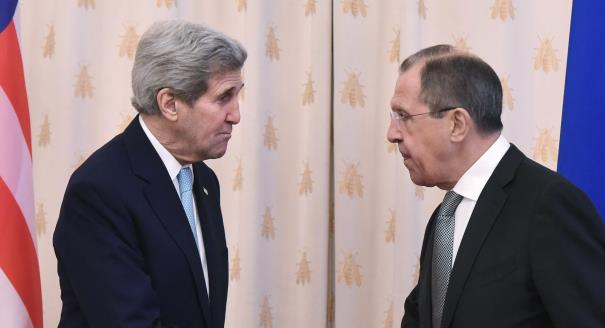
In comparison to 2014, 2015 was at least a somewhat positive year for relations between Russia and the West. However, it is unlikely that these relations will improve in the near future.
Source: Global Times
This year has seen a "new normal" in relations between Russia and the West: systemic conflict with small and occasional examples of cooperation. Compared to 2014, the year of the Crimean crisis, war in eastern Ukraine, the tragic downing of MH-17, Western sanctions against Russia and acute disputes over Syria, 2015 was at least a somewhat positive year. It started with Minsk-II talks, which allowed to reduce violence in Donbas, ended with Russia, the US and some key European powers trying to find modus vivendi in Syria, and delivered a deal over Iranian nuclear program. Is it then justified to expect that we may see gradual improvement of Russian-Western relations? Hardly so. A sober view on the underlying issues and on the political calendar requires us to expect a new low.
First of all, the roots of confrontation between Russia and the West have not been addressed. The gap of mutual perceptions is widening. Russia is seen by most policymakers in the US and EU as a revisionist power, which seeks to challenge the existing international norms and undermine the Western principles. The country's leader, President Vladimir Putin, is portrayed as a cowardly dictator, suppressing civil rights at home and destabilizing Russia's neighbors through hybrid warfare. In the international domain the Kremlin is supporting the regime of Bashar al-Assad, which is seen by the West as the cause of prolonged conflict in Syria.In Russia, the US is seen as a player trying all means to maintain its fading global dominance and creating problems for rising powers like Russia or China through "color revolutions" and creating chaos in the Middle East. Moscow sees Western sanctions against Russia or the creation of new trade blocks like the Trans-Pacific Partnership as use of economic weapons. The systemic lack of trust between the leaders and societies precludes meaningful dialogue on these issues any time soon.
A key marker for the improved relations would be the roll-back of Western sanctions against Russia. But the most crucial parts of the sanctions regime are likely to stay in place in 2016. The criteria for removal of sanctions remain formal and are tied to Minsk II. Moscow is highly unwilling to implement several parts of the Minsk deal, including full withdrawal of its troops from eastern Ukraine and return of control over the border to the Kiev government. Even if some of the EU measures are abolished, US sanctions will stay in place.
The prospects for resolution of Syrian conflict remain dubious. The US and Russia are highly unlikely to form a real military partnership to eradicate the self-proclaimed Islamic State. Moscow's key goal remains supporting the current regime in Damask, so it can continue its air raids against military groups which are defined as "moderate" by the West.
Even if the major powers achieve some form of consensus, regional powers with competing interests like Turkey, Saudi Arabia and Iran have powerful tools to undermine these efforts. Widening conflict between Moscow and Ankara is yet another factor blocking normalization of the relationship.
Last but not least, the political calendar in the US and Russia suggests a high probability of conflict. All the major candidates for the US presidential elections are very hawkish on Russia, save for Donald Trump, so debates in public space will be full of tough language and personal attacks on Putin. In this environment the outgoing administration is highly unlikely to do anything meaningful to improve the relationship even if it chose to do so.
In Russia, 2016 is the year of the State Duma elections. If history is any guide, anti-Western rhetoric will be everywhere. With low commodity prices and prolonged mismanagement of the economy the Kremlin has no better choice as to blame economic troubles on the hostile West.
Recent examples of official reaction to opposition activists' investigations into high-profile corruption cases show that the authorities always blame these investigations as CIA-orchestrated campaigns against "innocent officials." Many also expect further suppression of NGOs, human rights activists and election monitoring organizations as the votes approach.
It's very hard to imagine how Russia and the West can talk constructively under these circumstances.

Director, Carnegie Russia Eurasia Center
Alexander Gabuev is director of the Carnegie Russia Eurasia Center. Gabuev’s research is focused on Russian foreign policy with particular focus on the impact of the war in Ukraine and the Sino-Russia relationship. Since joining Carnegie in 2015, Gabuev has contributed commentary and analysis to a wide range of publications, including the Financial Times, the New York Times, the Wall Street Journal, and the Economist.
Recent Work
Alexander Gabuev
Alexander Gabuev
Carnegie does not take institutional positions on public policy issues; the views represented herein are those of the author(s) and do not necessarily reflect the views of Carnegie, its staff, or its trustees.
Reconciliation councils are emerging throughout the country to mediate in intracommunal disputes, many from the war years.
Natacha Danon

In an interview, Rozina Ali discusses her new book on the rise and manifestations of Islamophobia in the United States.

Michael Young
The civil war in Syria may have ended, but the country continues to serve as a source for the trafficking of illegal substances into and via Jordanian territory.

Armenak Tokmajyan, Laith Qerbaa

In an interview, Ian Lustick and Eli Clifton discuss their new book on why a prominent ally has so much influence in America.
Michael Young

As the U.S. stumbles in its war with Iran, we are likely to see an acceleration of its disengagement from the region.
Michael Young