Myanmar’s elections were a rousing victory for Aung San Suu Kyi’s National League for Democracy (NLD). The NLD captured nearly 80 percent of the contested seats and, with approximately 59 percent of the total seats, a majority in both the upper and lower houses of parliament. The incumbent majority Union Solidarity and Development Party, which had 51 percent of the total seats in the current parliament, was decimated, winning a mere 8 percent of the contested seats in this election. Under a military-drafted constitution, 25 percent of parliamentary seats remain reserved for unelected representatives of the military (see table).
While the elections were largely free and fair, a smooth and peaceful transition to the new administration remains a significant challenge. Encouragingly, the current president, military chief, and parliamentary speaker all have pledged to make the transition as smooth as possible. Even Myanmar’s former military dictator, Than Shwe, came out of retirement to support the election’s outcome. The transition, however, is four months long and much will depend on how events unfold during this period. During this prolonged transition, Myanmar will be in uncharted waters and the lack of trust on all sides could magnify any misstep and postpone, or even derail, the transition.
The new NLD-dominated government will face immense challenges even if the transition goes smoothly. Perhaps the greatest challenge will be to end Myanmar’s sixty-year conflict with ethnic minority groups—the modern world’s longest-running civil war. Another will be to bring economic development to a poverty-stricken economy that was mismanaged by the military junta for half a century.
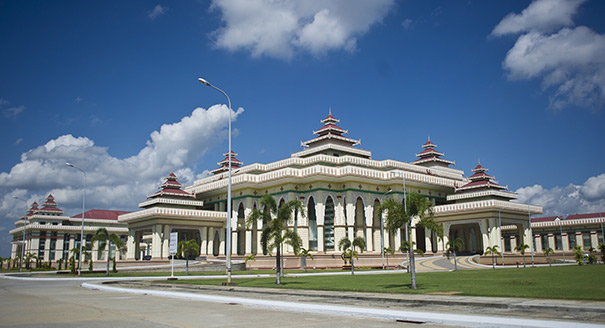
Will Myanmar’s new parliament and administration―composed largely of neophytes who have never before wielded political power, let alone run a country―have the capacity to address these challenges? The NLD parliamentarians who will now dominate the legislature are more familiar with the insides of jails than they are with Naypyitaw’s cavernous halls of parliament. They owe their newfound political power to the icon of democracy in Myanmar, the wildly popular Aung San Suu Kyi, who was the face of the party and the wind in its sails. Her coattails proved so strong that an NLD candidate for the Sagaing regional parliament who died on the campaign trail was still elected by a wide margin.
Yet, Aung San Suu Kyi is constitutionally barred from the presidency because her children are foreign citizens. It is still not clear how she will exert her influence in the new government, who she will put forward as the NLD’s candidates for the presidency and one vice presidential position (the military will choose the other vice president), or who she will appoint to the country’s next cabinet. She and her novice colleagues will also have to share power with the military, which will retain control of three key security-related ministries—defense, home, and border affairs—as well as the subnational administrative apparatus. So far, the two sides have agreed to treat each other with respect. Over the longer run, however, the military’s dark shadow will hover over the new administration, poised to snatch power if the direction of change is not to its liking.
While the politics of the transition remain an internal matter for Myanmar to navigate, the international community can nevertheless play a useful role during this critical period. Most importantly, it must allow Myanmar’s new leaders space to find a navigable path toward solidifying and sustaining the democratic transition. It must also signal clearly to Myanmar the economic and strategic advantages of a successful transition, and it must stand ready to train Myanmar’s new legislative and administrative leaders while making it easier for them to access aid and technical assistance. More aid is not necessarily the answer, though, given the economy’s weakened absorptive capacity and the country’s inadequate institutions. Instead, members of the international community should better coordinate among themselves to ensure their support reaches those who need it most, responds flexibly and immediately to the new government’s priorities, and minimizes the administrative burden for the recipient government.
In the final reckoning, Myanmar’s recent elections should be viewed as one step on the long road toward democracy. All fledgling democracies are vulnerable in the formative years of their existence—Myanmar’s democracy more so than most. The decisions and judgments made in these early days and months will have an important bearing on how this new democracy matures. While much will depend on how Myanmar’s internal political forces evolve, the international community should also play its part. The early signs are positive. For Myanmar’s sake, and for the sake of its long-suffering people, it is critical that this momentum be sustained in the months and years ahead.
Nehru was a nonresident senior fellow in the Carnegie Asia Program. An expert on development economics, growth, poverty reduction, debt sustainability, governance, and the performance and prospects of East Asia, his research focuses on the economic, political, and strategic issues confronting Asia, particularly Southeast Asia.
Carnegie does not take institutional positions on public policy issues; the views represented herein are those of the author(s) and do not necessarily reflect the views of Carnegie, its staff, or its trustees.
More Work from Malcolm H. Kerr Carnegie Middle East Center
To address the deepening climate crisis, climate activism is employing a wider variety of tactics and aiming at a broader set of goals. In response, the movement faces stronger repression and civic backlash against climate action.
A humanitarian crisis in Lebanon deepens, and Syrian refugees face a perilous choice: remain in a war-torn environment or return to Syria where they risk encountering significant dangers and discrimination. There are significant challenges and risks to their search for safety in Syria.
In Syria’s border regions, changes in demographics, economics, and security mean that an inter-Syrian peace process will require consensus among main regional powers that Syria must remain united, that no one side can be victorious, and that perennial instability threatens the region.
The interaction of national armed forces and private business sectors offers a useful lens for viewing the politics of numerous countries of the so-called Global South. A rising trend of military political activism—often accompanied by military commercial activity—underlines the importance of drivers and outcomes in these relationships.