

Paper
Renad Mansour, Faleh A. Jabar
{
  "authors": [
    "Renad Mansour"
  ],
  "type": "legacyinthemedia",
  "centerAffiliationAll": "dc",
  "centers": [
    "Carnegie Endowment for International Peace",
    "Malcolm H. Kerr Carnegie Middle East Center"
  ],
  "collections": [],
  "englishNewsletterAll": "menaTransitions",
  "nonEnglishNewsletterAll": "",
  "primaryCenter": "Malcolm H. Kerr Carnegie Middle East Center",
  "programAffiliation": "MEP",
  "programs": [
    "Middle East"
  ],
  "projects": [],
  "regions": [
    "Gulf",
    "Iraq",
    "Middle East"
  ],
  "topics": [
    "Political Reform",
    "Security"
  ]
}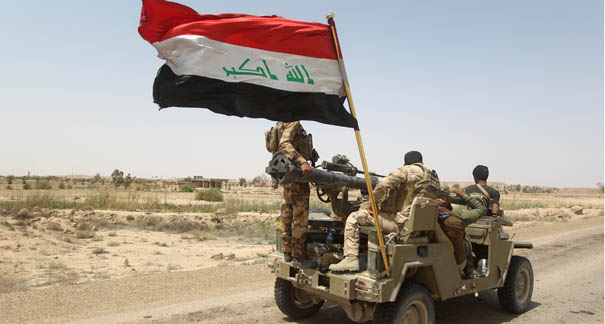
Source: Getty
Its inability to properly combat ISIS highlights the malfunctioning of the Iraqi state.
Source: The Cipher Brief
In Iraq, the fight to rid the country of the Islamic State (referred to colloquially in Arabic as Daesh) is taking longer than officials and analysts expected. For instance, U.S. Marine Corps Lieutenant General Vincent Stewart, the Director of the Defense Intelligence Agency, recently stated that the campaign to eject Daesh from Mosul, Iraq’s second largest city, will not be achieved in 2016.
This inability to combat the Salafi-jihadist group, which is detested more than supported in most parts of the country, highlights the malfunctioning state of Iraq’s government. Haider al-Abadi, who emerged as Iraqi prime minister in an effort to address the conditions that facilitated the re-emergence of Daesh in 2014, has been unable to bring about real change – despite his so-called reforms package. He faces several challenges.The biggest impediment to Abadi’s program comes from inside; members of his own Dawa Party are working to undermine his premiership. The most notable rival is his predecessor, Nouri al-Maliki, who initially established the country’s largest paramilitary group, known as the Popular Mobilization Units (PMU or al-Hashd al-Shaabi in Arabic). Today, Maliki continues to enjoy both political and military influence outside of state institutions. More critically, the former prime minister is actively creating a narrative of a weak and incompetent Abadi. Joining him are senior PMU leaders, including Badr Corps leader Hadi al-Ameri and PMU committee leader Abu Mahdi al-Muhandis, who are both antagonistic towards Abadi.
This article was originally published on The Cipher Brief website.

Former El-Erian Fellow, Middle East Center
Mansour was an El-Erian fellow at the Carnegie Middle East Center, where his research focuses on Iraq, Iran, and Kurdish affairs.
Recent Work
Renad Mansour, Faleh A. Jabar
Renad Mansour
Carnegie does not take institutional positions on public policy issues; the views represented herein are those of the author(s) and do not necessarily reflect the views of Carnegie, its staff, or its trustees.

As the U.S. stumbles in its war with Iran, we are likely to see an acceleration of its disengagement from the region.

Michael Young
The Zaidi government’s objective to collect weapons is constrained by regional conflict, but it can take certain measures at home.
Ali Al-Mawlawi

Huawei pushed hard to enter the Egyptian data centers market, until the Americans made a better offer.

Angie Omar

Middle Eastern states should welcome an accelerated U.S. disengagement from their region.
Michael Young

The accord represents a pivotal moment in the region to avert a security vacuum in the Gulf.


Azeema Cheema, Mohanad Hage Ali