

Paper
Yezid Sayigh
{
  "authors": [
    "Yezid Sayigh"
  ],
  "type": "legacyinthemedia",
  "centerAffiliationAll": "dc",
  "centers": [
    "Carnegie Endowment for International Peace",
    "Malcolm H. Kerr Carnegie Middle East Center"
  ],
  "collections": [],
  "englishNewsletterAll": "menaTransitions",
  "nonEnglishNewsletterAll": "",
  "primaryCenter": "Malcolm H. Kerr Carnegie Middle East Center",
  "programAffiliation": "MEP",
  "programs": [
    "Middle East"
  ],
  "projects": [],
  "regions": [
    "Levant",
    "Syria",
    "Middle East"
  ],
  "topics": [
    "Political Reform",
    "Security"
  ]
}
Source: Getty
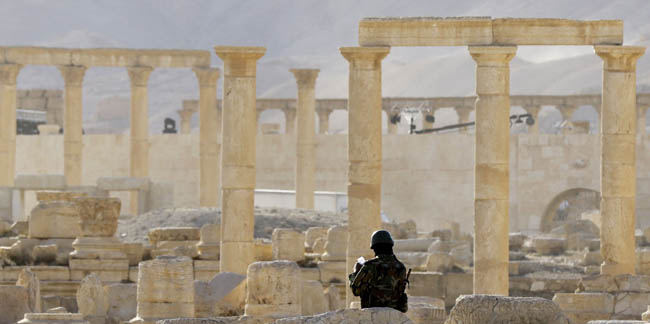
The conflict in Syria is a complex one with different world powers and the Syrian opposition playing different roles that have changed over time.
Source: RT
Yezid Sayigh discussed Russia’s strategy in Syria in an interview with Oksana Boyko on the Worlds Apart program on Russia Today. He elaborated on the degree of Russia’s leverage over the Assad regime, its interaction with the West, and future prospects for a potential political settlement.
Sayigh argued that the regime is unwilling and unable to change, so it resorted to a military confrontation. The regime did not accept Russia’s proposal for a political settlement, which was the most realistic one. Sayigh pointed out that it does not have enough leverage to force the regime in accepting the proposal.
In the case of the Syrian opposition, Sayigh clearly stated its mistakes at the beginning of the conflict. He pointed out that the opposition should have considered several steps to be taken before demanding Assad to step-down.
On the US- Russian military collaboration to fight the Islamic State, Sayigh explains that the US has come to terms that Syria is a Russian battlefield. The new administration will eventually adopt a similar approach to Obama with less involvement and effective Russian collaboration.

Senior Fellow, Malcolm H. Kerr Carnegie Middle East Center
Yezid Sayigh is a senior fellow at the Malcolm H. Kerr Carnegie Middle East Center in Beirut, where he leads the program on Civil-Military Relations in Arab States (CMRAS). His work focuses on the comparative political and economic roles of Arab armed forces, the impact of war on states and societies, the politics of postconflict reconstruction and security sector transformation in Arab transitions, and authoritarian resurgence.
Recent Work
Yezid Sayigh
Yezid Sayigh
Carnegie does not take institutional positions on public policy issues; the views represented herein are those of the author(s) and do not necessarily reflect the views of Carnegie, its staff, or its trustees.

As the U.S. stumbles in its war with Iran, we are likely to see an acceleration of its disengagement from the region.

Michael Young
The Zaidi government’s objective to collect weapons is constrained by regional conflict, but it can take certain measures at home.
Ali Al-Mawlawi

Huawei pushed hard to enter the Egyptian data centers market, until the Americans made a better offer.

Angie Omar

The accord represents a pivotal moment in the region to avert a security vacuum in the Gulf.


Azeema Cheema, Mohanad Hage Ali

In an interview, Jason Burke discusses his sweeping account of the “revolutionists” who so shaped the 1970s and early 1980s.
Michael Young