

Commentary
Sarah Chayes
{
  "authors": [
    "Sarah Chayes"
  ],
  "type": "other",
  "centerAffiliationAll": "dc",
  "centers": [
    "Carnegie Endowment for International Peace"
  ],
  "collections": [
    "Anti-Corruption",
    "Violence and Conflict"
  ],
  "englishNewsletterAll": "democracy",
  "nonEnglishNewsletterAll": "",
  "primaryCenter": "Carnegie Endowment for International Peace",
  "programAffiliation": "DCG",
  "programs": [
    "Democracy, Conflict, and Governance",
    "South Asia"
  ],
  "projects": [],
  "regions": [
    "North America",
    "United States",
    "South Asia",
    "Afghanistan"
  ],
  "topics": [
    "Democracy",
    "Foreign Policy"
  ]
}
Source: Getty
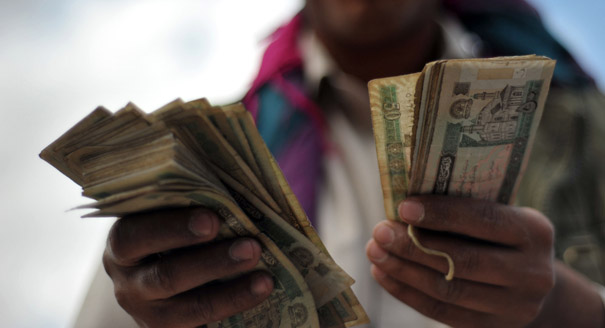
The issue of corruption must be central to policy development, engaging every aspect of how the United States interacts with fragile states.
“If you don’t fix the administration of this country—go after the bribe-gobblers and the tyrants—you can send all the soldiers you want, security will never come.”1
These colorful words, spoken by a village elder in Afghanistan in 2009, suggest an insight whose implications Western policymakers are only now beginning to grasp. Corruption—to put it academically—as it has developed in this turn of the 21st century, is at the root of state brittleness. It is not just a consequence, which can be tended to at some later date after security is established. As the experiences in Afghanistan and Iraq have most bitingly demonstrated, it is impossible to reduce fragility and some of its most chaotic manifestations while corruption runs rampant.
An indication that this realization is hitting home—after 15 years of interventions that ignored it—can be found in recent official statements pillorying corruption. “From the Arab Spring to Latin America,” wrote U.S. Secretary of State John Kerry in May 2016, “political turbulence has made clear that governments are unwise to shrug off their citizens’ growing concerns about corruption. ... It is long past time for the international community to treat corruption with the seriousness and attention it deserves.”2
But such truculence carries a risk: that the gap between words and practice will widen. Indeed, while the scramble for remedies is on, it is usually subcontracted to poorly resourced or regarded specialists at the bureaucratic margins, while dignitaries (once their remarks are delivered) get on with business more or less as usual.
Given the significance of the consequences—in terms of sustainably distributed economic progress, the ability of a state to control its territory and citizens’ faith in the legitimacy of their government or their willingness to keep submitting to it—that problem must instead be central to policy development, engaging every aspect of how the United States interacts with fragile states. But to understand why, and how to put it there, a better grasp of the phenomenon is needed. As it stands, the rush to action has leapfrogged efforts to analyze how corruption is structured and operates on behalf of the sophisticated networks that control many fragile states. Without a clearer picture of this functioning, piecemeal “remedies”—usually outweighed by other interventions that reinforce the abuse and redound to the discredit of the interveners—have little hope of making a difference.
Former Senior Fellow, Democracy, Conflict, and Governance Program
Sarah Chayes is internationally recognized for her innovative thinking on corruption and its implications. Her work explores how severe corruption can help prompt such crises as terrorism, revolutions and their violent aftermaths, and environmental degradation.
Recent Work
Sarah Chayes
Carnegie does not take institutional positions on public policy issues; the views represented herein are those of the author(s) and do not necessarily reflect the views of Carnegie, its staff, or its trustees.

In an interview, Rozina Ali discusses her new book on the rise and manifestations of Islamophobia in the United States.

Michael Young

In an interview, Ian Lustick and Eli Clifton discuss their new book on why a prominent ally has so much influence in America.
Michael Young

As the U.S. stumbles in its war with Iran, we are likely to see an acceleration of its disengagement from the region.
Michael Young

Middle Eastern states should welcome an accelerated U.S. disengagement from their region.
Michael Young

In an interview, former ambassador Charles Freeman assesses the Trump administration’s war against Iran.
Michael Young