

In The Media
Petr Topychkanov
{
  "authors": [
    "Petr Topychkanov"
  ],
  "type": "legacyinthemedia",
  "centerAffiliationAll": "",
  "centers": [
    "Carnegie Endowment for International Peace",
    "Carnegie Russia Eurasia Center"
  ],
  "collections": [
    "Inside Russia"
  ],
  "englishNewsletterAll": "",
  "nonEnglishNewsletterAll": "",
  "primaryCenter": "Carnegie Russia Eurasia Center",
  "programAffiliation": "",
  "programs": [],
  "projects": [],
  "regions": [
    "Russia"
  ],
  "topics": [
    "Political Reform"
  ]
}
Source: Getty
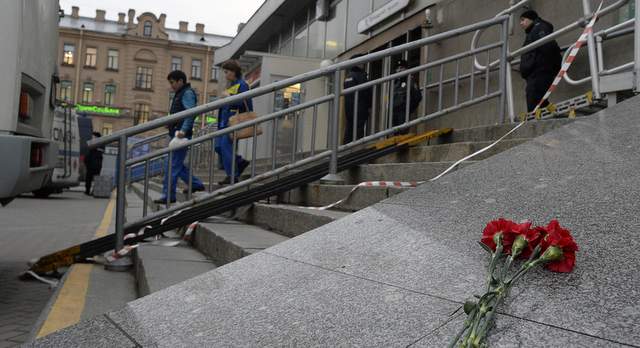
The attack in St Petersburg should push Moscow to revisit its counterterrorism strategy and be ready to meet the challenge of this evolving threat. Monday’s bombing should make Kremlin understand the need for a comprehensive strategy.
Source: Hindustan Times
The explosion in the subway of St Petersburg on Monday has been seen by many as a terrorist attack. There are other versions too that were articulated by Russian President Vladimir Putin, including criminal offense. But with initial reports coming in it looks more like a terrorist attack.
This is the second attack on the subway system of the cultural capital of Russia, as St Petersburg is widely known. The first one happened on December 19, 1996, when one person died. In Monday’s attack at least 10 people were killed.
This is the latest of the many attacks on the transport facilities in various places across Russia. The Moscow subway was hit by terrorists six times, in 1977, 1996, twice in 2004, and twice in 2010. There have been many attacks on airports and airplanes, railway stations and trains, and buses.
There are the regions in Russia, like in the North Caucuses, which constantly face a terror threat. The capital Moscow is another such place. In both cases, there is a heavy presence of security agencies.
But there are many regions where terrorists do not pose a permanent threat, and, the local authorities in these places are unwilling to earmark substantial budgets on security to be prepared to confront such threats.
St Petersburg is one of those regions that has let its guard down. Known as the “second capital of Russia” or “Russia’s cultural capital”, St Petersburg is home to many top level Russian politicians, including Putin and Prime Minister Dmitry Medvedev. It is also the most favourite tourist destination in Russia. This is the place of international forums and a host for high-level events. And it is at one such event, at the St Petersburg International Economic Forum, on June 1-2 that India’s Prime Minister Narendra Modi is expected to be present.
Monday’s bombing exposed the chinks in St Petersburg’s armour against terrorists. It showed that the city could not defend itself against terrorist threats. Has the national security system failed? That seems to be the realisation reflected by the chairman of the Russian upper house of parliament’s defense committee, Viktor Ozerov: “…Counterterrorism measures, lawmakers, and security agencies failed. We need to analyse the reasons [of the failure], understand, where our security system failed.”
The accent on technical issues of providing public security, the absence of public awareness about terrorist threats, the lack or inefficiency of preventive counterterrorism measures, the lack of an active policy towards groups/individuals who could be radicalised — the reasons for the failure are many. In short, the latest technology and equipment has a limited scope and cannot replace a sound counterterrorism strategy.
The failure, described by Ozerov, could be because of the transforming terrorist threats Russia faces today. Earlier, the main source of this threat was linked to few groups, mainly from the North Caucuses. This is not the case anymore.
A number of cases show that terrorist recruiters focus now on people from different regions, religion communities, language and ethnic groups — and at times they are successful. The number of Russian citizens, or of those belonging to erstwhile USSR, involved in terrorist activities world over is wider than any time before: Afghanistan, Iraq, Pakistan, Syria, Europe, and even the United States, where the Tsarnaevs brothers were responsible for the 2013 Boston Marathon bombing.
The St Petersburg terrorist attack shows that there are trained people in Russia with the requisite experience and easy access of explosives ready to target civilians. At the end of the day, the goals of such people are secondary — the more pressing issue in the larger context is the scale and depth of this terrorist threat.
The number of such terrorist elements should be a cause for concern for Moscow, especially because there are a large number of Russians fighting terror groups in West Asia. The poor terror preparedness and levels of security alertness is no hindrance for these highly-trained terrorists.
The attack in St Petersburg should push Moscow to revisit its counterterrorism strategy and be ready to meet the challenge of this evolving threat. Monday’s bombing should make Kremlin understand the need for a comprehensive strategy.
It is hoped that such a process is launched without any delay.
Former Fellow, Nonproliferation Program, Moscow Center
Topychkanov was a fellow in the Carnegie Moscow Center’s Nonproliferation Program.
Recent Work
Petr Topychkanov
Petr Topychkanov
Carnegie does not take institutional positions on public policy issues; the views represented herein are those of the author(s) and do not necessarily reflect the views of Carnegie, its staff, or its trustees.

The country’s leadership is increasingly uneasy about multiple challenges from the Levant to the South Caucasus.

Armenak Tokmajyan
In an interview, Daniela Richterova speaks about her book on Czechoslovakia’s Cold War ties to Palestinian groups and others.

Michael Young
The downfall of the Assad regime represented a setback, but Russia’s primary focus remains Ukraine.
Sergei Melkonian
Why did Bashar al-Assad’s armed forces fail to act, unlike those in Egypt, Libya, Algeria, and Sudan?

Yezid Sayigh
Spot analysis from Carnegie scholars on events relating to the Middle East and North Africa.
Armenak Tokmajyan