

Article
Deborah Gordon, Smriti Kumble, David Livingston
{
  "authors": [
    "David Livingston"
  ],
  "type": "legacyinthemedia",
  "centerAffiliationAll": "dc",
  "centers": [
    "Carnegie Endowment for International Peace"
  ],
  "collections": [],
  "englishNewsletterAll": "ctw",
  "nonEnglishNewsletterAll": "",
  "primaryCenter": "Carnegie Endowment for International Peace",
  "programAffiliation": "SCP",
  "programs": [
    "Sustainability, Climate, and Geopolitics"
  ],
  "projects": [
    "Carnegie Oil Initiative"
  ],
  "regions": [
    "North America",
    "United States",
    "East Asia",
    "China"
  ],
  "topics": [
    "Climate Change"
  ]
}
Source: Getty
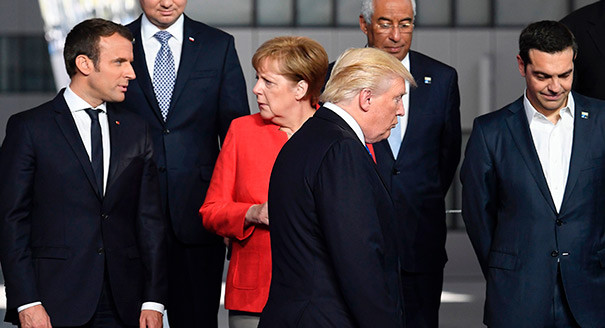
With U.S. climate leadership lagging, the G-7 is finding ways to move forward in spite of U.S. reluctance while China looms as the new international climate powerhouse.
Source: CGTN America
Carnegie’s David Livingston joined CGTN’s Rachelle Akuffo to discuss the outcomes of the G-7 environment meeting focusing on the new role being played by the United States under a Trump administration. Livingston noted that the U.S. decision to not engage on climate may have backfired.
“It should be noted that the U.S. probably hoped to really hold things up by refusing to make progress on climate in this round of G-7 environment ministers talks, but it was reduced to simply . . . being a footnote at the bottom of the leaders declaration.”
Livingston pointed out that while the G-7 talks did yield needed progress on “greening of the global financial system,” that the United States and EU lag considerably behind China on these efforts. In fact, with U.S. leadership lagging on climate, Livingston says that China’s role as a leader on climate “is probably the great story of the next few decades.”
Referring to the U.S. withdrawal from the Paris Climate Accord as essentially an “own goal,” Livingston points out that “China’s President, Xi Jinping met not with the energy secretary of the United States, but with California Governor Jerry Brown,” as China prepares for new ways to engage the world on climate.
Former Associate Fellow, Energy and Climate Program
Livingston was an associate fellow in Carnegie’s Energy and Climate Program, where his research focuses on emerging markets, technologies, and risks.
Recent Work

Deborah Gordon, Smriti Kumble, David Livingston

Erik Brattberg, David Livingston
Carnegie does not take institutional positions on public policy issues; the views represented herein are those of the author(s) and do not necessarily reflect the views of Carnegie, its staff, or its trustees.

Huawei pushed hard to enter the Egyptian data centers market, until the Americans made a better offer.

Angie Omar

Middle Eastern states should welcome an accelerated U.S. disengagement from their region.

Michael Young

In an interview, former ambassador Charles Freeman assesses the Trump administration’s war against Iran.
Michael Young

By failing to address Palestinian representation, the current process is bound to lead to just another temporary arrangement.

Nathan J. Brown

Morocco and Algeria, each in its own way, are having to navigate the global economic fallout of the U.S.-Israeli military campaign against Iran.

Yasmine Zarhloule